



Advancements in Palladium Membrane Technology for Hydrogen Separation Using Electroplating Method
Introduction
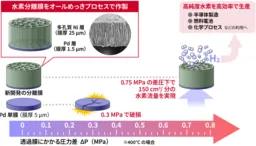
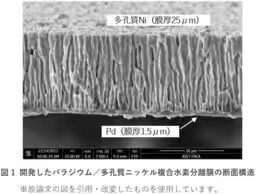
The advancement of hydrogen separation technologies is crucial for various industrial applications such as semiconductor manufacturing, fuel cells, and chemical processing. In this context, the National Institute of Advanced Industrial Science and Technology (AIST), in collaboration with Sanno Co., has developed a composite palladium/nickel membrane using an electroplating method. This membrane is notable for its ultra-thin 1.5 µm palladium layer and a porous nickel support that enhances its structural integrity under high-pressure conditions.
Significance of Pure Hydrogen
High-purity hydrogen is essential not only as a raw material but also as an energy medium in numerous processes. The efficient separation and purification of hydrogen from other gases are vital in creating high-purity hydrogen. The use of palladium membranes is promising due to their unique property of selectively allowing hydrogen to pass through. However, the high cost associated with palladium limits its widespread application, thus necessitating the development of thinner membranes while maintaining performance and durability.
Development of Composite Membrane
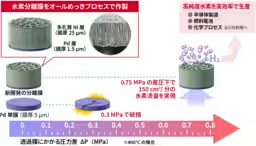
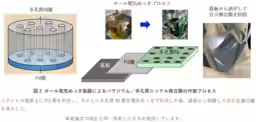
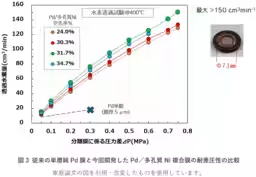
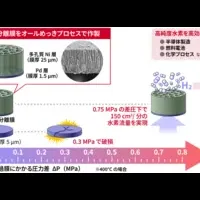
The newly developed membrane integrates a thin palladium layer on a porous nickel backing to withstand substantial pressure differences while ensuring effective hydrogen permeability. This innovation is achieved through an all-electroplating process, allowing for precise control over layer thickness and composition. At a pressure differential of 0.75 MPa and a temperature of 400°C, the membrane exhibited a hydrogen flow rate exceeding 150 cm³ per minute, showcasing its capacity for high-performance hydrogen separation.
Mechanism and Performance
In this study, the palladium layer acts primarily as the selective barrier for hydrogen, while the porous nickel support provides essential mechanical support without compromising the flow pathway for hydrogen. By achieving an approximately 30% porosity level in the nickel substrate, the team effectively maintained the quality and quantity of hydrogen flow while ensuring that the thin palladium layer remains intact under pressure.
Interestingly, previous experiments with thicker palladium membranes (around 5 µm) were unsuccessful at similar pressures, elucidating the enhanced performance parameters of the new composite structure.
Future Prospects
Future research will focus on assessing the membrane's performance under mixed gas conditions, exploring long-term durability, and further refining the manufacturing processes. These advancements are expected to enhance the membrane's application in hydrogen purification devices and membrane reactors, ultimately leading to lower costs and improved efficiency in hydrogen production technologies.
Research Background
The exploration of palladium membranes has been ongoing, with investigations emphasizing the necessity of reducing palladium usage while optimizing operational reliability. Thin films have shown better hydrogen permeability, but they often lack the mechanical strength required for practical applications. This research reconciles these challenges by employing a tailored porous support system for the palladium layer, marking a significant step in the technology's evolution.
Conclusion
This work demonstrates the feasibility of creating an effective and cost-efficient palladium-based hydrogen separation membrane through innovative electroplating techniques. The implications for industrial applications, especially in energy-intensive sectors, could lead to transformative advancements in hydrogen technology.
For more detailed insights, please refer to the original paper published in the International Journal of Hydrogen Energy on September 2, 2026.
Topics Consumer Technology)
【About Using Articles】
You can freely use the title and article content by linking to the page where the article is posted.
※ Images cannot be used.
【About Links】
Links are free to use.