



Understanding the Rise in Rice Prices During the Tenpo Famine: A Closer Look at Climate and Market Dynamics
Understanding the Rise in Rice Prices During the Tenpo Famine: A Closer Look at Climate and Market Dynamics
The Tenpo famine, which occurred in the 1830s in Japan, stands as a stark reminder of how climate conditions can directly influence economic markets. Recent research sheds light on the correlation between reduced solar radiation, adverse weather, and soaring rice prices during this period, providing valuable insights for modern discussions on climate change and its societal impacts.
Overview of the Research
A study focused on the Tenpo famine used monthly data to investigate the relationship between summer climate conditions and market dynamics. Researchers restored records of solar radiation from weather journals at 18 locations across Japan, covering the periods from 1821 to 1850. The findings revealed a significant drop in solar radiation—about 10% below average—over a wide area, including Eastern Japan down to Kyushu, during the summer of 1836, the height of the famine.
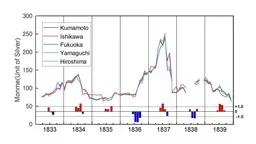
Concurrently, prices in the Osaka rice market skyrocketed to three to four times their normal levels even before the harvest season began. This spike suggests that information regarding summer weather conditions might have been reflected in market prices ahead of time, illustrating how environmental factors can directly impact economic decisions.
Background of the Study
Understanding the ramifications of climate change on societies and economies is crucial, especially in the context of current global warming trends. The research team, consisting of Miku Ichino, Kooiti Masuda, Takehiko Mikami, and Yasuo Takatsuki, centered their study on the Tenpo famine as a historical case. Previous climate studies often relied on proxy data such as tree rings, which may overlook seasonal and regional variances critical for informing economic activities.
Given that historical economic data primarily recorded annual trends, assessing how pre-harvest climate conditions influenced market movements was notably challenging. This research contributes a month-by-month analysis of climatic impacts on the economy, enriching our understanding of past events.
Key Findings
The research team meticulously converted historical weather descriptions from ancient diaries into monthly average solar radiation values, allowing for a comprehensive reconstruction of solar radiation distribution for the years 1821 to 1850. This dataset underwent statistical spatial analysis via Principal Component Analysis (PCA) to derive indexes indicative of summer climate conditions.
The investigation showed that in 1836—a year marked by one of the most severe phases of the Tenpo famine—cool and cloudy weather persisted from June through September, contributing to agricultural failures across Japan. A critical correlation was established between this climate data and rice prices in the Osaka market, revealing that the price of rice surged while the harvest was still pending. Prices escalated from their usual range of 50-70 monme to around 200 monme, thus remaining elevated until the summer of 1837.
Implications for Future Research
The findings from this study highlight how critical climatic information influenced market movements ahead of the harvest period, offering a nationwide perspective on the interplay between environment and economy. Future research can build on this methodology to explore other historical periods and geographical regions, aiming to analyze how unusual weather patterns have historically impacted societies and economies.
Collectively, this body of research lays groundwork for a deeper understanding of how past societies reacted to climate fluctuations, helping us reflect on contemporary challenges posed by global climate change.
Conclusion
The Tenpo famine serves as an important historical reference in discussing the effects of climate on economies. As climate change continues to be a pressing concern, studies like this help inform current and future responses to similar challenges, emphasizing the ongoing relevance of understanding the interplay between environmental factors and economic outcomes.
Reference
- - Ichino, M., Masuda, K., Mikami, T., & Takatsuki, Y. (2026). Unusual solar radiation and its impact on the Japanese rice market during the 1830s famine. Scientific Reports. DOI: 10.1038/s41598-026-40316-w
Topics People & Culture)



【About Using Articles】
You can freely use the title and article content by linking to the page where the article is posted.
※ Images cannot be used.
【About Links】
Links are free to use.