



Indonesia's Housing Crisis and Opportunities for Japanese Investors in Real Estate
Indonesia's Housing Crisis: A 13 Million Unit Deficit
Indonesia, with a burgeoning population of approximately 287.9 million, faces a severe housing shortage estimated at 13 million units. Each year, 4 million newborns add to the demand for housing, escalated further by the need for renovations totaling nearly 29.1 million households. Currently, only 43% of all households occupy adequate housing, leading to about 26.9 million families living in substandard conditions and approximately 9.9 million being homeless. The World Bank's 2023 data shows that around 22% of the urban population resides in slums, making housing a top priority for the Indonesian government.
Under President Prabowo's leadership, the “3 Million Housing Construction Program” has been launched as a national strategy to assist low-income families in obtaining affordable housing through a combined effort from both the public and private sectors.
Understanding the FLPP: Government Subsidized Housing Loans
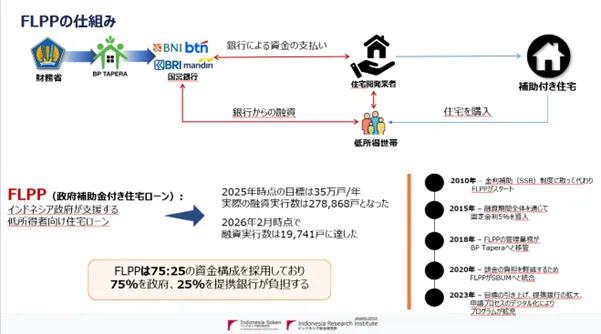
The Fasilitas Likuiditas Pembiayaan Perumahan (FLPP) is an innovative solution designed to aid low-income households in Indonesia to secure housing by providing government-subsidized loans. Unlike traditional housing loans requiring a 15-20% down payment and variable interest rates of 8.5-11%, FLPP lowers the barrier significantly with just a 1% down payment, a fixed interest rate of 5%, and monthly repayments of 1 million to 1.8 million IDR.
The housing prices are set between 1.6 billion to 1.8 billion IDR (approximately 1.66 to 1.86 million yen), ensuring that it remains accessible for the low-income demographic. Since its inception in 2010, the FLPP has seen improvements including the introduction of a fixed interest rate in 2015 and a more streamlined application process in 2023 via digitization, establishing a robust support structure that is 75% government-funded and 25% from partner banks.
The Market Landscape: Stable Demand for 300,000 Houses Annually
Since Jokowi's administration, around 300,000 subsidized housing units have been consistently sold each year. The target by 2025 is to increase this to 350,000 units annually, with nearly 19,741 loans executed by February 2026. With housing shortage recognized as a national issue, the demand for affordable housing is expected to persist in the long term.
Investment returns in this market look promising. Using a typical development project for 100 units on a hectare of land as a case study:
Project Estimation and Steps
1. Acquisition of Land and Permits (8 months - 1 year): This phase involves land acquisition and clearing, alongside securing necessary permissions, which can be time-consuming in Indonesia.
2. Development of Initial 50 Units (3-6 months): The sold homes are completed before construction starts to meet the immediate demand, typically resulting in quick sales. Initial investment is around 100 million yen, with revenue from 50 units yielding approximately 83 million yen.
3. Completion of Remaining 50 Units (3-6 months): The revenue from the first batch is reinvested to complete the project, yielding similar returns.
Financial Overview: Profit and Returns
- - Total Profit: Approximately 26 million yen
- - Estimated Annual Return Rate: Around 13%
- - Investor-Bank Return Rates: 20-30%
- - Expected Sales Duration: 2 years
- - Risk Mitigation Strategy: Collaborating with established developers in Indonesia significantly reduces construction and management risks.
Beyond Housing: Building Communities
The true potential of these subsidized housing projects lies in their role as a catalyst for creating entire communities. Investment of about 1 billion yen can lead to the construction of 1,000 homes, housing around 4,000 people with essential community amenities like schools, clinics, waste management facilities, and internet access. This holistic approach transforms the housing initiative into a comprehensive development model.
Supporting Investors: The Role of the Indonesian Institute
Over the last five years, the Indonesian Institute has backed multiple real estate development projects, amassing a wealth of knowledge on local financing systems, permitting processes, and community integration. Looking ahead to 2024, the establishment of the credit union “SOKEN DAYA UTAMA” aims to address financial issues stemming from Indonesia's collateral-based system and high-interest rates.
Currently, the organization collaborates with several Japanese firms on project planning, leveraging its network among local developers and financial institutions to provide comprehensive support—from project assembly to permitting, and sales strategies. Companies and investors eager to venture into Indonesia's real estate sector are encouraged to reach out for more information.
About the Company
Name: Indonesian Institute
Services: Real estate development support, research, and consulting services in Indonesia
Website: Indonesian Institute
Download our free report here.
Topics Consumer Products & Retail)
【About Using Articles】
You can freely use the title and article content by linking to the page where the article is posted.
※ Images cannot be used.
【About Links】
Links are free to use.