



2025 Fukui Prefecture Happiness and Living Continuity Rankings Unveiled
Unveiling the 2025 Happiness and Living Continuity Rankings for Fukui Prefecture
Daito Kentaku Co., headquartered in Minato-ku, Tokyo, has conducted one of the largest residential satisfaction surveys to date. The results are presented as the "2025 Fukui Prefecture Happiness Ranking" and the "2025 Fukui Prefecture Living Continuity Ranking." These rankings reflect public feedback amassed over the past five years, focusing on the happiness levels and preferences of local residents.
Key Points from the Happiness Ranking
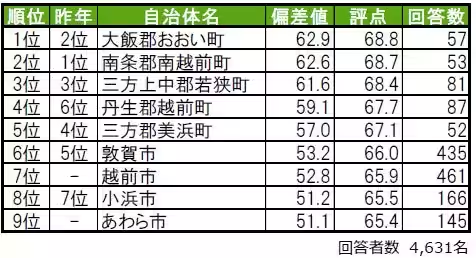
The happiness ranking identifies the top three towns in Fukui Prefecture:
1. Ohkita Town, Ooi District
2. Minamiechizen Town, Nanjou District
3. Wakasa Town, Mikata District
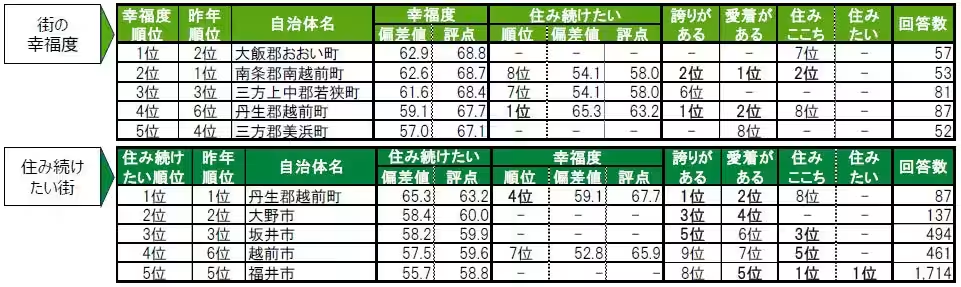
Ohkita Town secured the top position this year, rising from second place in the previous survey. Minamiechizen Town remains steady at the second position, while Wakasa Town has held firm at third place for the second consecutive year. Other notable mentions in the top nine include Eiheiji Town at seventh and Awara City at ninth.
It’s noteworthy that the happiness index is derived from responses received between 2021 and 2025. If a municipality had fewer than 50 responses, data from 2020, and potentially 2019, was supplemented to ensure a robust dataset.
Living Continuity Ranking Insights
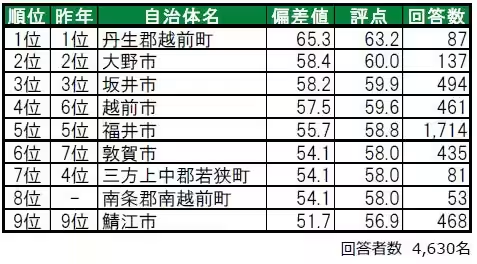
For the second consecutive year, the top three towns in the Living Continuity Ranking are:
1. Echizen Town, Nyu District
2. Ono City
3. Sakai City
Echizen Town has maintained its first-place status, accompanied by Ono City and Sakai City, which continue to hold their second and third positions, respectively. This year's rankings also welcomed Minamiechizen Town, which at eighth place, represents a remarkable debut after previously being unranked due to a lack of sufficient responses.
Detailed Methodology
The rankings rely on multiple-choice surveys distributed online by MacroMill to residents aged 20 or older across Fukui Prefecture. Over 4,600 participants provided valuable insights, with a representative gender distribution of nearly 50/50 between males and females. Age demographics spanned from young adults in their twenties to seniors in their seventies, with the majority identified as married, and many having children.
The survey assessed happiness with a simple prompt, asking respondents to rate their overall happiness on a scale from one to ten. This average score was then converted to a 100-point scale for ranking purposes. Similarly, the living continuity ranking was based on responses indicating long-term residence intentions in their current town, using a scale from 0 to 100 to gauge sentiments.
The data collected was comprehensive, covering different generations and various social backgrounds, providing a detailed picture of life in Fukui. The inquiry encapsulated the essence of local residency satisfaction, informing potential improvements in community development efforts.
Summary of Results
The top five towns from both rankings underscore a robust response to community satisfaction and livability values that resonate among Fukui residents. These findings are pivotal in encouraging local governance and policy enhancements aimed at sustaining and improving the quality of life across the ranked towns.
For a comprehensive view of all rankings and methodology, please visit the official website or see the detailed press release from Daito Kentaku here.

Topics People & Culture)


【About Using Articles】
You can freely use the title and article content by linking to the page where the article is posted.
※ Images cannot be used.
【About Links】
Links are free to use.