



Understanding the Mechanism Behind Rapid Repair of Lava Caps in Volcanic Eruptions
New Insights into the Mechanism of Volcanic Eruptions
Introduction
Volcanic eruptions represent some of nature's most powerful events, and the explosive characteristics of these eruptions can vary significantly. Among these, Vulcanian eruptions are particularly notable for their intermittent explosions that can occur over a period of hours or days. Recent research carried out by Keiko Matsumoto, a lead researcher at the National Institute of Advanced Industrial Science and Technology, alongside Nobuo Geshi, a professor at Kyushu University, sheds light on the unique geological factors affecting such eruptions. In particular, they explore the mechanics behind how the 'caps' of lava can form and repair themselves in quick succession, a phenomenon previously not well-understood.
The Vulcanian Eruption Mechanism
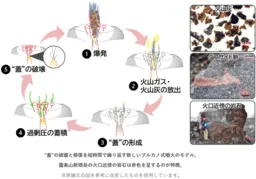
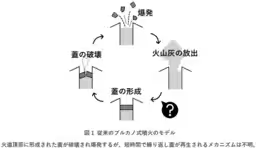
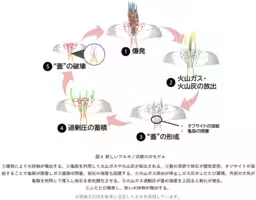
This research focused on the 2018 eruption of the Shinmoedake volcano in the Kirishima mountain range of Japan. Vulcanian eruptions are typified by singular explosive events that follow each other intermittently. Physically, these eruptions result from lava caps that form at the top of the volcanic conduit, trapping volcanic gas beneath. Eventually, pressure builds up until it breaks the lava cap, leading to an explosive release of gases and materials.
One of the central challenges for researchers has been to understand how these robust caps can reform so quickly following their destruction. Previous models indicated that the caps were thick and strong enough to withstand substantial pressure, yet details on how they could reinstate their integrity in such a short time frame remained elusive.
Findings from the Study
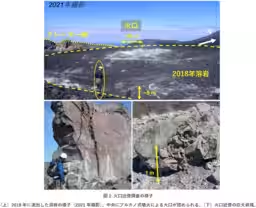
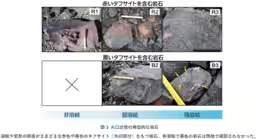
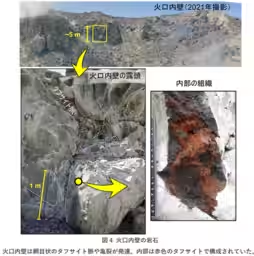
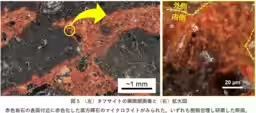
Post-eruption studies commenced in 2019 after the activity of Shinmoedake had ceased and safety was confirmed. Detailed examinations were conducted both at the summit crater and the surrounding areas. The team observed distinct features: the interiors of the lava and the walls of the crater presented a network of toughite veins interspersed with various sizes of red-hued volcanic rocks. This observation suggested that as explosive events shattered the lava cap, the remaining pieces with multiple cracks would subsequently be infiltrated by toughite material, rapidly repairing the cracks and re-establishing the necessary pressure build-up.
To test their hypothesis, the researchers compared the characteristics of the red volcanic ash collected during the 2018 eruption with their geological findings. This comparison yielded consistent results, lending credibility to their model.
The Social Implication of the Research
Involvement in volcanic activity is a significant concern for public safety, particularly when eruptions pose a hazard to populated areas. By enhancing the predictive capabilities regarding eruption behavior through detailed studies of volcanic ash from safe distances, researchers can provide more accurate forecasts related to volcanic activity. Thus, this research not only contributes scientifically but also has practical implications for monitoring and predicting volcanic threats.
Conclusion
This study highlights an important advancement in our understanding of the Vulcanian eruption mechanism, and it offers a refined model that integrates physical observations and geological findings. By characterizing the different layers of lava caps and understanding the processes of fracturing and healing, the research sheds light on the dynamic and complex nature of volcanic activity. With further studies planned, including investigations of past eruptions, it may provide even deeper insights into volcanic behavior and enhance safety measures.
Future Directions
The research team plans to examine volcanic ash collected during the 2011 and 2025 eruptions of Shinmoedake, correlating these findings with observational data at that time to evaluate the robustness and applicability of the proposed eruption model.
Acknowledgments
This research was supported by various grants, showcasing the collaborative efforts between institutions in advancing geological research.
References
Matsumoto K., Geshi, N. (2021). Shallow crystallization of eruptive magma inferred from volcanic ash microtextures: a case study of the 2018 eruption of Shinmoedake volcano, Japan. Bull Volcanol. 83(31). DOI: 10.1007/s00445-021-01451-6.
Topics Environment)


【About Using Articles】
You can freely use the title and article content by linking to the page where the article is posted.
※ Images cannot be used.
【About Links】
Links are free to use.