




How Coexistence with Predators Leads to Rapid Evolution of Death-Faking in Beetles
Coexistence with Predators: A Study on the Evolution of Death-Faking in Beetles
In a groundbreaking study conducted by Professor Takahisa Miyatake from Okayama University, researchers explored the fascinating phenomenon of death-faking behavior in beetles, specifically the Sitophilus granarius. This behavior, where an animal suddenly stops moving in response to external stimuli, has been observed across various species, including mammals, birds, reptiles, amphibians, fish, and crustaceans. But does this behavior truly evolve in the wild?
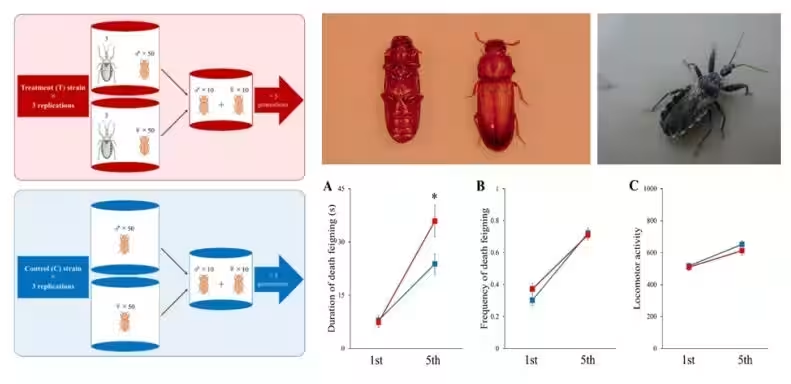
To investigate this question, the researchers housed the granary weevil with the assassin bug, a known predator, over five generations. The findings revealed that beetles living in the presence of predators exhibited a death-faking duration that was over three times longer than those raised without such threats. This significant difference supports the hypothesis that death-faking behavior can evolve rapidly in response to predation pressure.
This study corroborated previous fieldwork conducted by the same team, which found that wild populations of granary weevils cohabitating with assassin bugs displayed longer death-faking durations compared to those that did not share their environment (Konishi et al. 2020). The current experimental evolution project proved that in a controlled environment where predation is a factor, meaningful evolutionary changes can occur in as few as five generations.
The research, conducted in collaboration with Assistant Professor Kentaro Matsumura from the University of Tokyo and graduates from Okayama University’s Faculty of Agriculture, included comprehensive experimental designs. The study found that while the duration of death-faking significantly increased, there were no notable differences in the frequency of death-faking actions or overall activity levels due to the presence of the predator.
Data indicates that beetles exposed to predators develop longer death-faking durations, lending weight to the idea that their response to threats is influenced by environmental pressures. This study has been published online in the journal Applied Entomology and Zoology, further establishing its validity and relevance within the field of entomology.
Professor Takahisa Miyatake’s Insights
Professor Miyatake reflected on the historical context of death-faking research, noting that since the time of Henri Fabre, no one had definitively clarified whether death-faking behavior could truly evolve in the wild. His collaborative efforts with students aimed at pushing the boundaries of accepted scientific knowledge, ultimately culminating in this research output.
This study serves as a reminder of the intricate adaptations that exist within the animal kingdom, particularly in response to the constant threat posed by predators. The evolution of behavior such as death-faking highlights the remarkable nature of ecological interactions and evolutionary dynamics.
For further reading, the detailed results of this research can be accessed through the DOI: 10.1007/s13355-025-00913-z. The research was supported by funds from the Japan Society for the Promotion of Science (JSPS) and associated with the innovative research initiatives at Okayama University.







Topics People & Culture)
【About Using Articles】
You can freely use the title and article content by linking to the page where the article is posted.
※ Images cannot be used.
【About Links】
Links are free to use.