



Unraveling the Brain's Mechanisms in Choosing Singing Teachers
Unraveling the Brain's Mechanisms in Choosing Singing Teachers
In a fascinating new study published in The Journal of Neuroscience, researchers explore the intricate workings of the brain in the context of selecting vocal instructors among zebra finches. Understanding how both humans and animals like these birds choose mentors for cultural learning has long been a mystery. This research sheds light on the relationship between social motivation, imitation, and the amygdala, a crucial brain structure known for its role in emotional regulation.
Key Findings
1. The study highlights that when learning a cultural skill like singing, both humans and birds decide from whom to learn, an essential first step in the cultural transmission process.
2. Previous observations have confirmed that even birds utilize a selective process to choose their singing teachers, indicating a deep-rooted mechanism of cultural learning.
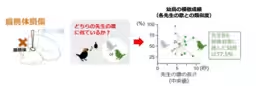
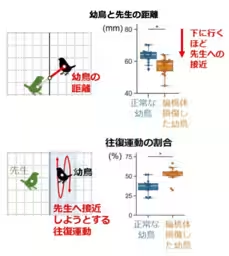
3. The current research reveals that the amygdala is instrumental in this selection process among zebra finches. Specifically, damaging the amygdala increases social tendencies in young finches, leading them to approach potential teachers indiscriminately.
4. Understanding this mechanism may provide insights into how humans, too, select appropriate teachers to foster cultural development.
The Role of the Amygdala
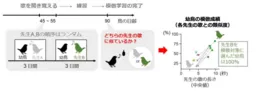
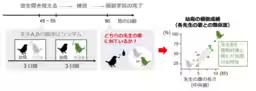
The amygdala, often connected to emotional responses, plays a pivotal role in the decision-making processes of zebra finches when choosing who to imitate. In their experiments, the research team from Waseda University, including Associate Professor Masafumi Tanaka and researcher Tomoko Fujii, found that when young finches were presented with two adult birds singing different songs, those with intact amygdalae were more likely to favor a specific teacher exhibiting particular singing characteristics. In contrast, the finches with damaged amygdalae displayed decreased selectivity, suggesting the importance of this brain region in focusing social attention on appropriate figures for cultural learning.
Implications of the Research
This groundbreaking study is not only essential for understanding avian culture but also provides frameworks for investigating the neural mechanisms underlying cultural transmission in humans. The strong correlation between social behavior and cultural learning observed in these birds may suggest that similar processes could be at play in human societies. This highlights the significance of social communication in the learning of culture, indicating that social factors heavily influence learning preferences.
The reinterpretation of the amygdala's role broadens its significance beyond merely processing fear to include important aspects of social interaction and cultural learning. As society continues to evolve, understanding these mechanisms may further our grasp of how cultural values and traditions are passed down through generations.
Future Research Directions
While this study marks a significant advancement, it is vital to recognize that it captures only a portion of the complexities involved in selecting mentors for learning. The specific behaviors exhibited by potential teachers and other modalities in social interactions could further influence the choices made by young birds. Future research will explore the unique vocal characteristics that predispose certain birds to be selected as mentors, as well as the roles of various social cues in decision-making.
Moreover, the fact that zebra finches are just one among approximately 4,000 songbird species opens up numerous avenues for exploration. Each category of songbird presents its own unique vocal patterns and learning strategies, enriching our understanding of this avian world.
Concluding Thoughts
As our understanding of the amygdala and its multifaceted functions develops, this study suggests the potential for a broader interpretation of how social structures influence cultural learning. As researchers like Fujii and Tanaka continue to investigate the connection between social factors and the transmission of culture, we move closer to unraveling the narrative of how complex cultures develop across species, including our own. As a society, recognizing the pivotal role of social exchanges in cultural learning can enhance how we approach education and mentorship in the future.

Topics People & Culture)

【About Using Articles】
You can freely use the title and article content by linking to the page where the article is posted.
※ Images cannot be used.
【About Links】
Links are free to use.