



FlashLabs Unveils Qwen3.8-Flash-Next-Uncensored for Security Research
FlashLabs Introduces Qwen3.8-Flash-Next-Uncensored for Security Research
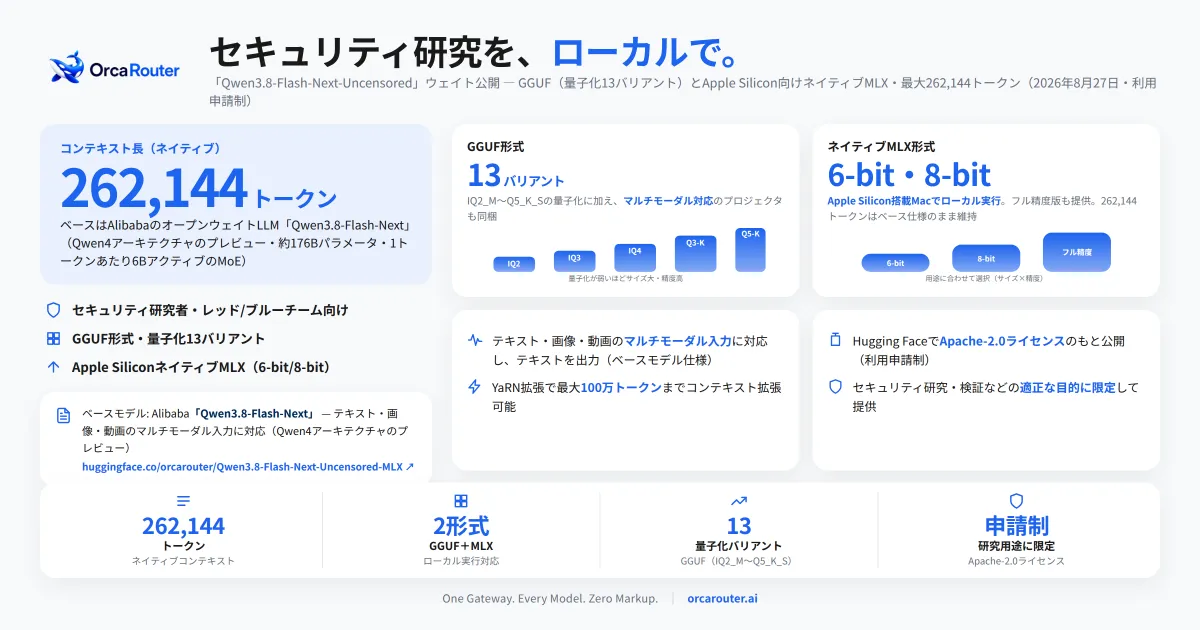
FlashLabs, based in Chiyoda, Tokyo, has recently announced the release of a new security-focused AI model dubbed Qwen3.8-Flash-Next-Uncensored. This model builds upon Alibaba's Qwen3.8-Flash-Next, providing an open-weight configuration that alleviates content filtering, thereby serving security researchers, red teams, and blue teams more effectively.
The OrcaRouter, an AI inference gateway developed by the U.S.-based research organization Continuum AI, is the platform through which FlashLabs is exclusively offering this model for the Japanese market. By focusing primarily on security applications, the Qwen3.8-Flash-Next-Uncensored has been designed with a specific audience in mind, allowing for testing and validation in realistic scenarios.
Key Features
Some of the primary attributes of this model include:
- - A reduction in content filtering aimed at enhancing usability for security validation tasks.
- - Capability to handle native tokenization of up to 262,144 tokens (approximately 260,000 tokens), allowing for substantial context in conversations.
- - It is available in GGUF format with various quantization options and an optimized MLX format for Apple Silicon, available in full precision, 6-bit, and 8-bit variants.
- - Derived from the base model which utilizes a Mixture of Experts (MoE) structure, featuring around 176 billion parameters—only activating 6 billion parameters per token for efficiency.
- - Makes provisions for multi-modal inputs including text, images, and videos, maintaining the versatility that modern applications demand.
- - Accessible through Hugging Face, with a strictly regulated license for research purposes, necessitating an application for usage approval.
Background of the Development
Understanding the critical demand for realistic validation models in the security research field is essential. Security researchers often need to approach vulnerabilities from both offensive (red team) and defensive (blue team) perspectives. Traditional safety-filtered models can fall short in simulating real-world testing scenarios, making it necessary to create models with relaxed content filtering, while also taking precautions against potential misuse.
Continuum AI has opted for a targeted release strategy, combining a usage application system with specific licensing agreements, to ensure that the model is used responsibly and solely for research and security validation purposes.
Insights into Qwen3.8-Flash-Next-Uncensored
The Qwen3.8-Flash-Next-Uncensored offers a collaborative framework that mitigates content restrictions. Designed to support comprehensive research specifications, this model not only adheres to high-performance standards but also enhances multi-modal processing capabilities. With its advanced MoE architecture, it empowers users to efficiently navigate between multiple streams of input—be it text, imagery, or video material—in conducting in-depth security analyses.
Licensing and Responsible Usage
Usage of the Qwen3.8-Flash-Next-Uncensored model is strictly restricted to validated researchers within the security field. As part of this ethical approach, users must comply with application protocols on Hugging Face and agree to the accompanying license terms. For real-world systems, the OrcaRouter features built-in guardrails such as PII shields, content policies, and agent firewalls, ensuring a clear delineation between its research and commercial applications.
Future Directions
With a commitment to enhancing the contribution to the security research community, FlashLabs plans to advance the OrcaRouter continuously to foster a safe and robust AI-enabled environment. As they carve out their niche within the AI tech landscape, this initiative highlights the intersection of innovation and responsibility in technology deployment.
About FlashLabs
Founded in July 2023 and headquartered in Tokyo, FlashLabs focuses on AI applications that integrate human-AI hybrid models to automate and enhance customer experiences. They are the primary provider of the OrcaRouter in Japan, engaging with several high-profile LLMs and generative AI models, as well as developing the open-source speech model Chroma.
For further inquiries, please contact FlashLabs' Marketing Department: Koki Kobayashi, at [email protected].

Topics Consumer Technology)
【About Using Articles】
You can freely use the title and article content by linking to the page where the article is posted.
※ Images cannot be used.
【About Links】
Links are free to use.