



Innovative Collaboration to Expedite Disaster Relief Certification in Kyoto
Introduction
In recent years, the occurrence of natural disasters has increased dramatically, necessitating improved responses and preparedness from local governments. The rising frequency of such events, combined with a shortage of disaster assessment personnel due to declining numbers of municipal staff, has made it imperative to streamline disaster evaluation processes.
In response to these pressing needs, NTT East has collaborated with NTT West, Mitsui Sumitomo Insurance, MS&AD InterRisk Research & Consulting, and ESRI Japan to conduct a proof-of-concept (PoC) project aimed at expediting the issuance of disaster certifications during water-related calamities. With the support of Kyoto Prefecture and Seika Town, the project leverages insurance damage assessment data, facilitating direct integration with local government systems to alleviate administrative burdens and enhance support to affected residents.
Background and Purpose
The Japanese government has recognized the importance of accelerating the certification process for disaster victims, particularly following revisions to Cabinet Office guidelines in May 2024. These guidelines permit municipalities to issue disaster certifications based on preliminary assessments of water levels and flood damage without the need for extensive on-site investigations.
Objectives
This initiative seeks to establish a more efficient and rapid evaluation system for flood damage assessments. By integrating data from Mitsui Sumitomo Insurance into NTT East's disaster recovery support system, local governments can streamline their administrative processes, benefiting both officials and the residents they serve. The collaboration aims to foster public-private partnerships that create social value while improving the efficiency of disaster response efforts.
Implementation Details
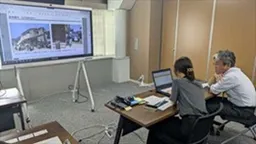
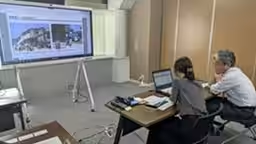
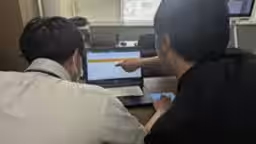
On July 29, 2025, the collaborative project was officially executed at the Kyoto Prefectural Office, where representatives from the participating companies gathered to assess the effectiveness of the integrated data approach. The project effectively demonstrated that without conducting traditional field assessments—typically taking 15 to 30 minutes per case—localized teams could efficiently evaluate multiple incidents using the provided insurance data. The results were remarkable; during the PoC, ten evaluations were completed in just 30 minutes, signifying an efficiency improvement of up to tenfold compared to conventional methods.
Collaborative Roles
1. Kyoto Prefecture and Seika Town: Utilized the disaster recovery support system and served as the official certification issuance hub.
2. NTT East: Developed and operated the disaster recovery support system, providing resources and assistance to local governments.
3. NTT West: Focused on system implementation within Japan’s western regions.
4. Mitsui Sumitomo Insurance: Supplied damage assessment data to municipalities operating under the disaster assistance agreement.
5. MS&AD InterRisk Research & Consulting: Contributed to the development of a DX package for damage assessment and streamlined information-sharing formats.
6. ESRI Japan: Played a critical role in developing the mobile assessment system within the disaster recovery program.
Results and Future Prospects
The comprehensive collaboration confirmed that the integration of insurance data can indeed facilitate quicker disaster certifications, relieving municipal workload and streamlining response efforts. The agreement among the partnered companies highlighted the potential for future enhancements in damage assessment formats, ensuring ongoing efficiency improvements.
Looking ahead, NTT East and Mitsui Sumitomo Insurance plan to engage in continued dialogue with Kyoto Prefecture and other participating municipalities to refine operational standards and address emerging challenges. The aim is to promote and perfect the integration of the disaster recovery support system throughout 362 municipalities already in the program, ensuring that all are equipped with the necessary tools for efficient disaster response strategies.
Moreover, following upgrades to the data connection functionalities, the municipal support components are expected to be provided at no cost, significantly pushing forward the agenda of reducing burdens on disaster-afflicted residents and the municipal staff who serve them. Ultimately, the collaboration aspires to elevate the quality of disaster recovery operations and contribute to building a more resilient and sustainable society.
Conclusion
Such initiatives exemplify how technology and collaboration can transform disaster response, creating proactive systems that benefit communities during critical times. As we witness the increasing necessity for rapid response in the face of natural disasters, efforts like these are essential in advancing public safety and establishing enduring support frameworks for affected populations.
Topics Policy & Public Interest)
【About Using Articles】
You can freely use the title and article content by linking to the page where the article is posted.
※ Images cannot be used.
【About Links】
Links are free to use.