



New Insights into Earth's Deep Water Cycle: Study Reveals Major Mineral's Dry State
Understanding the Earth's Deep Water Cycle
Recent research conducted by a collaborative team from Okayama University, Ehime University, Hiroshima University, Teikyo University of Science, Kyoto University, and the SPring-8 facility has brought new insights into the fundamental dynamics of the Earth’s interior. They found that davemaoite, a primary mineral within the Earth’s lower mantle, holds an unexpectedly low amount of water, paving the way for new models concerning the circulation of water within our planet.
Key Findings of the Study
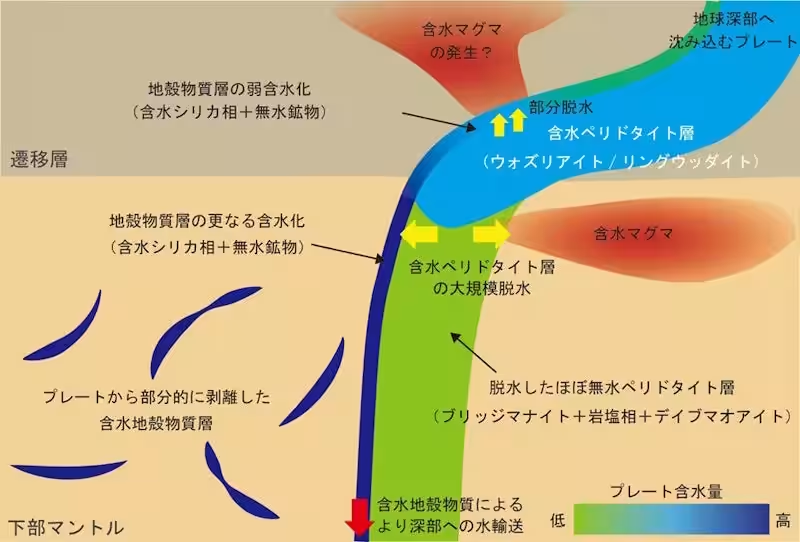
On September 3, 2026, Okayama University announced that their research team managed to measure the water content of davemaoite under conditions mimicking the upper parts of the lower mantle. High-precision experiments revealed that this mineral contains less than 0.08 wt% water, which is less than one-tenth of previous estimates. This contradictory finding suggests that davemaoite, thought to play a role in transporting water in the lower mantle, is mostly dry. Consequently, the study proposes a new water cycling model that focuses on the accumulation of water within subducted crustal materials rather than in mantle minerals.
Implications for Earth Science
The implications of this research are profound. The discovery that major lower mantle minerals like davemaoite do not retain water means that our understanding of deep Earth processes needs re-evaluation. In particular, it indicates that water primarily resides within silica-rich crustal materials that subduct into the mantle, rather than within the less hydrous minerals found deeper in the mantle.
With water's vital role in tectonic plate movement and volcanic activity, adjusting our understanding of where and how water exists within the Earth could significantly enhance geoscientific models.
The Research Journey
Utilizing a combination of a multi-anvil press and synchrotron X-ray facilities at SPring-8, the international research group conducted a series of high-temperature and high-pressure experiments. The results of these endeavors were formally published in the journal Communications Earth & Environment on July 24, 2026.
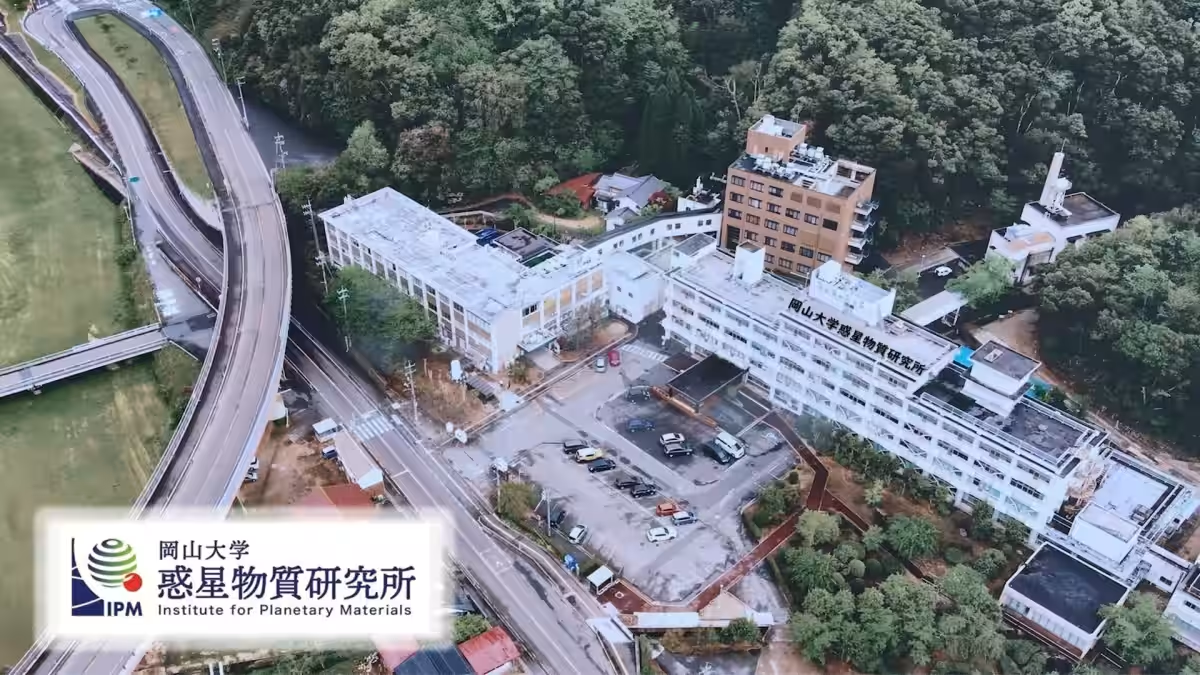
Takayuki Ishii, an associate professor at Okayama University’s Planetary Materials Research Institute, emphasized that this achievement underscores Japan's leadership in the application of synchrotron and multi-anvil press technologies in earth science research. The continued development of multi-anvil experiments allows scientists to recreate conditions of the Earth’s depth in the laboratory accurately.
“This research shines new light on how processes within the Earth evolve and interact. As we move ahead, we hope to inspire the next generation of scientists who are eager to explore these mysteries themselves,” Ishii stated.
A New Paradigm
The new paradigm suggested by these findings not only interrupts traditional views related to water storage in the Earth but also provides actionable insights for future research on Earth’s evolution and material circulation. It shifts the narrative from one that considers major mantle minerals as reservoirs of water, toward one where subducted crustal materials serve as the primary custodian of the Earth's deep water.
In conclusion, this pivotal research helps to bridge the gap in our understanding of geological processes and the Earth’s hydrosphere. The study serves as a cornerstone for further exploration into the complex dynamics of the Earth’s interior and is expected to catalyze additional investigations into related areas of geology and geophysics.


Topics Environment)
【About Using Articles】
You can freely use the title and article content by linking to the page where the article is posted.
※ Images cannot be used.
【About Links】
Links are free to use.