



Innovative Modal Combination Efforts in Hokkaido Aiming for Sustainable Logistics
Modal Combination Initiatives in Hokkaido: A Look at Sustainable Logistics
Hokkaido, Japan, is becoming a focal point for innovative logistics approaches as six domestic food manufacturers collaborate with logistics firm, F-LINE, to enhance transportation efficiency while striving for sustainability. This unique initiative involves a trial transport method known as 'modal combination,' which integrates rail and truck transport, beginning in September 2025.
Background of the Initiative
The increasing shortage of truck drivers has raised concerns in the logistics sector. To address this labor crisis while simultaneously reducing carbon footprints, a collaboration among six prominent food companies—including Ajinomoto, Kagome, Nisshin OilliO, Nisshin Seifun, House Foods, and Mizkan—has been established. Partnering with F-LINE, these manufacturers aim to leverage the capabilities of both rail and truck transportation to create a more sustainable logistics system in the Hokkaido region.
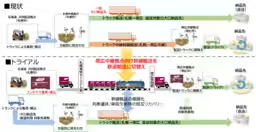
This effort is rooted in the concept of modal combination, which optimally orchestrates various transport modes—trucks, rail, and shipping—to enhance overall efficiency and minimize environmental impacts. By shifting a portion of transport from road to rail, the initiative expects to achieve a reduction of approximately 43% in CO2 emissions for the main transport corridor between Sapporo and Obihiro.
The Current Logistics Landscape
In Hokkaido, roughly 80% of the delivery endpoints for joint distribution are concentrated in the Sapporo metropolitan area, while the remaining 20% are spread across the region. This calls for a robust middle to long-distance transport solution from Sapporo to various hubs, currently dominated by trucking. Given the labor shortage within the logistics industry, the looming 'carry risk' makes this challenge all the more pressing. Transporting goods also remains a challenge concerning carbon neutrality ambitions, as the enhancing demand for sustainable practices must be addressed.
The trial will allow operators to collectively assess the practicality of implementing modal combination strategies. It involves switching middle-distance transport from truck to rail from the Hokkaido joint delivery center to the Obihiro intermediary hub, while still utilizing trucks for the final, flexible delivery phases.
Progress and Future Goals
The collaboration isn't just a recent development; it builds on earlier efforts to streamline logistics. Since April 2016, joint delivery initiatives have been gradually implemented, with significant organizational advancements achieved by consolidating storage and distribution operations to a central location in Sapporo in October 2023. This restructuring is focused on increasing logistics efficiency through coordinated operations.
Moreover, in February 2015, the six food manufacturers created a shared logistics platform aimed at enhancing the overall efficiency and stability of their logistics efforts. This commitment to '共同配送' (shared delivery) reflects the ethos that competition should focus on products, while logistics should be a collaborative endeavor.
Conclusion
With backing from Japan's Ministry of Land, Infrastructure, Transport and Tourism under the 2025 Modal Shift Promotion Project, this initiative is set to reshape how food logistics is managed in Hokkaido, contributing to sustainability and efficiency while addressing labor shortages. As they advance towards a more sustainable logistics framework, the collaborative efforts undertaken here not only benefit the companies involved but also the broader community and environment.
This approach represents a significant breakthrough in how the food supply chain can evolve, enabling these companies to meet the future challenges of logistics while remaining environmentally conscious and economically sustainable. As the initiative is set to launch in 2025, all eyes will be on Hokkaido as this model may very well revolutionize logistics practices across Japan and beyond.





Topics Consumer Products & Retail)
【About Using Articles】
You can freely use the title and article content by linking to the page where the article is posted.
※ Images cannot be used.
【About Links】
Links are free to use.