



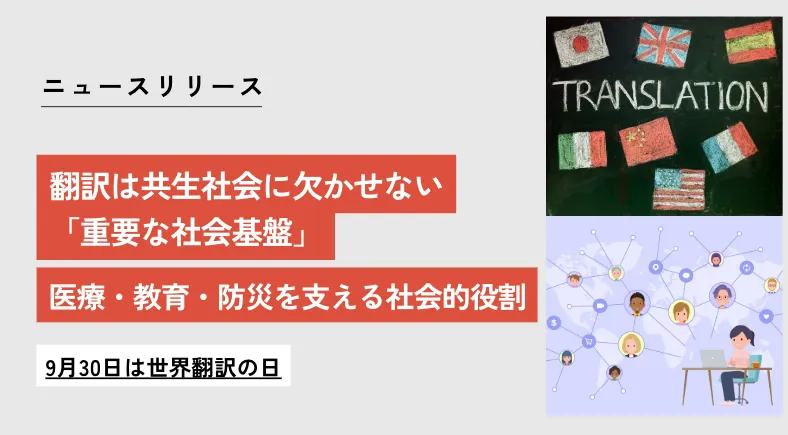
Translation as a Pillar for a Cohesive Society: Celebrating International Translation Day
Translation as a Pillar for a Cohesive Society: Celebrating International Translation Day
International Translation Day, observed on September 30, emphasizes the vital social role of translation, aiming to share its significance worldwide. In light of this commemoration, five prominent translation and interpretation companies have jointly declared that "translation is a crucial social infrastructure supporting a cohesive society."
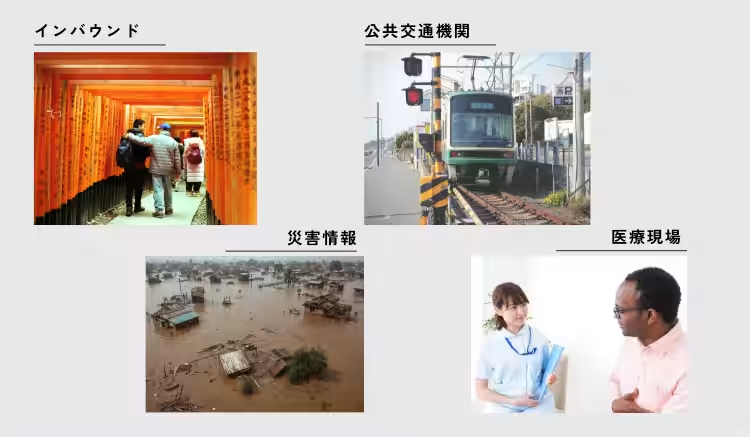
The recent acceleration of global business, along with the increasing presence of foreign residents and inbound tourism in Japan, has made translation indispensable not only in corporate contexts but also in foundational sectors such as construction, healthcare, disaster response, and transportation. This declaration underscores the necessity of acknowledging translation as more than mere language conversion, but as a socially significant endeavor.
The Message of the Joint Declaration
1. Supporting Safety and Coexistence: The declaration stresses that translation plays a critical social role in ensuring “safety and coexistence” among diverse populations.
2. Demonstrating Value: Through their unified statement, the participating translation companies aim to highlight the value of translation to society at large.
3. Foundation for Safety and Security: It asserts that translation is a vital foundation for safety, security, and coexistence within society.
Evolving Need for Translation in Japan
Japan has seen a significant shift in its social structure, characterized by the establishment of foreign residents and the increasing demand for inbound tourism, alongside companies expanding their operations abroad and embracing foreign workers. This evolution mandates multilingual information dissemination as an integral part of daily life. While translation has traditionally been fundamental for international companies entering overseas markets, its role is expanding domestically.
With a growing number of foreigners residing in Japan, the need for translation in critical areas like disaster management, healthcare, public transport, and education has become essential. Translating information plays a vital role in safeguarding the safety and security of all residents, thereby underpinning a society that embraces coexistence.
Furthermore, multilingual communication is not solely beneficial to foreign residents or visitors; it is a proactive strategy for enhancing safety and sustainability for all in Japanese society. Misinformation or misunderstanding can lead to serious complications, especially during emergencies or health crises. By providing accurate translations, we can mitigate chaos and secondary damages in such scenarios, ensuring safety for both foreign and Japanese residents.
The Role of Translation: Specific Cases
The joint declaration also illustrates how translation serves as a crucial social infrastructure through specific examples provided by participating companies:
- - Aska Corporation: By utilizing AI translation for the expedited approval of rare disease treatments, Aska Corporation enhances Japan's medical landscape, allowing quicker access to vital medications.
- - Congrès Global Communications: This firm has contributed by localizing economic sanction lists, assisting financial institutions in compliance and mitigating risks associated with engaging with sanctioned entities.
- - Teriology Serviceware: Through cultural promotion within martial arts, Teriology helps share traditional Japanese values across borders by translating essential documentation and educational materials.
- - Human Science: This organization supports multilingual education and research in national universities, reinforcing a culture of inclusivity in academia.
- - Yaraku: In Minowa Town, Nagano Prefecture, efforts to provide multilingual public information ensure that residents are adequately informed and protected against disasters, reflective of a commitment to multicultural coexistence.
Academic Perspectives on the Translated Foundation
The critical role of translation as a foundational element has also gained traction in academic circles. Professor Yu Yamada from Rikkyo University emphasizes that translation directly correlates to societal security in areas such as disaster response, healthcare, and education. He noted the growing international recognition of translation as a catalyst for human rights, as discussed in an upcoming panel at the European Society for Translation Studies Congress.
In conclusion, the emphasis on translation during International Translation Day is a reminder that it transcends language conversion - it's about ensuring equitable access to information for everyone, fostering a safer and more sustainable society. Translation is indeed a vital social infrastructure that deserves recognition and support from all sectors.
Participating Companies
- - Aska Corporation
- - Congrès Global Communications
- - Teriology Serviceware
- - Human Science
- - Yaraku
By highlighting these instances, the declaration collectively reinforces the argument that translation is critical for enhancing community safety, international dialogue, and cultural exchange — elements that are essential for developing a resilient, cohesive society.




Topics People & Culture)



【About Using Articles】
You can freely use the title and article content by linking to the page where the article is posted.
※ Images cannot be used.
【About Links】
Links are free to use.