



Japan's Work Environment: Rising Pessimism and Remote Work Trends Post-COVID-19
Recent Trends in the Japanese Workforce
In a climate of economic uncertainty, recent findings from the Japan Productivity Center have shed light on the prevailing attitudes among employees regarding work and career development. Conducted in July 2023, the 17th iteration of the "Awareness of Working People Survey" illustrates both the evolving perceptions about the economy and the ongoing changes in work practices stemming from the COVID-19 pandemic.
Growing Economic Pessimism
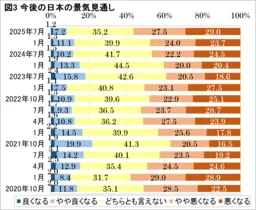
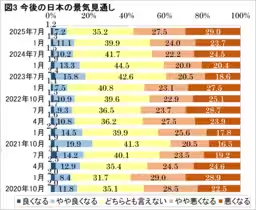
The survey indicated that confidence in Japan's economy continues to wane. The number of respondents predicting decline in the economic environment rose significantly, reflecting fears that are resonating throughout the workforce. The percentage of individuals considering the economic situation as "bad" or “somewhat bad” increased from 59.0% in January to a significant 68.3%. Furthermore, expectations for the future suggest that 56.5% foresee the economic outlook as worsening, up from 47.7% just a few months prior. This marked uptick highlights a growing trend of apprehension that has been noted for five consecutive rounds of the survey.
What’s more alarming is the shift in personal circumstances as many individuals report a reduction in leisure time and increments in working hours. The Diffusion Index, which measures responses of increased vs. decreased workloads, noted that leisure time has diminished, dropping from -3.6 to -6.9 since earlier this year.
Changing Attitudes Towards Career Development
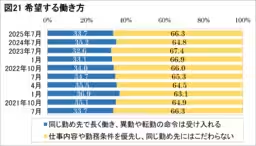
As companies navigate this uncertain economic terrain, the perceptions surrounding job types are also experiencing subtle shifts. Interest in the “job-based” employment model, which emphasizes job roles and conditions over company loyalty, has increased slightly. Conversely, the traditional “membership-type” job, characterized by long tenures and willingness to accept transfers, appears to be on the decline.
Interestingly, while interest in self-improvement initiatives had been high, it has begun to dwindle with only 36.4% of respondents expressing positive intentions towards self-education. This has been attributed in part to a significant 63.6% of employees indicating a lack of intention to engage in personal development, marking one of the highest levels of disinterest recorded.
Remote Work Practices in Transition
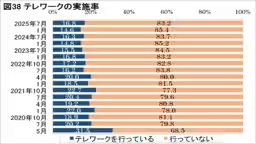
In light of the ongoing shifts caused by the pandemic, the dynamics of remote work are also evolving. The implementation rate of telecommuting has seen a gentle rise from 14.6% in January to 16.8% in July. However, in the context of COVID-19's classification change to category 5 in May 2023, the average telework rate has settled at 15.6% post-transition.
Breaking down the data by company size reveals that larger organizations (over 1,001 employees) have embraced remote work more, increasing their telework adoption to 31.8%. In contrast, smaller companies with fewer than 100 employees saw a slight drop from 9.7% to 9.3%.
Furthermore, in instances of coworkers taking childcare leave, the preference for financial support over additional staffing has become pronounced, with 71.5% of respondents favoring financial assistance. This reveals a significant emphasis on the type of support employees desire during times of personal and professional transition.
The comprehensive findings of this survey are poised to serve as a crucial analytical tool as organizations look to navigate the complexities of workforce management and economic challenges going forward. For a deeper insight into the methodology and detailed results of this survey, please refer to the Japan Productivity Center's full report here.
Topics People & Culture)
【About Using Articles】
You can freely use the title and article content by linking to the page where the article is posted.
※ Images cannot be used.
【About Links】
Links are free to use.