



The Fascinating Role of Self-Touch in Language Retrieval Processes
The Fascinating Role of Self-Touch in Language Retrieval Processes
In an intriguing study, researchers have discovered that the act of touching one’s face or body, known as self-touch behavior, significantly aids in vocabulary retrieval during moments of linguistic struggle. Conducted by a research team led by Associate Professor Kazuki Sekine from Waseda University's Graduate School of Human Sciences, this study emphasizes the importance of our physical actions in cognitive processes.
Background of the Study
Self-touch behavior, which refers to unconscious gestures like touching one’s face or hair, has traditionally been associated with self-soothing, reducing tension and stress. Previous social science studies by Ekman and Friesen in the 1960s outlined its psychological implications. More recent research expanded this understanding, suggesting that such behaviors could also relate to cognitive processing and attention control. Barroso’s studies recognized an increase in self-touch during tasks demanding attention, while other findings showed that people tend to touch themselves more when struggling to recall specific words, a condition known as the 'Tip-of-the-Tongue' (TOT) state.
Despite these observations, until now, no experiments rigorously tested the direct impact of self-touch on vocabulary retrieval. This leaves a gap in our understanding of whether this body language truly aids memory recall effectively. The present study sought to bridge that gap by experimentally investigating the connection between self-touch and language retrieval.
Experimental Design and Findings
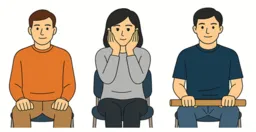
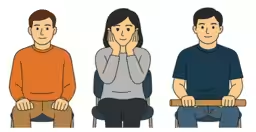
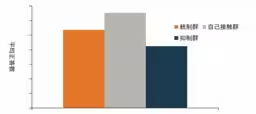
The study involved 60 native Japanese-speaking adults participating in vocabulary tasks that required them to recall proverbs or four-character idioms based on provided definitions. Participants performed under three conditions: a control condition where no specific instructions regarding hand movement were given, a self-touch condition where they were encouraged to touch their face while thinking, and a suppression condition where they held rods, preventing hand movement.
Results indicated that participants in the self-touch condition significantly outperformed those in the suppression condition in terms of correct responses. This finding clearly demonstrates that self-touch behaviors can enhance attention control, thus aiding cognitive processes like language memory retrieval. Notably, while the transitional state from TOT did not show a marked difference across conditions, the prevalence of self-touch behaviors increased, particularly when participants faced a linguistic block.
Implications of the Research
The outcomes of this research extend far beyond academic curiosity. The discovery that self-touch aids vocabulary retrieval could be transformative, especially in applications aimed at aiding elderly populations or individuals with speech impairments. In stressful or distracting environments, the act of self-touch may provide a psychological anchor, allowing individuals to maintain a focus on the words they need, ultimately facilitating smoother communication.
Notably, while much of the previous research emphasized gestures as a means of conveying meaning, this study’s contributions highlight the role of non-communicative body movements in cognitive functioning. The ability to delineate between expressive gestures and self-touch behaviors as distinct entities could deepen understanding in fields like psychology and linguistics, potentially informing interventions aimed at improving linguistic productivity and cognitive engagement.
Future Directions
Despite its significant insights, the research presents further questions for exploration. The participant demographic was limited to young adults, which begs the inquiry into how factors such as age and cultural variances may influence self-touch behaviors. Future studies should widen their scope, looking to examine older populations and children, as well as apply these findings to more naturalistic conversation settings to observe how well they translate outside controlled environments.
Additionally, coupling self-touch behavior with neuroimaging studies might unravel the neurological underpinnings of how these gestures impact attention and memory functions, paving the way for broader applications in education and speech therapy.
Conclusion
The profound realization that our unconscious actions, such as self-touching, can support our cognitive processes challenges previously held notions of mere habits. This study not only proposes that our bodies play a vital role in thinking and conversation but suggests practical applications for enhancing communication skills in everyday life. As we seek to understand and harness these invisible links between thought and action further, the potential for enriched interactions continues to expand.
Reference
The culmination of this study is set to be published in Languages (MDPI) on August 26, 2025. The research underscores the importance of integrating physical awareness into language and cognitive studies, highlighting the interplay between body and mind.
For more details on the study, please refer to the publication: The Role of Self-Adaptors in Lexical Retrieval.
Topics People & Culture)









【About Using Articles】
You can freely use the title and article content by linking to the page where the article is posted.
※ Images cannot be used.
【About Links】
Links are free to use.