



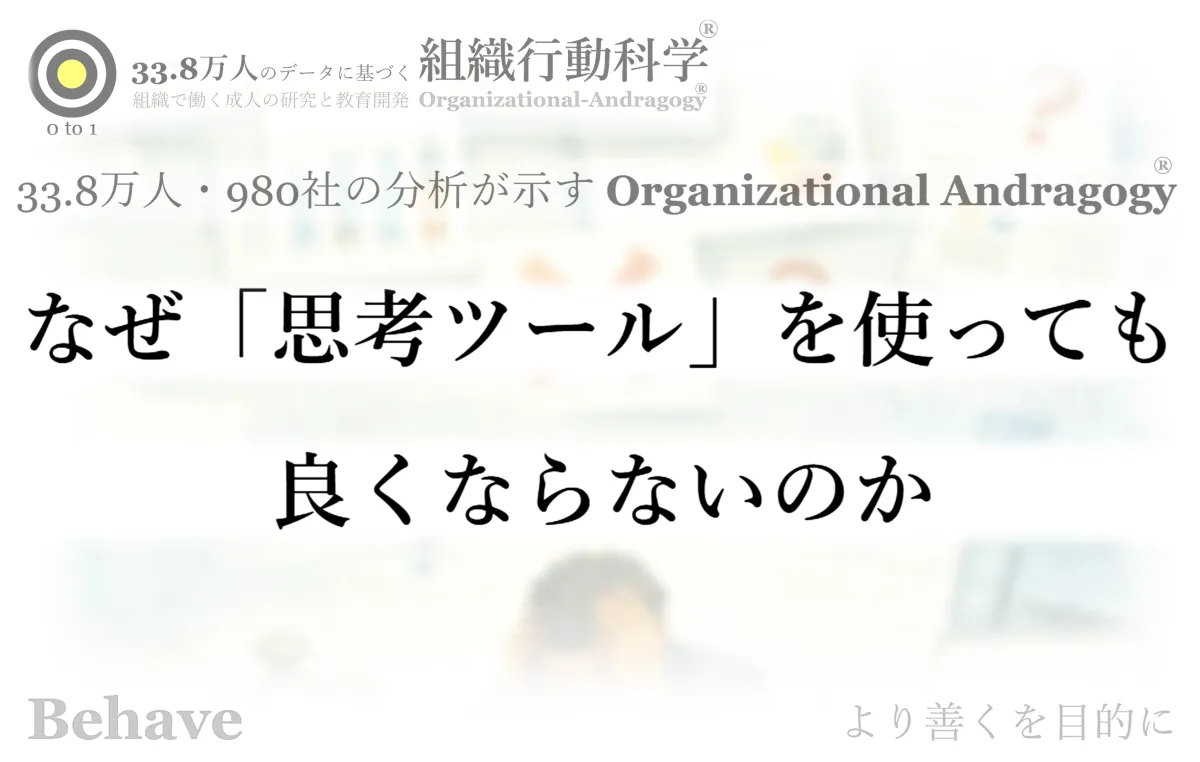
Understanding Why Using Thinking Tools Fails to Improve Outcomes
Why Using Thinking Tools Often Doesn't Yield Better Results
A recent report published by Request Inc., headquartered in Shinjuku, Tokyo, brings to light an intriguing paradox in organizational behavior: despite the continuous use of thinking tools and frameworks aimed at improving decision-making and business operations, many organizations find themselves in a perplexing cycle of increased meetings and refined documents without achieving meaningful progress.
The Human Capital Development Planning center, part of Request Inc., based its findings on an analysis of behavioral data from 338,000 individuals across 980 companies in Japan. The report, titled “Why Using Thinking Tools Doesn't Lead to Improvements,” reveals specific issues surrounding how discussions are structured during meetings.
Observations from the Field
Despite implementing various thinking tools:
- - The frequency of meetings continues to rise.
- - Documentation becomes increasingly organized and detailed.
- - Nonetheless, the execution of solutions remains stagnant, leading to frustration on the ground.
This report does not attribute the lack of improvement solely to individual capabilities or the usage of tools. Instead, it emphasizes the importance of what happens prior to discussions.
Key Points of Focus:
1. The nature of what is regarded as fact during discussions.
2. The context from which these facts are perceived.
3. The underlying assumptions that participants share before the conversation begins.
Target Audience for the Report
This report is beneficial for:
- - Individuals who have integrated thinking tools but feel disconnected from tangible outcomes.
- - Teams that conduct numerous meetings yet struggle to build upon past decisions.
- - Those interested in understanding the structural reasons behind the misalignment in discussions.
Problem Settings
In business discussions, participants often share occurrences, numbers, and reports from the field. However, the conversations may commence without clarity on:
- - What is being acknowledged as fact.
- - The context in which these facts are being interpreted.
- - The assumptions included in the conversation.
This lack of clarity can lead to scenarios where participants reference different interpretations of facts, backgrounds, and assumptions. Consequently:
- - Even if the same terminology is employed during discussions, the intended meanings may diverge.
- - Discussions may seem to progress while failing to align.
Consequences of Unresolved Facts, Backgrounds, and Assumptions
The report asserts that when conversations or organizational processes continue without organizing facts, backgrounds, and assumptions, the following phenomena emerge:
- - An increase in topics and issues under discussion.
- - Ongoing elaboration and clarification are made without consensus on foundational elements.
- - As a result, even if a conclusion is reached, participants frequently struggle to understand:
- The contextual conditions underpinning this conclusion during future discussions.
Similar explanations and confirmations tend to recur, resulting in a prevalent sentiment of:
- - “We are busy, but there is a lack of tangible progress.”
The Report’s Position
This report does not critique any specific methodologies or dismiss the value of existing thinking tools and analytical techniques. Instead, it highlights how the handling of facts, contexts, and assumptions prior to discussions can drastically influence the quality of dialogues and subsequent actions taken within organizations.
Overview of the Report
- - Title: Why Using Thinking Tools Doesn’t Lead to Improvements
- - Published by: Human Capital Development Planning Center
- - Format: PDF report (16 pages)
For more insights, reach out to the Human Capital Development Planning Center at [email protected] or visit Request Inc. for comprehensive details about their organizational behavior science initiatives.

Topics Business Technology)
【About Using Articles】
You can freely use the title and article content by linking to the page where the article is posted.
※ Images cannot be used.
【About Links】
Links are free to use.