



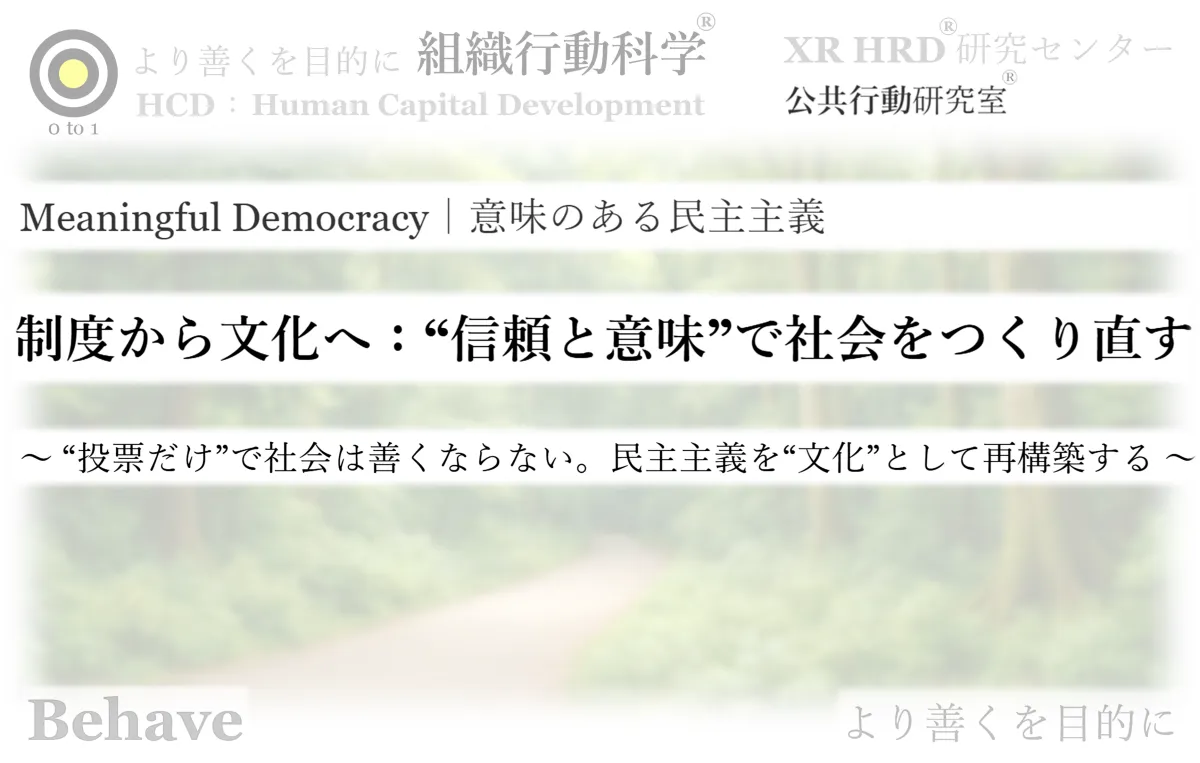
Rethinking Democracy: Redesigning Organizational Behavior for Meaningful Engagement
Redefining Democracy: A New Perspective
In recent dialogues surrounding democracy, one alarming sentiment has been gaining traction: the notion that having well-established systems does not equate to effective action. This issue resonates not just within corporate walls but also within government and community sectors. Observers have begun to voice concerns that merely having formal mechanisms in place is insufficient for nurturing authentic trust and fostering productive dialogues.
Insights from Request Company
Request Company, based in Shinjuku, Tokyo, has engaged with over 980 organizations and 338,000 individuals, gathering extensive behavioral data to explore fundamental questions such as, "What prompts people to find meaning in their work?" and "How does trust evolve and circulate within institutions?" This organization specializes in organizational behavior science and is now advocating for a shift towards what it terms 'Meaningful Democracy.'
Their recent report boldly asserts, “Democracy is not merely about the correctness of systems but rather a culture of relationships.” This perspective opens the door to a more profound understanding of how democratic systems can function in a way that truly serves the community.
The Report Overview
The report's contents are structured around the following critical areas:
1. “Why can’t I trust even when systems are in place?”
2. The erosion of systems: A human-centric issue?
3. Transformations in motivation from the Edo period to Showa.
4. Post-war stagnation: Behaviors that propelled growth versus neglected questions.
5. Modern dissonance: The impact of the gap between systems and inner convictions.
6. Psychological analysis: The chain of distorted incentive structures and loss of comfort.
7. Directions for restructuring.
8. Conclusion: Engaging in inquiry and co-creation.
9. Appendices on capitalism.
The Disconnection Between Systems and People
Regardless of how well our regulations and rules are defined, without shared meaning and a cycle of trust between people, actions risk becoming mere formalities lacking creativity and improving capacities. In practice, while systems are employed as tools to ensure “safety” and “validity,” critical questions like “Why does this system exist?” and “For whom is this structure designed?” have often been overlooked. Consequently, individuals prioritize aligning their behavior with institutional norms rather than developing a culture of inquiry and meaning-making.
Shifting Perspectives on Systems
According to Request Company, overcoming these structural limitations demands not just a focus on fixing the façade of systems but also nurturing a culture that shares trust and meaning through these frameworks. This is not merely an ideological stance but a practical viewpoint grounded in organizational behavior science that links to actual outcomes in organizational transformations and human capital management.
The report introduces the concept of 'Public Behavioral Science,' suggesting a cultural shift where systems are viewed not as the basis of trust but rather as a starting point for dialogue.
“Meaningful Democracy is not about using systems correctly but about cultivating a culture of rightful engagement through these systems. It's about a shared inquiry and behavior that fosters development collectively.”
Establishing a Public Behavioral Research Center
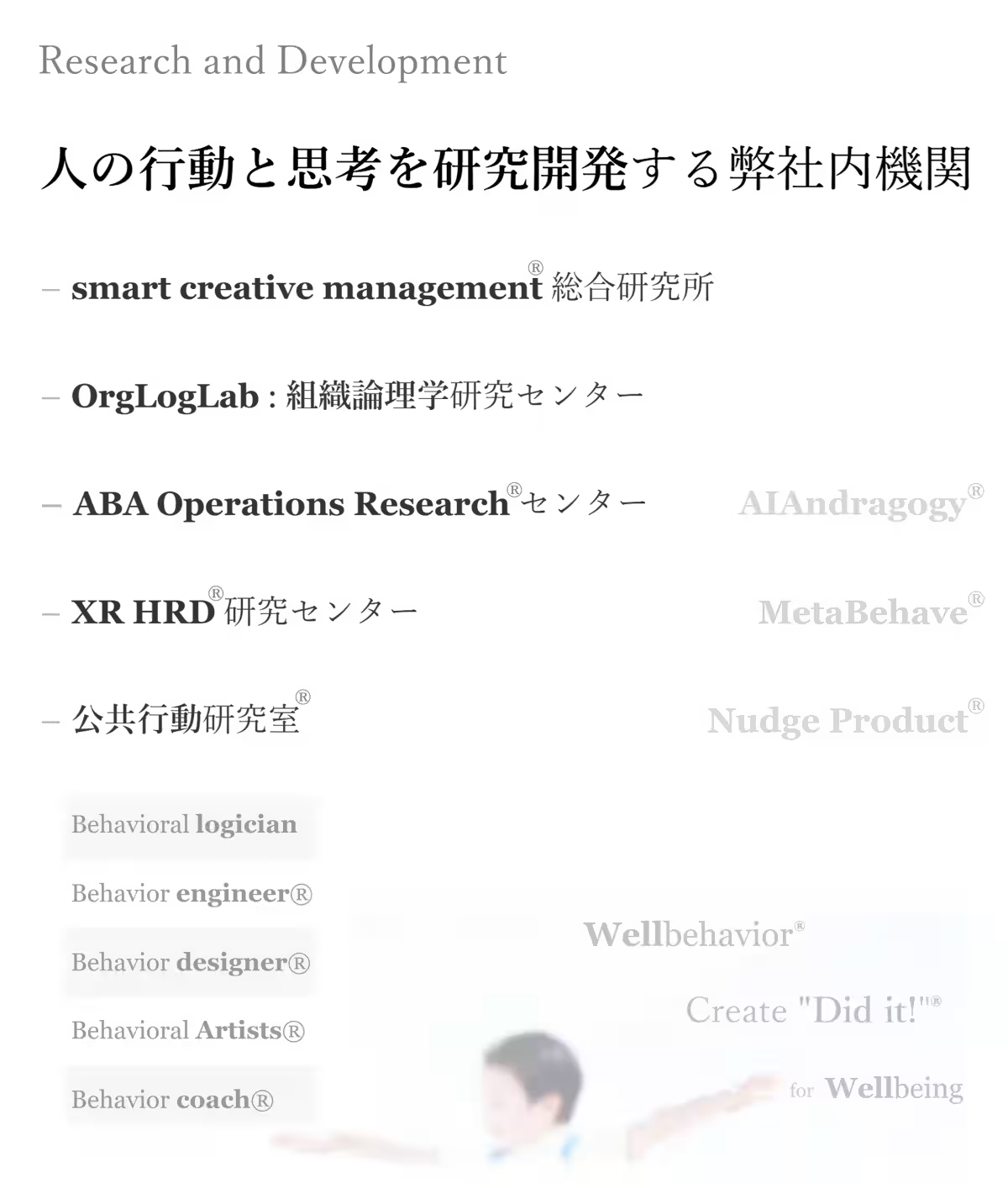
In pursuit of critically reexamining the foundation of trust and meaning within society, Request Company has established the Public Behavioral Research Center, leveraging its expertise in organizational behavior science for these larger societal questions. They have initiated practical collaborations with government bodies, educational institutions, and local communities.
Closing Remarks
With the growing recognition of our systemic shortcomings, the call for a reimagined approach to democracy is more pertinent than ever. The journey towards a Meaningful Democracy is one that each individual must embark on, fostering a culture of inquiry and community engagement that transcends mere compliance with established norms. For those interested in the detailed findings and exploration presented in the report, it is available for download.
- ---
E-mail: [email protected]
Company Information:
- - Name: Request Company
- - Address: 3-4-8 Shinjuku, Shinjuku-ku, Tokyo, 160-0022
- - Representative: Tomoyasu Kohata
- - Corporate Site: https://requestgroup.jp/
- - Company Profile: https://requestgroup.jp/profile
- - Download Company Information: https://requestgroup.jp/download
Topics People & Culture)

【About Using Articles】
You can freely use the title and article content by linking to the page where the article is posted.
※ Images cannot be used.
【About Links】
Links are free to use.