



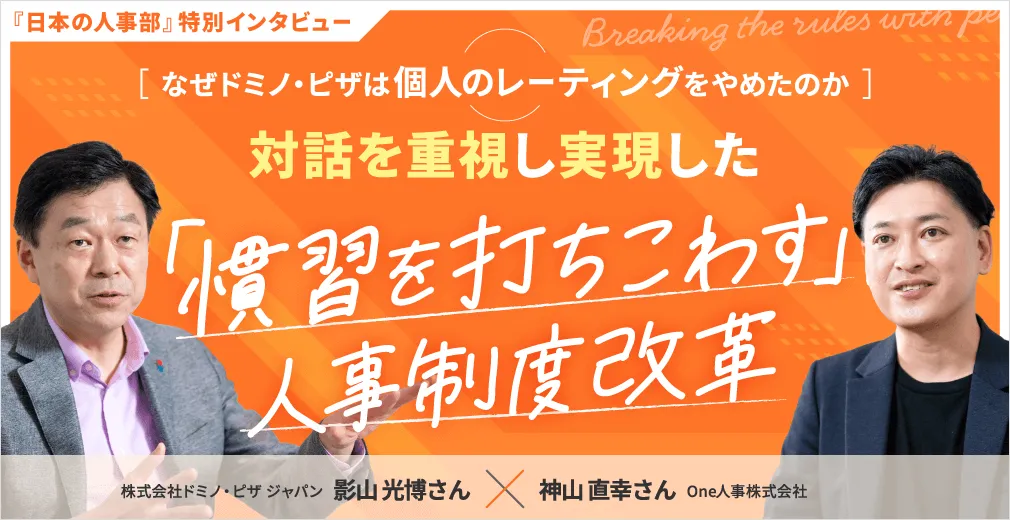
Exploring the Transformation of HR Practices: A Dialogue with Domino's Pizza
Revolutionizing HR Practices: Insights from Domino's Pizza and One HR
In a notable dialogue featured in "Nihon no Jinji-bu," One HR Inc., a leading provider of HR solutions, engaged in a profound discussion with Domino's Pizza Japan's HR Business Partner, Mitsuhiro Kageyama. This enlightening conversation took place under the leadership of Naoyuki Kamiyama, head of the Field Sales Division at One HR. The core of their discussion revolved around the evolving landscape of human resource management, particularly in light of recent shifts in evaluation systems that many companies adopt, such as MBO (Management by Objectives).
A Radical Shift in Evaluation Systems
Three years ago, Domino's Pizza Japan made a groundbreaking decision to eliminate its individual evaluation system as it introduced the OKR (Objectives and Key Results) framework. This decision stemmed from a philosophical approach centered on gathering the best talent and fostering a winning team spirit, underpinned by a belief in the inherent goodness of employees. This dramatic change challenges the conventional wisdom around employee evaluation and reflects an urgent need for a more collaborative and performance-driven culture.
In the discussion, Kageyama articulated how this pivot towards OKRs promotes a more dynamic and engaged workforce. Rather than focusing on individual performances, employees are encouraged to work towards collective goals, which nurtures collaboration and enhances productivity across the organization.
Trust and Culture at the Core
The foundation of this transformative approach lies in establishing a culture of trust. Kageyama emphasized that trusting employees to operate in the best interest of the company allows for greater freedom and creativity in achieving goals. This trust-based approach aligns perfectly with the concept of "Go Gemba!" which encourages employees to be present where value is created, ultimately embodying the company’s core values.
Furthermore, this transformation is indicative of a broader trend within corporate environments, where traditional, rigid structures are being replaced by flatter organizational models. Such environments not only promote agility but also harness the strengths and insights of employees at all levels.
Balancing Defensive and Offensive HR Strategies
Kamiyama and Kageyama also explored the intricate balance between defensive and offensive HR strategies. In today's fluid market conditions, companies must navigate safeguarding existing talent while aggressively pursuing new growth opportunities. The dialogue underscored that maintaining this balance is crucial, as it directly influences organizational resilience and adaptability.
The conversation highlighted how HR strategies must evolve to foster both security and innovation, with a clear focus on sustainable growth. Companies are encouraged to adopt a forward-thinking mindset, instilling a sense of responsibility among HR professionals to drive meaningful change.
A Vision for Sustainable Organizations
As they navigated the complexities of modern HR practices, both leaders expressed a shared vision for the future: one that prioritizes sustainability and employee wellbeing. Their insights offer a glimpse into the evolving dynamics of workplace culture, where the role of human resources transcends traditional boundaries.
Kageyama's experience at Domino's Pizza, paired with Kamiyama's expertise at One HR, underscores the importance of leveraging innovative HR technologies alongside progressive management philosophies. Together, they advocate for a paradigm shift in how organizations view talent management—not just as a function of keeping track of performance, but as a strategic element in building a thriving workplace.
Conclusion
In conclusion, the dialogue between Domino's Pizza and One HR sheds light on the critical changes in human resource management. By embracing innovative systems like OKRs and fostering a culture built on trust and collaboration, companies can effectively prepare for the challenges of the future. This transformative journey not only contributes to organizational growth but also ensures that employees feel valued and engaged in their roles—key elements for sustainable success in today's competitive landscape.
For those interested in learning more about the discussion, the complete interview is available within the pages of "Nihon no Jinji-bu."
Topics People & Culture)

【About Using Articles】
You can freely use the title and article content by linking to the page where the article is posted.
※ Images cannot be used.
【About Links】
Links are free to use.