




Key Findings from the New Employee Work Life Consciousness Survey for 2026
Insights from the 2026 New Employee Work Life Survey
In a recent survey conducted by Sanno University’s Research Institute, the values and preferences of 500 new employees who joined in 2026 were explored. This comprehensive study sheds light on various aspects of the work environment, the process of selecting an employer, and the factors that contribute to job satisfaction. Here are some key findings from this significant survey.
Attractive Work Environment
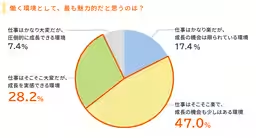
When questioned about the most appealing work environment, 47.0% of respondents stated they preferred a job that is "somewhat easy with slightly available growth opportunities." This preference reflects a trend towards seeking a balanced work experience that prioritizes manageable workload over high-stress situations that promise significant growth. Following this, 28.2% of the new employees appreciated an environment that is "somewhat challenging but allows for growth." Additionally, 17.4% favored work that is "very easy, albeit with limited opportunities for growth." Collectively, 64.4% gravitated towards less demanding work conditions, indicating a shift away from highly competitive environments and a desire for stability in their careers.
Key Factors in Job Selection
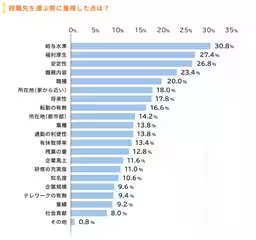
The survey further investigated what factors are most important to new employees when choosing a workplace. The leading concern, cited by 30.8%, was the "salary level." Following closely behind were "employee benefits" at 27.4% and "job stability" at 26.8%. The content of the job itself also mattered, as 23.4% mentioned that the nature of the work was crucial, while 20.0% pointed to the job category as important. These findings suggest that while salary and benefits are significant, employees are equally concerned with their job roles and responsibilities when making employment decisions.
Work-Life Balance
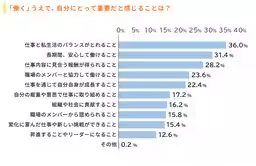
The significance of work-life balance emerged as a top priority for new employees, with 36.0% indicating that it was the most crucial aspect of their work life. This was followed by the importance of job security (31.4%) and fair compensation aligning with responsibilities (28.2%). Notably, opportunities for advancement or leadership were the least important to them, with only 12.6% of respondents focusing on these aspects. This reinforces the growing trend among younger employees to prioritize personal well-being and stability in their work environments rather than traditional markers of success like promotions.
Communication Beyond Working Hours
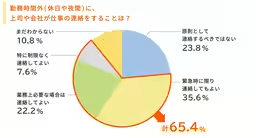
Lastly, the survey addressed the topic of communications outside regular working hours. When asked if it's acceptable for employers to contact employees after hours, 35.6% stated it’s permissible only in emergencies. A notable 23.8% insisted that under no circumstances should contact occur outside working hours, highlighting a concern for personal time and boundaries. Interestingly, when considering essential business matters, 22.2% felt communication should be allowed, and 7.6% were comfortable with any communication at any time. Overall, a significant 65.4% of respondents were open to communications, although they emphasized the necessity of limits based on urgency.
These findings not only present a snapshot of the new workforce's mentality towards work but also signal a shift in expectations from employers. The implications for organizations lie in understanding these preferences as they shape workplace policies and cultures. As every new generation enters the workforce, businesses must adapt to foster environments that align with the evolving values and beliefs of their employees.
Conclusion
This survey conducted by Sanno University underscores the evolving nature of work in modern society, particularly among new employees. In an age where flexibility, clear ethics, and personal satisfaction are becoming paramount, organizations must take heed of these insights to remain competitive and appealing to the future workforce.
For further details, you can find the complete survey report on the Sanno University Research Institute website.

Topics People & Culture)
【About Using Articles】
You can freely use the title and article content by linking to the page where the article is posted.
※ Images cannot be used.
【About Links】
Links are free to use.