



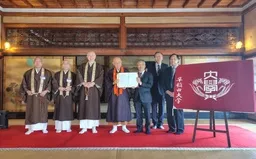
Waseda University and Ninna-ji Temple Forge Comprehensive Partnership for Cultural Research
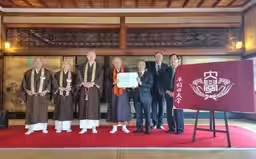
On March 30, 2026, Waseda University's Faculty of Letters, located in Shinjuku, Tokyo, led by Dean Akira Yanagisawa, and the Ninna-ji Temple, the headquarters of the Omuro sect of Shingon Buddhism, based in Ukyo, Kyoto, forged a comprehensive partnership agreement aimed at mutual support and cooperation in advancing research and educational activities. This agreement emphasizes ongoing collaboration around the cultural properties and materials that are preserved at Ninna-ji Temple and its affiliated institutions, focusing particularly on Buddhist culture and court culture.
The purpose of this partnership is to establish a framework for mutual support and collaboration between Waseda University and Ninna-ji Temple in the following areas:
1. Facilitating reciprocal visits aimed at research and educational initiatives.
2. Exchanging scholarly materials, knowledge, and other informational resources (including research reports, educational materials, and related documents).
3. Engaging in academic exchange activities targeting the study and dissemination of knowledge regarding Ninna-ji and the Omuro sect temples, as well as Buddhist and court cultures.
4. Participating in any other scholarly exchange activities agreed upon by both parties.
This partnership was inspired by a lecture given by Professor Akio Kawajiri of Waseda University’s Faculty of Letters in 2023 at the request of Ninna-ji Temple, which was part of the initiatives to commemorate the 1250th anniversary of the birth of Kobo Daishi Kukai. During this lecture, Daisuke Segawa, the head priest of Ninna-ji, highlighted the existence of over a thousand cultural properties, primarily related to art, that have yet to be thoroughly explored. He proposed an academic collaboration for research and investigation by Waseda University, which prompted the establishment of this partnership.
Both Professor Kawajiri and fellow professor Yutaka Kawase expressed their view that this treasure trove of cultural heritage at Ninna-ji is an exceptionally significant research field for scholars, particularly in the areas of religious history, art history, and cultural studies. The Faculty of Letters, equipped with a diverse range of faculty and graduate students, is well-suited to handle research related to temple archives covering art history, Japanese history, and Buddhist studies.
Additionally, Daisuke Segawa, who holds academic ties with Waseda University, having graduated from the first Faculty of Letters specializing in Japanese History, further solidifies the foundation of this partnership.
Going forward, Professors Kawajiri and Kawase will play pivotal roles as coordinators in promoting cultural heritage research and academic exchanges. They are committed to disseminating research outcomes, expanding educational programs, and organizing exhibitions and public activities. Proposed initiatives include conducting research on Ninna-ji's collections of sculptures and paintings, creating catalogues, hosting symposiums related to Ninna-ji, and organizing public lectures and classes for the community.
Akira Yanagisawa, Dean of Waseda University’s Faculty of Letters: "For our students and faculty in the Faculty of Letters (comprising the Graduate School of Letters, School of Cultural Creation, and Faculty of Letters), the opportunity to engage with the rich cultural heritage preserved at Ninna-ji, a significant landmark in Japan's history and culture, holds immeasurable value. We are also looking to explore collaborative opportunities around the digitalization of materials as we embark on research methodologies in digital humanities."
Daisuke Segawa, Head Priest of Ninna-ji Temple: "Ninna-ji and the affiliated temples of the Omuro sect have treasured cultural properties passed down for many generations. Through this newly established partnership with Waseda University’s Faculty of Letters, we aim to scientifically elucidate the value of our artifacts with the help of researchers and students from Waseda, ensuring these treasures are preserved for future generations."
Objectives of the Agreement
The purpose of this partnership is to establish a framework for mutual support and collaboration between Waseda University and Ninna-ji Temple in the following areas:
1. Facilitating reciprocal visits aimed at research and educational initiatives.
2. Exchanging scholarly materials, knowledge, and other informational resources (including research reports, educational materials, and related documents).
3. Engaging in academic exchange activities targeting the study and dissemination of knowledge regarding Ninna-ji and the Omuro sect temples, as well as Buddhist and court cultures.
4. Participating in any other scholarly exchange activities agreed upon by both parties.
Background of the Agreement
This partnership was inspired by a lecture given by Professor Akio Kawajiri of Waseda University’s Faculty of Letters in 2023 at the request of Ninna-ji Temple, which was part of the initiatives to commemorate the 1250th anniversary of the birth of Kobo Daishi Kukai. During this lecture, Daisuke Segawa, the head priest of Ninna-ji, highlighted the existence of over a thousand cultural properties, primarily related to art, that have yet to be thoroughly explored. He proposed an academic collaboration for research and investigation by Waseda University, which prompted the establishment of this partnership.
Both Professor Kawajiri and fellow professor Yutaka Kawase expressed their view that this treasure trove of cultural heritage at Ninna-ji is an exceptionally significant research field for scholars, particularly in the areas of religious history, art history, and cultural studies. The Faculty of Letters, equipped with a diverse range of faculty and graduate students, is well-suited to handle research related to temple archives covering art history, Japanese history, and Buddhist studies.
Additionally, Daisuke Segawa, who holds academic ties with Waseda University, having graduated from the first Faculty of Letters specializing in Japanese History, further solidifies the foundation of this partnership.
Future Initiatives and Expectations
Going forward, Professors Kawajiri and Kawase will play pivotal roles as coordinators in promoting cultural heritage research and academic exchanges. They are committed to disseminating research outcomes, expanding educational programs, and organizing exhibitions and public activities. Proposed initiatives include conducting research on Ninna-ji's collections of sculptures and paintings, creating catalogues, hosting symposiums related to Ninna-ji, and organizing public lectures and classes for the community.
Comments from Stakeholders
Akira Yanagisawa, Dean of Waseda University’s Faculty of Letters: "For our students and faculty in the Faculty of Letters (comprising the Graduate School of Letters, School of Cultural Creation, and Faculty of Letters), the opportunity to engage with the rich cultural heritage preserved at Ninna-ji, a significant landmark in Japan's history and culture, holds immeasurable value. We are also looking to explore collaborative opportunities around the digitalization of materials as we embark on research methodologies in digital humanities."
Daisuke Segawa, Head Priest of Ninna-ji Temple: "Ninna-ji and the affiliated temples of the Omuro sect have treasured cultural properties passed down for many generations. Through this newly established partnership with Waseda University’s Faculty of Letters, we aim to scientifically elucidate the value of our artifacts with the help of researchers and students from Waseda, ensuring these treasures are preserved for future generations."
Topics People & Culture)



【About Using Articles】
You can freely use the title and article content by linking to the page where the article is posted.
※ Images cannot be used.
【About Links】
Links are free to use.