




Enhancing Management Skills of Public Officials: A New Report from Japan
New Report on Management Skills for Public Officials in Japan
In July 2024, Japan's renowned think tank, the Japan Research Institute (JRI), collaborated with Globis, a leading business school, to establish a research group focusing on the clarification and updating of essential skills for public officials, particularly aimed at enhancing their management capabilities. This initiative responds to the increasing complexity of social and economic issues that public servants face today.
Background of the Research Group
In recent years, public officials have been challenged to manage increasingly intricate issues within society. This rising demand for skills has led to noticeable attrition among mid-career and younger public servants, often referred to as "public service attrition." Consequently, the country is facing a significant shortage of civil servants due to a decline in new recruits, compounded by outdated operational practices and uncertainty regarding personal skill sets. To address this crisis, it is crucial for governmental organizations to improve recruitment processes, retain existing staff, and establish systems that facilitate the re-employment of former employees.
To effectively enact these changes, it is vital to delineate the skills necessary for public service, thereby enhancing the appeal and career development opportunities available to civil servants. This discussion has been at the forefront of various administrative advisory meetings.
Objectives and Findings of the Report
The report, which has been compiled as a result of this research group, focuses primarily on clarifying the management skills required for Japan’s national public sector managers. The research group examined various capabilities that are universally needed across ministries yet remain inadequately defined, particularly around management skills.
The Significance of Clarifying Skills for Public Officials
The report asserts that defining the skills required for effective public service is essential not only for showcasing the value of public service but also for enhancing organizational productivity. To ensure that civil servants can manage the complexities of modern public duties while increasing overall productivity, the understanding of "management" must evolve. It must shift from merely fulfilling designated personnel, budgetary, and operational responsibilities to a model that allows for agile strategic management responsive to change.
To enhance the quality of public service, there is also a need to bolster the decision-making capabilities of officials; thus, establishing common frameworks for management skills is crucial for promoting systematic rather than individual skill development.
Classification and Extraction of Necessary Skills
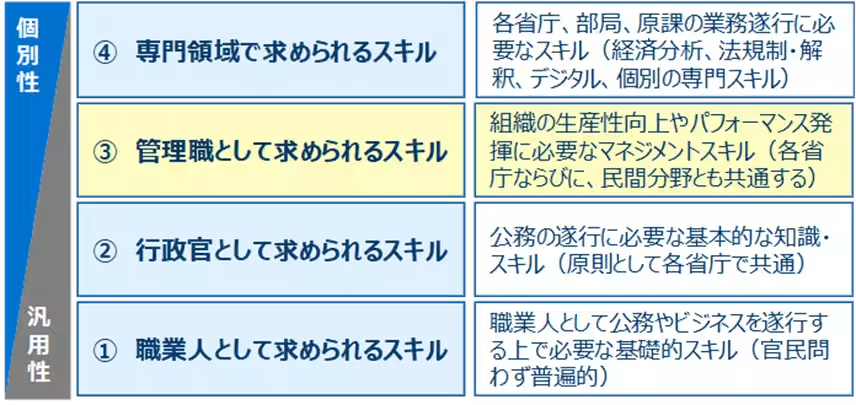
The skills necessary for public service have been categorized into four distinct groups, drawing parallels with management competencies required in the private sector. This alignment suggests that training methodologies employed in private management can be beneficially adapted for public servants.
Developing and Acquiring Skills
To facilitate the acquisition and development of essential public management skills, including managerial capabilities, it is necessary for organizations to undertake a structured, phased approach that promotes the recognition of the connection between tasks and skills for civil servants.
1. Linking Duties to Skills: Employees must understand that acquiring these skills is vital for performing their jobs effectively.
2. Establishing Skill Acquisition Systems: There is a need for comprehensive training systems tailored to ensure civil servants can gain the requisite skills practically and efficiently, potentially leveraging e-learning and case methods.
3. Visualizing Existing Skills: Enhancing visibility of individual skills within human resources records can promote personal development and help improve organizational productivity.
Implementation into Human Resources Practices
The implementation of these newly defined skills and acquisition processes must extend into human resources strategies, utilizing skill data as a basis for promotion and career development decisions, thus ensuring proper staffing that enhances public service productivity.
Cascading Effects of the Initiatives
While this report primarily examines the skills required for national public officials, the findings underscore the importance of extending these initiatives to local government agencies and facilitating broader dialogue about public service management skills across the sector. Furthermore, as public-private partnerships grow in prominence, the alignment of management skills between public and private sectors may further enhance the mobility of human resources between these domains.
Future Prospects
Moving forward, the research group is committed to engaging ongoing dialogues with relevant governmental bodies to refine skill definitions continually. By focusing on training opportunities for potential leaders in public service and professionals transitioning from the private sector, the group aims to provide concrete educational services to elevate skill acquisition. Looking ahead, considerations surrounding broader civil service reform and governance systems will also be on the agenda as the discourse evolves.
This report embodies a significant step toward better defining the skillsets required in today's public service landscape, ensuring that Japan's civil servants are equipped to meet the increasingly complex demands of their roles.

Topics People & Culture)

【About Using Articles】
You can freely use the title and article content by linking to the page where the article is posted.
※ Images cannot be used.
【About Links】
Links are free to use.