



Supporting Power Infrastructure in the AI Era: Insights from a Recent Webinar
Supporting Power Infrastructure in the AI Era
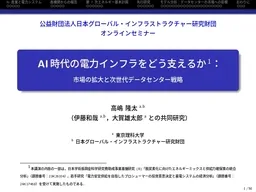
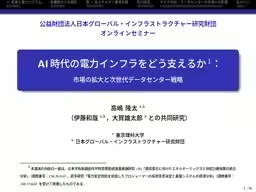
On July 31, 2025, the Japan Global Infrastructure Foundation (Japan GIF), located in Minato, Tokyo, hosted an online seminar titled "Supporting Power Infrastructure in the AI Era: Market Expansion and Next-Generation Data Center Strategies." The event featured Professor Ryuta Takashima, a prominent figure in the field, who provided insights into the rapidly evolving landscape of data centers driven by advancements in AI.
The Meaning Behind the Seminar
The emergence of generative AI has led to an unprecedented increase in demand for power and cooling at data centers worldwide. This rising demand is primarily due to the high-performance GPUs (Graphics Processing Units) required for real-time machine learning algorithms. These GPUs consume significant power and generate considerable heat, which raises concerns about peak loads on power grids. There are regions where the infrastructure for power transmission and cooling facilities cannot keep pace with this escalating demand, necessitating urgent discussion in forums such as this seminar.
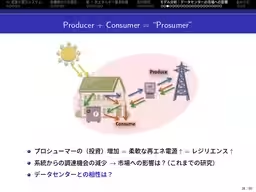
At the seminar, the anticipated AI computation requirements were contemplated, with a thorough assessment of the economic challenges that data center operators face. The discussion also highlighted the broader implications of surging demand on electrical systems and examined the pivotal role of "prosumers"—entities that produce and consume their own power—in this evolving landscape. As renewable energy implementation continues to develop, the influence of both prosumers and data center operators on society was scrutinized. The seminar proposed policy options aimed at simultaneously advancing digital transformation (DX) and green transformation (GX), offering actionable insights for building the necessary power infrastructure in an AI-driven society.
Key Presentation Highlights
1. The AI Industry and Power Systems
- - The AI industry is expanding rapidly, and the power consumption of a single GPU server, essential for generative AI processing, can equate to that of ten to several dozen average households. Consequently, data centers are evolving from mere server locations into "AI Factories" that perform intensive computations.
- - While AI technology aids in predicting electricity demand and optimizing the operation of renewable energy sources, it simultaneously raises concerns regarding increased electricity rates and CO2 emissions. Additionally, there are issues related to geographical concentration of data centers that raise security risks.
2. Reports from Various Institutions
- - It is essential to adopt a flexible power configuration that combines renewable energy, nuclear, and natural gas to effectively operate data centers. Moreover, policy incentives must be devised that factor in the demand fluctuations of data centers, regional disparities, and power source diversity, including peak shifting and off-grid operations.
3. Japan's 7th Energy Basic Plan
- - According to Japan's 7th Energy Basic Plan, power source configurations aim to achieve carbon neutrality by 2050. This includes a shift towards LNG, decarbonization of thermal power, and expanding reliance on renewable energy.
- - A new challenge has emerged: balancing the increase in electricity demand while achieving decarbonization.
4. Model Analysis: Impact of Data Centers on the Market
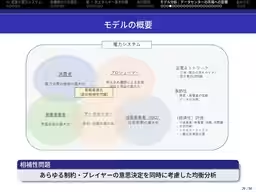
- - Analysis shows that increased demand from data centers will elevate electricity prices, which hinges on the growth of renewable energy adoption. The presence of prosumers further drives prices higher.
- - It was found that the values created by data centers, along with the existence of consumers and producers, can boost surpluses for both consumers and electricity generators.
- - The greater the value attributed to data centers, the more substantial investments will flow into renewable energy resources, thus decreasing carbon emissions.
- - This analysis posits that as data centers and prosumers evolve, they may increase the renewable energy ratio in future energy mixes without diminishing the inherent value of data centers themselves.
5. Conclusion
- - The strategies needed to support power infrastructure in the AI era can be broadly classified into two aspects: (i) decision support powered by AI, and (ii) the collaborative transformation between data centers and power systems. The former addresses the interplay between AI-driven decisions and the market dynamics, while the latter grapples with uncertainties arising from the relationship between revenue generation from data centers and operational costs stemming from electricity pricing.
- - Future developments will demand keen focus on the impact of data centers' market dominance and their interactions with energy storage systems.
During the Q&A session post-presentation, varied perspectives were shared regarding the definition of the AI market, suitable locations for data centers, the role of energy storage, and the implications of advancements in AI technology.
Post-seminar survey results indicated a high level of interest in segments such as "The AI Industry and Power Systems" and "The 7th Energy Basic Plan," alongside numerous questions and opinions, reflecting a keen public interest in the infrastructure needed for power consumption in the AI era.
Seminar Overview
Organizer: Japan Global Infrastructure Foundation (Japan GIF)
Date: July 31, 2025, from 14:00 to 15:30
Title: Online Seminar - "Supporting Power Infrastructure in the AI Era: Market Expansion and Next-Generation Data Center Strategies"
Format: Online via Zoom (webinar)
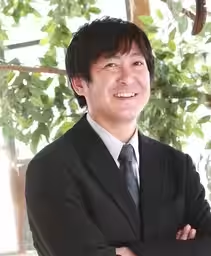
Speaker: Professor Ryuta Takashima (Tokyo University of Science, Japan GIF Executive Director)
Moderator: Akiko Sakamoto (Japan GIF Office Manager)
Participation Fee: Free
Video: Watch Here
Speaker Biography
Ryuta Takashima is a professor at the Tokyo University of Science, born in 1976 in Tokyo. He left the doctoral program at the University of Tokyo's Graduate School of Engineering midway, later serving as an assistant professor at the University of Tokyo, collaborating researcher at the Central Research Institute of Electric Power Industry, associate professor at Chiba Institute of Technology, and research participant at the Nuclear Safety Research Association, before assuming his current position. He holds a Ph.D. in engineering, specializing in energy economics, policy science, and health economics.
Contact for Inquiries: Japan Global Infrastructure Foundation (Japan GIF) Website Contact: Akiko Sakamoto, Office Manager Phone: 050-5601-8106 Email: [email protected]
Topics Policy & Public Interest)
【About Using Articles】
You can freely use the title and article content by linking to the page where the article is posted.
※ Images cannot be used.
【About Links】
Links are free to use.