



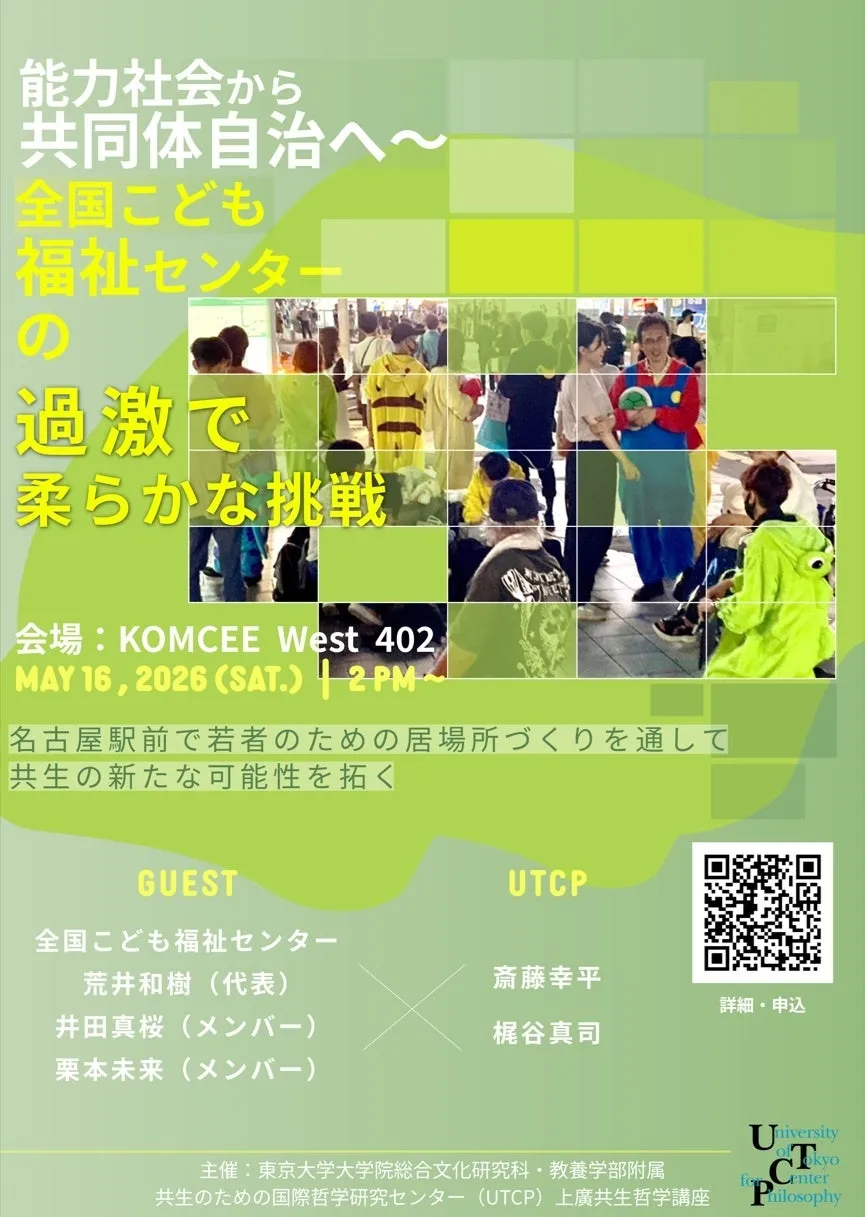
Exploring the Possibilities of Community Autonomy in Public Spaces in Nagoya
Exploring Community Autonomy in Public Spaces
In a world where competition and exclusion dominate, finding ways to create spaces where we can coexist is critical. The National Children's Welfare Center (NCCW) has been practicing youth outreach in Nagoya's public spaces for 15 years, emphasizing the potential for "community autonomy".
On May 16, 2026, the NCCW will participate in a commemorative event at the University of Tokyo, featuring Kazuki Arai, the center's director, who will present significant insights from his book, "From Meritocracy to Community Autonomy: Education and Welfare Practices Overcoming Competition and Exclusion". This book launch will facilitate discussions on how to foster relational spaces in an increasingly isolating society.
Event Background
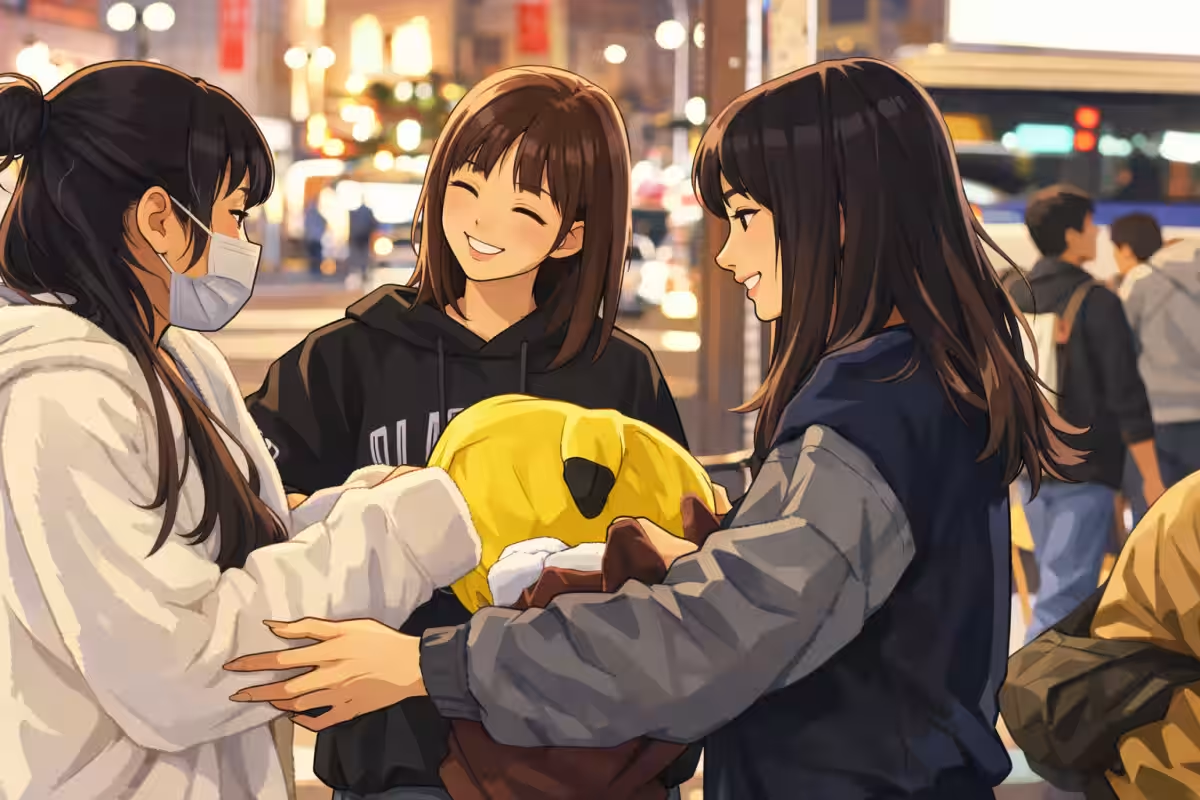
Recent years have seen rising social challenges concerning children and youth, such as isolation, poverty, school refusal, and mental health struggles. While systems and support services have been established, many individuals find it challenging to access them or feel resistant to being "helped". Instead of merely directing these individuals toward institutional support, the NCCW focuses on creating organic relationships through everyday interactions in public spaces.
Their approach involves welcoming children and youth not as mere subjects of support, but as peers who actively contribute to the community. Participants engage in planning, managing, and advertising activities, collaboratively creating spaces where they can find support from one another. This practice questions how to reclaim relational spaces in a society where people are often evaluated based on merit.
Dialogue Across Disciplines
During the event, noted thinkers like Kohei Saito and Shinji Kajitani will share their perspectives, bridging fields like social welfare, philosophy, and pedagogy as they engage in dialogues regarding coexistence beyond support dynamics. These discussions aim to cross the divides often created by institutional frameworks, advocating for a more inclusive and participatory approach.
A New Interpretation of Practices
By reframing their outreach practices through the lens of "meritocracy" and "community autonomy", the NCCW provides a fresh perspective on how we approach social interaction. It raises the question of how to meet people as human beings before categorizing them by abilities or outcomes. This call-to-action not only applies to the fields of welfare and education but also serves as a societal inquiry into how we can create environments that foster human connections.
The Book's Implications
"From Meritocracy to Community Autonomy" challenges the dominant narrative that positions children and youth solely as recipients of support. Instead, it advocates recognizing them as active community members capable of shaping their environments. By doing so, it offers vital insights into how educational and welfare systems can be reimagined to prioritize communal relationships over hierarchical assessments.
NCCW: A Model of Empowerment
Since its inception in 2012, the National Children's Welfare Center has established itself as a critical player in Nagoya, focusing on building collaborative spaces for children and youth who often feel isolated. Rather than classifying individuals by their needs, the NCCW opens its doors to all, regardless of age, gender, or background, thereby creating shared community experiences.
Through these grassroots activities, the center recently received recognition at the first "Children-First Award" from the Cabinet Office, highlighting its commitment to fostering inclusive practices that resonate within the community. The concept of community autonomy is not just theoretical; it is a lived experience that provides a blueprint for fostering deeper connections in society.
Conclusion
The upcoming event at the University of Tokyo represents more than a mere celebration of a book launch. It is an invitation to reconsider how we engage with one another in settings often overlooked by traditional support models. Kazuki Arai's reflections, juxtaposed with insights from prominent scholars, will surely inspire reimagining public spaces as places of connection rather than mere service delivery. This conversation is not only timely but crucial as we reflect on how we might build a more inclusive society where everyone can participate as equals.
For further information, you can visit the official website of the National Children's Welfare Center: National Children's Welfare Center.
Topics People & Culture)
【About Using Articles】
You can freely use the title and article content by linking to the page where the article is posted.
※ Images cannot be used.
【About Links】
Links are free to use.