



Understanding Loop Conversion Design in Clinical Organizational Science: A New Approach
The terms 'positive' and 'negative' here do not imply good or bad but signify whether the system's behavior is amplified or stabilized. COS argues for the necessity of structurally transforming the state where criticism and defensiveness amplify each other within organizations. Essentially, Loop Conversion Design offers methods to manage these feedback systems effectively.
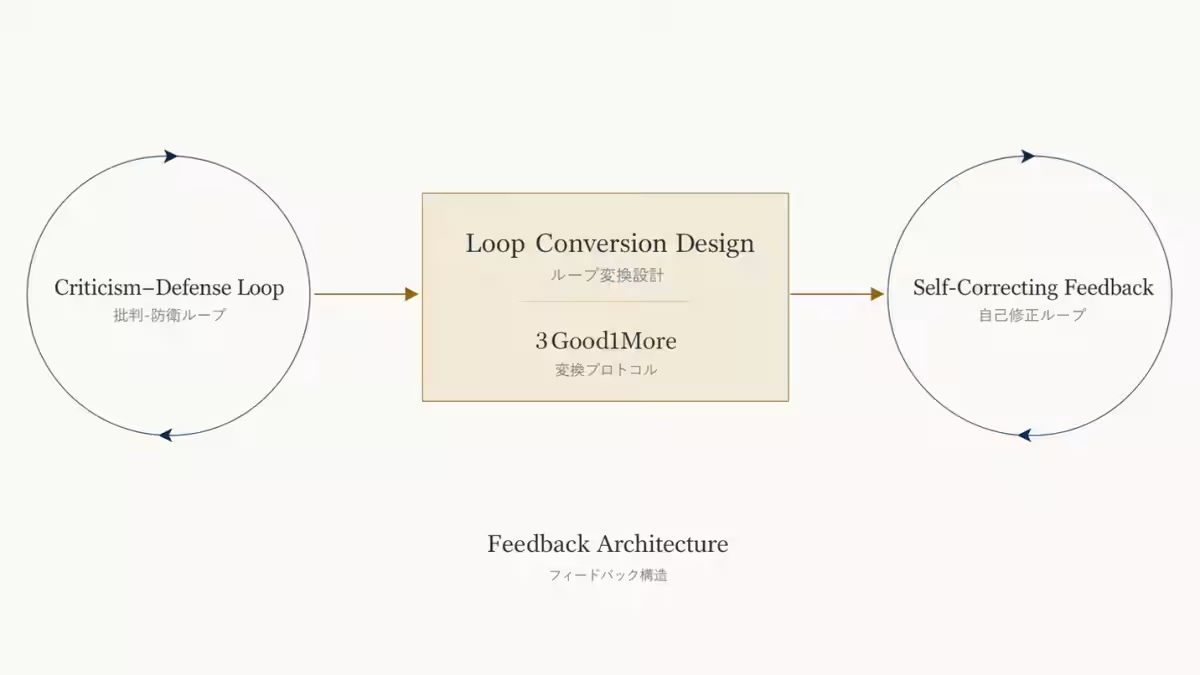
A notable implementation of Loop Conversion Design is the 3Good1More protocol. This method dictates that before providing one constructive piece of feedback (the 'More'), three specific positive observations (the 'Good') must be articulated. It is vital to clarify that this is not simply a technique to 'praise before pointing out issues'; instead, 3Good1More serves as a structural protocol designed to transform the self-amplifying criticism-defense loop into a self-correcting feedback structure.
The use of three positive observations is not an absolute ratio derived from first principles but a practical threshold based on experience. Just one observation could be perceived as superficial, while five or more could be cognitively overwhelming, hindering sustainable habits. Thus, the 3:1 ratio works as a practical initial benchmark, although COS emphasizes that this does not represent an inflexible criterion.
Appreciative Inquiry (AI) has a rich tradition in organizational development, focusing on leveraging strengths and successes to drive transformation. While both COS and AI acknowledge the power of positive observation, COS distinguishes itself by focusing on altering the structures of feedback loops rather than merely enhancing positive recognition.
The 3Good1More technique should not be viewed as a casual practice employees use at will. It must be embedded within organizational rhythms such as weekly reviews, one-on-ones, retrospectives, and team meetings to be effective. Relying merely on individual intent to communicate positively can lead to inconsistencies, especially in stressful circumstances. Therefore, COS positions the 3Good1More as a structural protocol defining the feedback cycles within organizations, independent of individual goodwill.
This paper presents a conceptual analysis proposing the Loop Conversion Design as an integrative framework for conducting structural interventions in organizations. It does not claim that COS techniques have been empirically proven effective as of yet. Rather, it synthesizes existing scientific insights to reconceptualize organizational change as an issue of structural interventions and introduces propositions that require future verification and falsification.
As proposed by Yamanaka, viewing feedback solely as a skill in communication can obscure what circulates within an organization. The 3Good1More protocol is designed to transform the self-amplifying structure of criticism and defensiveness into a self-corrective framework.
A subsequent communication will be released on May 14, providing insights into the neural base design within COS, focusing on habit formation, trust-building, and physical awareness. These elements serve as a foundational layer for the functioning of Field Gradient Theory and Loop Conversion Design.
DroR Inc. utilizes the principles of complex systems science and neuroscience to observe and design the hidden interaction structures within organizations. They aim to bridge research and practice by engaging continuously with organizations through expert BPO services, organizational development, well-being measures, and digital transformation support.
Core Protocol: 3Good1More
A notable implementation of Loop Conversion Design is the 3Good1More protocol. This method dictates that before providing one constructive piece of feedback (the 'More'), three specific positive observations (the 'Good') must be articulated. It is vital to clarify that this is not simply a technique to 'praise before pointing out issues'; instead, 3Good1More serves as a structural protocol designed to transform the self-amplifying criticism-defense loop into a self-correcting feedback structure.
The Choice of '3'
The use of three positive observations is not an absolute ratio derived from first principles but a practical threshold based on experience. Just one observation could be perceived as superficial, while five or more could be cognitively overwhelming, hindering sustainable habits. Thus, the 3:1 ratio works as a practical initial benchmark, although COS emphasizes that this does not represent an inflexible criterion.
The Relationship with Appreciative Inquiry
Appreciative Inquiry (AI) has a rich tradition in organizational development, focusing on leveraging strengths and successes to drive transformation. While both COS and AI acknowledge the power of positive observation, COS distinguishes itself by focusing on altering the structures of feedback loops rather than merely enhancing positive recognition.
Implementation as a Structural Protocol
The 3Good1More technique should not be viewed as a casual practice employees use at will. It must be embedded within organizational rhythms such as weekly reviews, one-on-ones, retrospectives, and team meetings to be effective. Relying merely on individual intent to communicate positively can lead to inconsistencies, especially in stressful circumstances. Therefore, COS positions the 3Good1More as a structural protocol defining the feedback cycles within organizations, independent of individual goodwill.
Positioning of the Research Paper
This paper presents a conceptual analysis proposing the Loop Conversion Design as an integrative framework for conducting structural interventions in organizations. It does not claim that COS techniques have been empirically proven effective as of yet. Rather, it synthesizes existing scientific insights to reconceptualize organizational change as an issue of structural interventions and introduces propositions that require future verification and falsification.
Comments from Makoto Yamanaka, CEO
As proposed by Yamanaka, viewing feedback solely as a skill in communication can obscure what circulates within an organization. The 3Good1More protocol is designed to transform the self-amplifying structure of criticism and defensiveness into a self-corrective framework.
Upcoming Releases
A subsequent communication will be released on May 14, providing insights into the neural base design within COS, focusing on habit formation, trust-building, and physical awareness. These elements serve as a foundational layer for the functioning of Field Gradient Theory and Loop Conversion Design.
About DroR Inc.
DroR Inc. utilizes the principles of complex systems science and neuroscience to observe and design the hidden interaction structures within organizations. They aim to bridge research and practice by engaging continuously with organizations through expert BPO services, organizational development, well-being measures, and digital transformation support.
Topics Business Technology)
【About Using Articles】
You can freely use the title and article content by linking to the page where the article is posted.
※ Images cannot be used.
【About Links】
Links are free to use.