



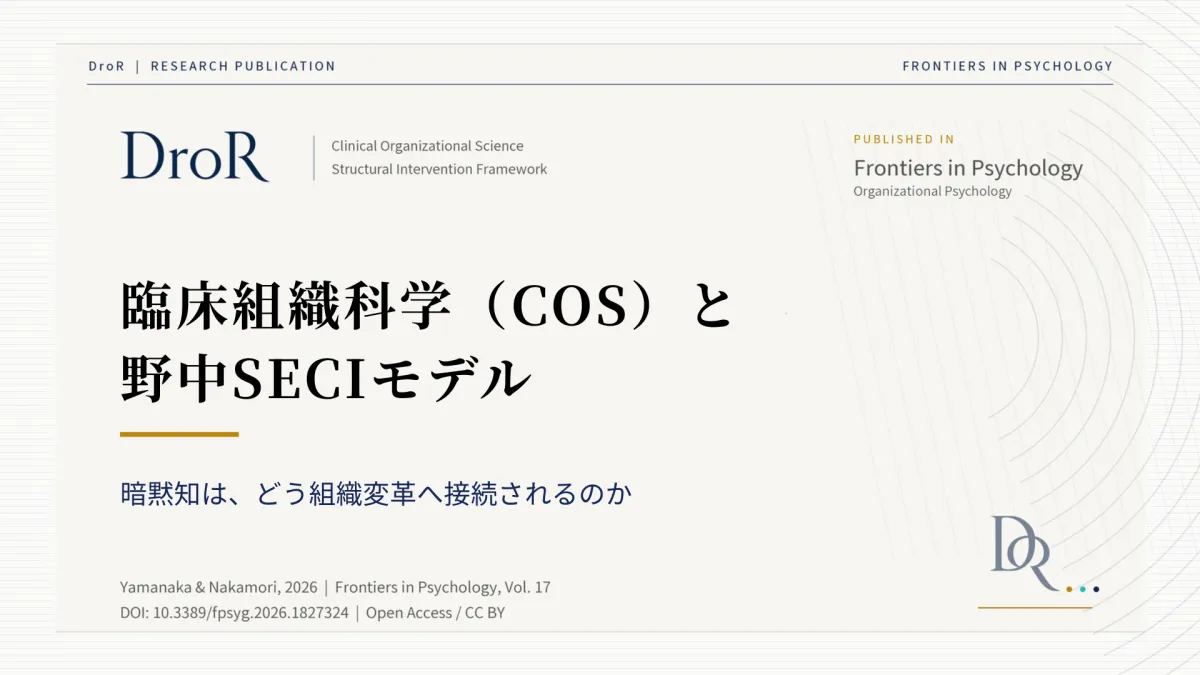
Exploring the Connection between Clinical Organizational Science and Nonaka's SECI Model for Organizational Transformation
Introduction
The interplay between tacit and explicit knowledge within organizations is a cornerstone for fostering effective transformation. Clinical Organizational Science (COS) provides a structured framework to observe and intervene in the hidden interaction structures of complex organizations, drawing significantly on Nonaka's SECI model. This article delves into the relationship between COS, as articulated by DroR, and Nonaka's influential model, underscoring the transformation of knowledge in organizational settings.
What is Clinical Organizational Science (COS)?
COS integrates concepts from complex systems science, neuroscience, organizational psychology, and behavioral science. It seeks to theorize the interaction structures that proactively reproduce stable states within organizations, framing transformation not merely as individual behavioral change, but as transitions between organizational attractors. Core techniques include Field Gradient Theory, Loop Conversion Design, and Neural Base Design. It introduces the concept of the "emergence bridge," connecting individual habits with organizational changes.
The SECI Model and Knowledge Creation
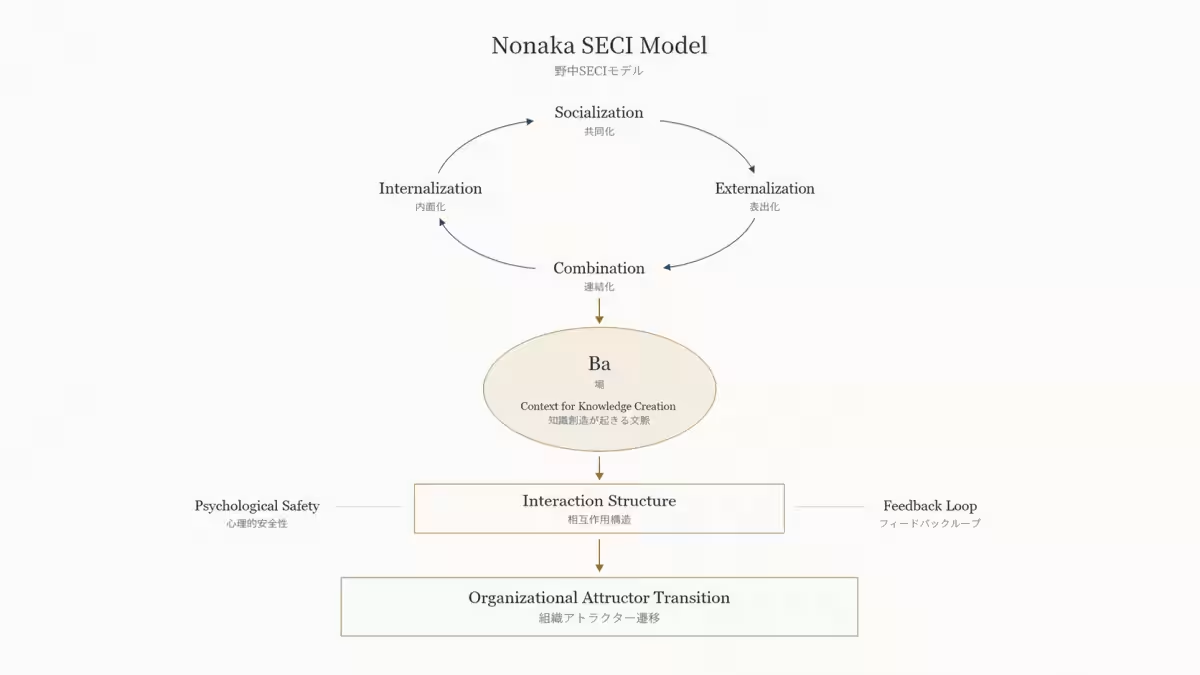
Nonaka's SECI model describes the cyclical process of knowledge creation through the conversion of tacit and explicit knowledge. The four stages—socialization, externalization, combination, and internalization—are widely recognized, particularly in Japan's organizational discourse. COS does not serve as a replacement for the SECI model; instead, it complements it by exploring the interaction structures, psychological safety, bodily awareness, feedback loops, and conditions for organizational attractor transitions that underlie knowledge creation.
Conditions for the Expression of Tacit Knowledge
For tacit knowledge to be expressed as explicit knowledge, members of an organization must share spaces conducive to vocalizing discomfort, bodily sensations, experiential insights, failures, and unstructured insights. COS emphasizes conditions such as psychological safety, bodily check-ins, sense-making practices, and reactions to negative information. The Somatic Awareness Axis technique helps address discomfort or tension before it’s articulated, treating it as a resource for collective sense-making.
The Importance of Space and Attractors
In Nonaka's theory, the concept of "space" is vital as a relational and contextual arena where knowledge creation occurs. In COS, this "space" encompasses meeting structures, norms of response, feedback loops, and organizational rhythms—conditions under which behaviors are produced. While not identical, they provide complementary insights. The SECI model explains how knowledge is created and transformed, while COS asks how to design the organizational attractors and interaction structures that enable this knowledge creation.
Mutual Reinforcement between SECI and COS
Both models provide unique insights:
- - Focus: SECI emphasizes the conversion between tacit and explicit knowledge, while COS centers on the design of the interaction structures and organizational attractors that facilitate this conversion.
- - Core Concepts: While SECI involves socialization, externalization, combination, and internalization, COS proposes Neural Base Design and the emergence bridge along with structural interventions.
- - Context: SECI discusses the context of knowledge creation, while COS interrogates the conditions under which action and dialogue emerge.
Implications for Japanese Corporations
In Japanese organizations, concepts such as tacit knowledge, experiential wisdom, and implicit nuances significantly dictate operations. COS endeavors to transform these tacit organizational patterns into observable constructs such as attractors, feedback loops, response norms, and bodily awareness. Understanding these dynamics can enhance decision-making processes at all organizational levels.
Insights from Makoto Yamanaka
According to DroR's CEO, Makoto Yamanaka, ambiguity plays a significant role in decision-making within Japanese workplaces. COS aims to scrutinize and design these interaction structures rather than overlook these elusive aspects. He believes that the questions raised by the SECI model regarding knowledge creation align closely with the structural intervention inquiries posed by COS.
The Conceptual Framework and Future Directions
This discourse acts as a conceptual analysis; the techniques within COS are not yet empirically validated. Instead, they serve as a theoretical framework designed to reconfigure existing scattered scientific knowledge and prompt new research implications for future validation. Hence, this series explores how COS interacts with existing theories without asserting itself as a replacement.
Upcoming Insights
Stay tuned for our upcoming feature on June 4th titled "Clinical Organizational Science and Senge's Learning Organization—How Learning is Integrated into Organizations." This will further clarify the distinctions and complementarities between learning organizations and COS.
About Frontiers in Psychology
The discussed paper, published in the Organizational Psychology section of the international journal Frontiers in Psychology, emphasizes the continuity of organizational research while enhancing the theoretical discourse in applied settings. It introduces crucial concepts related to structural interventions in organizations, aiming to bridge the gap between theory and practice.
About DroR
Founded in 2023, DroR specializes in observing and designing the unseen interaction structures within organizations, integrating complex systems science and neuroscience. Through an active involvement in organizations, DroR aims to foster a reciprocal relationship between research and practice. With a focus on Organizational Deep Tech, the firm addresses organizational needs holistically, including support for digital transformation and well-being initiatives.
Conclusion
The interface between Clinical Organizational Science and Nonaka's SECI model provides an expansive view for understanding knowledge flow in organizations. As more empirical validations and applications emerge, both frameworks have the potential to transform approaches toward organizational change and development.
Topics People & Culture)

【About Using Articles】
You can freely use the title and article content by linking to the page where the article is posted.
※ Images cannot be used.
【About Links】
Links are free to use.