



Exploring the Pros and Cons of Full In-Office Work for Professionals
The Dual Nature of Full In-Office Work
A recent survey conducted by LASSIC's Telework and Remote Work Research Institute, which aims to support non-location-dependent working styles, examined the advantages and disadvantages of full in-office work. The survey targeted 1,004 working professionals aged 20 to 65 from across Japan, uncovering significant insights into their experiences.
Advantages of Full In-Office Work
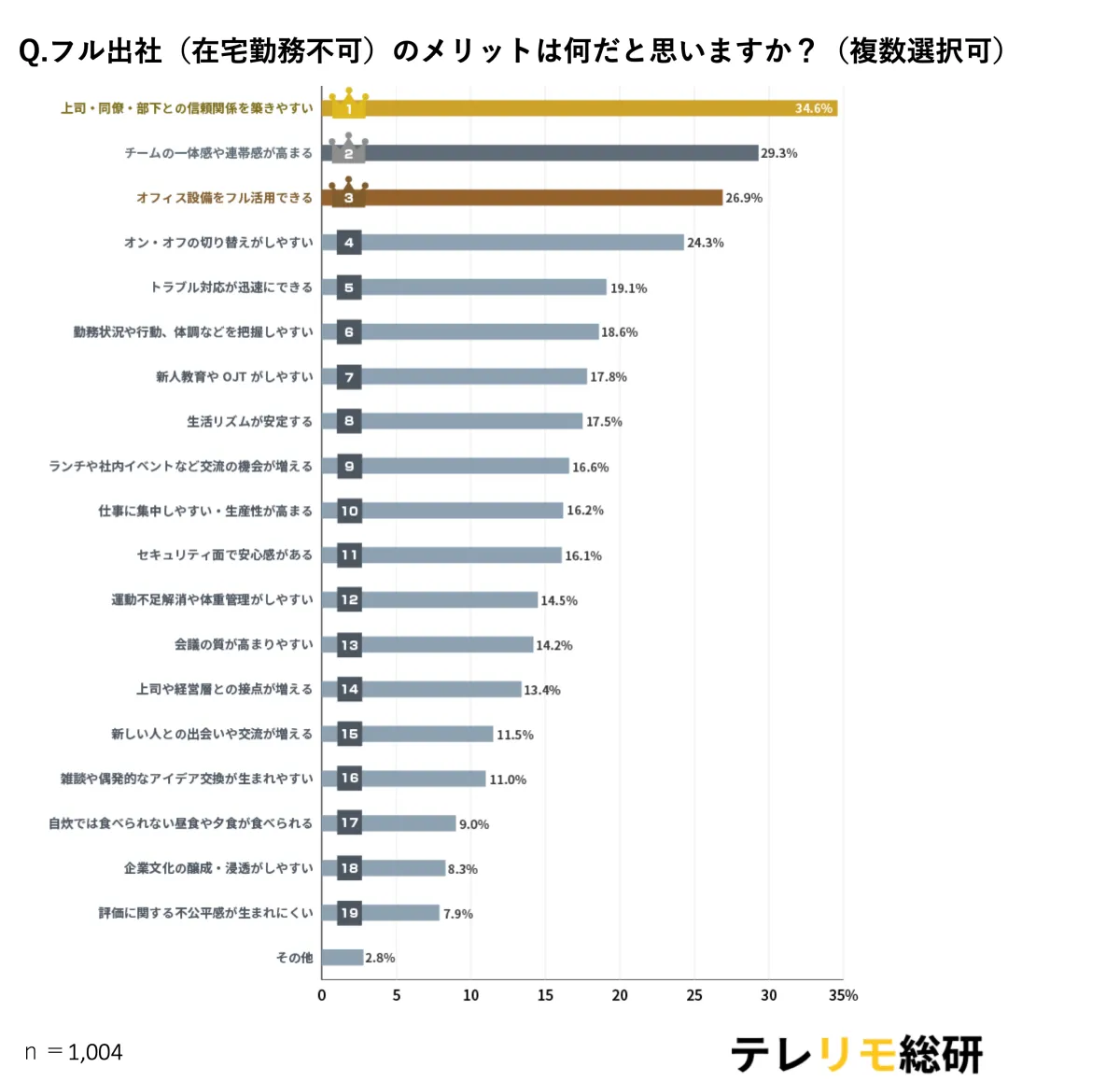
The survey revealed that the primary benefit of working in the office is the ease of establishing trust and building relationships, noted by 34.6% of respondents. This was followed closely by increased team cohesion and unity (29.3%), the ability to fully utilize office equipment (26.9%), and the manageability of switching between work and personal life (24.3%).
The emphasis on human interactions and work environments suggests that fostering relationships and quickly addressing issues are highly valued in the workplace. Notably, the perception of increased focus and productivity while at work ranked lower at 16.2%, indicating that many employees do not view their productivity as significantly enhanced by being present in the office.
Additionally, casual conversations and spontaneous idea exchanges—considered benefits that arise from in-person interaction—were only reflected in about 10% of responses, highlighting a potential area for growth in fostering creativity and innovation in traditional work settings.
Disadvantages of Full In-Office Work
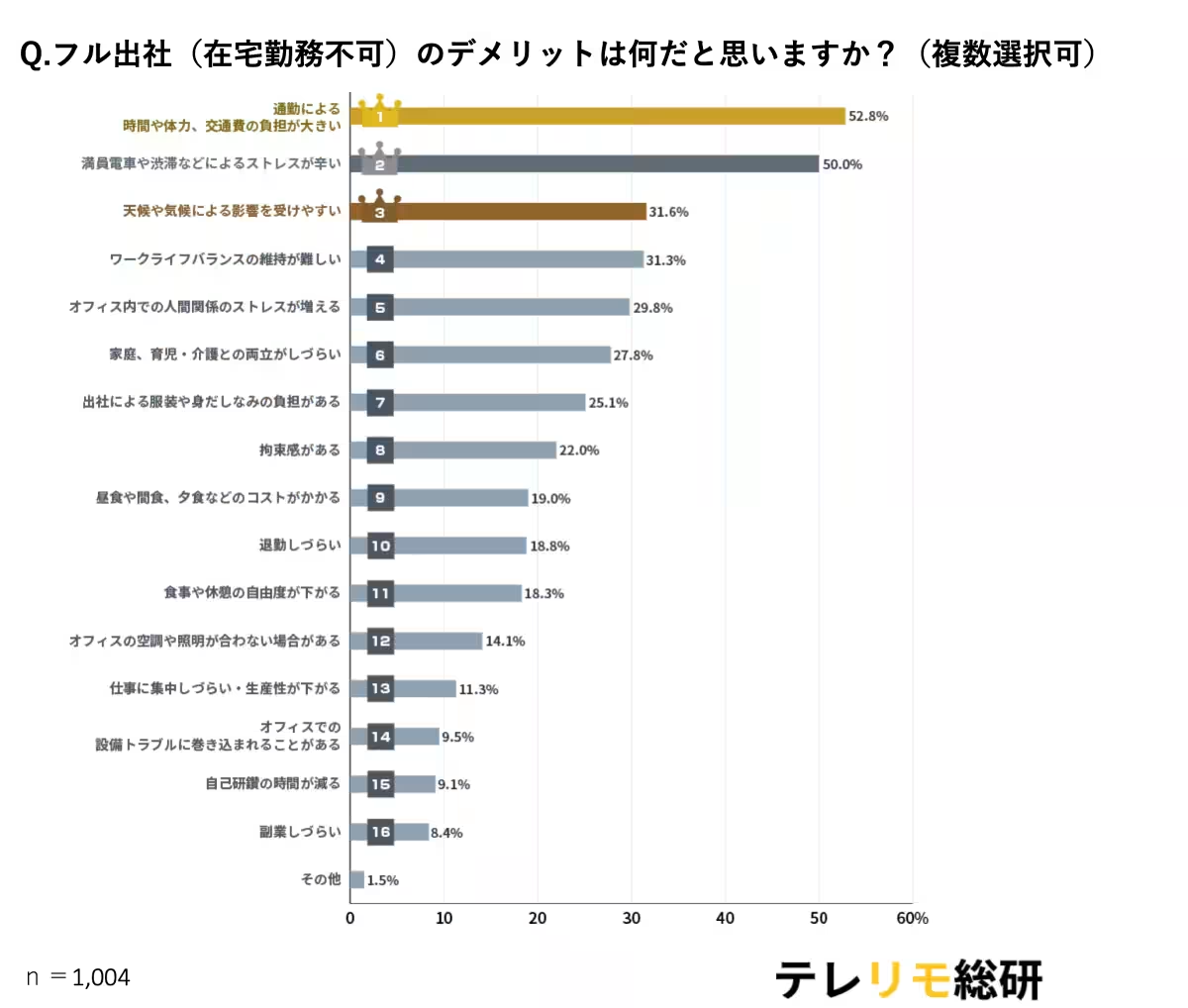
On the flip side, significant drawbacks were identified as well. The most pressing issues were related to commuting, with over half of the respondents (52.8%) citing the time, energy, and cost burdens associated with travel, while 50% indicated stress due to crowded trains and traffic. This paints a clear picture that for many, the biggest challenges of full office attendance lie in the commute rather than the actual work itself.
Following closely were concerns regarding weather impacts (31.6%), difficulties in maintaining work-life balance (31.3%), and stress from interpersonal relationships in the office (29.8%). These concerns underline the multifaceted pressures that employees face in their daily lives, transcending beyond mere tasks to emotional and lifestyle implications.
Interestingly, only 11.3% reported that working in the office made concentration difficult or decreased productivity, suggesting that the challenges stem more from external factors than from the work environment itself.
Four Themes of Full In-Office Work
Theme 1: Interpersonal Relationships and Team Dynamics
The ability to foster trust easily was a distinct advantage of full in-office work. However, it is essential to recognize that increased physical proximity can also lead to heightened interpersonal stress within the workplace. Management of this stress will likely require improvements in the quality of communication alongside physical closeness.
Theme 2: Productivity and Focus
While only 16.2% of individuals felt they were more productive when at the office, a notable number also experienced distractions stemming from personal life and environmental noise. Hence, there is a pivotal need for organizations to consider both the physical setting and the nature of interactions taking place in the office environment to genuinely foster productivity.
Theme 3: Environment, Equipment, and Security
The benefits of having access to reliable office equipment and robust security protocols stemmed from the sense of safety and efficiency associated with in-person work, as indicated by 26.9% of respondents. However, dissatisfaction with rigid office environments—manifesting through issues like unsuitable climate control—revealed that not all employees find the office to be a comfortable or conducive workspace.
Theme 4: Time, Energy, Cost, and Life Balance
While benefits like easier transitions between work and personal life (24.3%) were recognized, challenges related to commuting burdens and costs prevailed as critical issues for employees managing their lifestyles and obligations outside of work.
Conclusions from the Survey
The survey results illustrate the dual nature of full in-office work—it boasts distinct advantages regarding interpersonal relationships and work environments but poses significant lifestyle challenges, especially related to commuting and personal balance. Moving forward, both companies and employees will need to consider the complexities and implications of their working styles to establish more adaptable working arrangements.
LASSIC's Telework and Remote Work Research Institute plans to continue conducting relevant surveys to further explore these themes, fostering a more profound understanding of contemporary working conditions.
For more insights on the survey results, visit Telework and Remote Work Research Institute's website.
- ---
Survey Overview
- - Method: Online survey
- - Participants: 1,004 professionals aged 20-65 with remote work experience
- - Period: August 26-29, 2025



Topics People & Culture)


【About Using Articles】
You can freely use the title and article content by linking to the page where the article is posted.
※ Images cannot be used.
【About Links】
Links are free to use.