



Exploring the Solar System's Journey with Solar Twin Stars: A Galactic Mystery Unveiled
Exploring the Solar System’s Journey with Solar Twin Stars
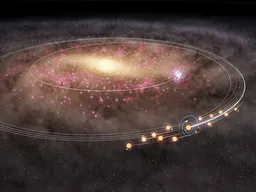
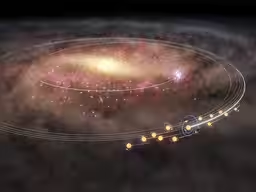
A recent research study unveils crucial insights into the vast journey of our solar system through the galaxy, a movement that spans over 10,000 light-years. For a long time, the precise mechanisms and timelines behind this migration remained shrouded in mystery. However, a fascinating revelation suggests that the solar system may have undertaken this journey shortly after its birth, thanks to newfound data from the Gaia satellite.
How the Research Unfolded
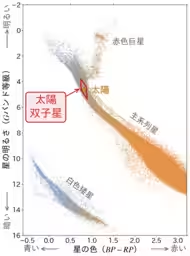
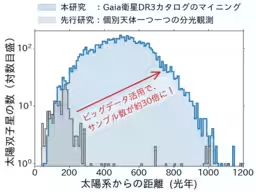
The research team, led by Assistant Professors Daisuke Taniguchi from Tokyo Metropolitan University and Takuji Tsujimoto from the National Astronomical Observatory, created the largest and most reliable catalog of solar twin stars—over 6,594 stars that share striking similarities with our sun. This catalog, derived from comprehensive data mining of the GSP-Spec samples released by the Gaia satellite, is approximately 30 times larger than previous catalogs.
Discovering these solar twins—stars that share close atmospheric parameters to our sun such as temperature and metallicity—provides compelling clues about the solar system's past. By statistically compensating for observational biases, the research identified a significant number of solar twins formed around the same timeline as our sun, around 4.6 billion years ago. This finding suggests that many stars of that era exist in close proximity to the solar system, which imposes strong constraints on the history of its movement.
Analyzing the Galactic Bar
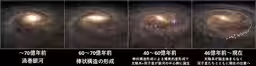
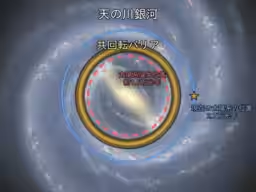
According to the researchers, the formation of the Milky Way's central bar structure might have prompted a large-scale migration of the solar system and its solar twins shortly after their formation. The proposed model suggests that this rapid migration allowed the solar system to escape the adverse high-energy phenomena prevalent in the galaxy's central regions, thus increasing the chances of developing a viable planetary ecosystem.
The Significance of the Findings
Currently located approximately 27,000 light-years from the Milky Way's center, the solar system has undergone a radial migration estimated to exceed 10,000 light-years. This raises intriguing questions: Was this migration a product of chance, or did some inevitable cosmic forces guide our journey to this particular position?
The study tackles these questions by highlighting the role solar twin stars play in shedding light on the solar system's trajectory. The statistical analysis revealed a distinct peak at around 2 billion years and a broad bump around 4 to 6 billion years—the latter closely matching the solar age. This suggests many solar twins were formed concurrently, offering a context to solve the mystery of our solar system's journey.
Implications for Future Discoveries
The implications of this research extend far beyond simple historical verification. By focusing on solar twins within this new catalog, scientists aim to identify potential 'true twins'—stars born at the same time and place as our sun. Such discoveries could unravel the origination points of migration and the potential paths our solar system navigated.
If the solar system migrated to the outer, safer regions of the galaxy shortly after its formation, it bolsters the notion that the conditions here were not coincidental but instead fostered an environment conducive to life. Moreover, the possibility exists that among the solar twins that traveled alongside the solar system, some may host planets with conditions ripe for life, akin to Earth.
In conclusion, this groundbreaking research not only builds the largest solar twin catalog but also provides a roadmap for understanding our solar system's journey through the galaxy. With future observations, scientists look to either confirm or redefine our understanding of the cosmic forces that shaped our home and the stellar companions that reside nearby, potentially revealing a network of solar systems that share a common origin.
Keywords Defined
- - Solar Twins: Stars with atmospheric parameters that closely resemble those of the sun.
- - Gaia Satellite: A space observatory launched by the European Space Agency to create a precise 3D map of our galaxy.
- - Galactic Bar: A structure within the Milky Way that affects stellar movements in the galaxy's core.
The findings signify the importance of collaboration across scientific fields in unraveling the mysteries of our universe, transforming our understanding of where we come from and where we are headed.

Topics Other)
【About Using Articles】
You can freely use the title and article content by linking to the page where the article is posted.
※ Images cannot be used.
【About Links】
Links are free to use.