




Understanding the Role of Microtubules in Oocyte Development and Communication
Unraveling Oocyte Maturation: The Role of Microtubules
Recent research has shed light on the intricate communication mechanisms between oocytes and surrounding granulosa cells, focusing on the discovery of microtubules in the cellular structures connecting them. This pivotal study, conducted by a collaborative team from Waseda University and Kyoto University, marks a significant advancement in our understanding of female reproductive biology, particularly regarding infertility issues stemming from defective oocyte maturation.
Key Findings
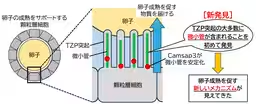
Through innovative super-resolution microscopy, researchers found that microtubules, previously thought to be less significant, are abundantly present in the transzonal projections (TZPs) — protruding structures from granulosa cells that connect with oocytes. The protein Camsap3 has been identified as essential for the formation of these TZPs. Mice lacking Camsap3 exhibited impaired oocyte maturation, ovulation issues, and infertility, highlighting the critical role of this protein in reproductive health.
The Importance of Camsap3
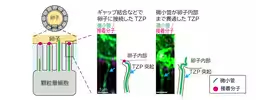
Camsap3 stabilizes microtubules, crucial for the development and functionality of TZPs. Investigations revealed that in Camsap3 knockout mice, about 60% of TZPs connecting to oocytes were absent compared to wild-type mice. This underscored the necessity of microtubules in the TZP architecture and function, contradicting previous beliefs that these structures primarily consisted of actin filaments.
When scrutinizing TZPs using advanced microscopy, about 80% were found to contain microtubules, suggesting a central role in oocyte maturation. This study not only redefines our understanding of TZP composition but also emphasizes the sophisticated cellular communication involved in oocyte development.
Insights into Oocyte Maturation
The maturation of oocytes is a highly regulated process requiring the precise exchange of molecules between granulosa cells and oocytes. Granulosa cells fulfill this by delivering essential substances through TZPs, which penetrate the zona pellucida, the protective layer surrounding the oocyte. Previously, it was believed that actin primarily facilitated this transport, but the revelation of microtubules' involvement introduces a new layer of complexity to the communication paradigm.
The research also elucidated that during oocyte maturation, the morphology of TZPs changes; they evolve from simple linear arrangements to more branched and complex forms. Camsap3 plays a key role in regulating this transformation, affecting the spatial orientation and stability of microtubules within TZPs, crucial for effective molecular transport.
The Path Forward
This groundbreaking discovery raises important implications for reproductive medicine. Given that defects in oocyte maturation are a leading cause of infertility, understanding the molecular mechanisms of TZPs could pave the way for novel therapeutic strategies. The research suggests potential avenues for clinical applications, such as artificially enhancing oocyte maturation and addressing issues related to infertility.
Looking ahead, the primary challenge remains identifying the specific molecules transported through TZPs, as this knowledge could facilitate the development of new treatments for infertility by enabling targeted interventions to support oocyte maturation.
Conclusion
In conclusion, the collaborative research led by Waseda University and Kyoto University represents a crucial step in unpacking the complexities of oocyte maturation and communication mechanisms within ovarian follicles. As insights continue to deepen, the potential for innovative reproductive therapies to emerge grows, fostering hope for those facing challenges with infertility. This study sets a foundation for further exploration into the dynamic interactions between oocytes and their surrounding cells, positioning us closer to breakthroughs in reproductive health.
References
- - iScience, Volume 26, Published April 28, 2026
- - DOI: 10.1016/j.isci.2026.115911


Topics Health)
【About Using Articles】
You can freely use the title and article content by linking to the page where the article is posted.
※ Images cannot be used.
【About Links】
Links are free to use.