




KIBOW Welcomes New Board Members to Strengthen Impact Investment Initiatives
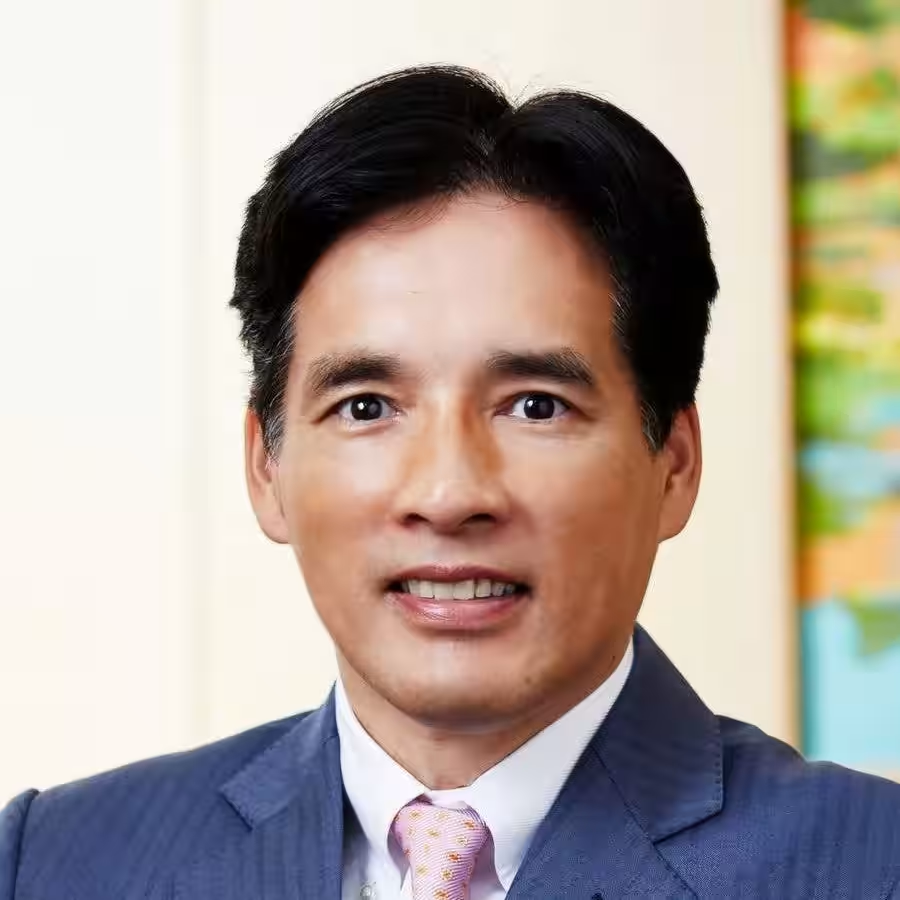
KIBOW, a public interest incorporated foundation based in Chiyoda, Tokyo, is thrilled to announce the addition of four new board members starting October 2025. These esteemed leaders include Kana Kawaguchi, Chair of the certified NPO Homedoor; Tomoko Shirai, CEO of a children's policy think tank; Kumi Fujisawa, Chair of the International Institute for Social Economics; and Allen Miner, the Chairman and Group CEO of Sunbridge.
Both Fujisawa and Miner have been actively involved in KIBOW’s Social Investment Advisory Board and now officially join as directors, bringing invaluable insights and expertise to the organization. Meanwhile, Kawaguchi and Shirai have been deeply engaged in addressing social challenges and have effectively driven policies and structures for transformation. Kawaguchi has been a strong advocate for the homeless, balancing direct support with sustainable business models, while Shirai has dedicated herself to supporting children in challenging environments through systemic reform and policy implementation.
The inclusion of Kawaguchi and Shirai in the KIBOW Board aims to closely tie practical implementation with social reform, creating a structure that promotes social change through their perspectives and experiences.
KIBOW plans to capitalize on these new board members' insights to establish a best-practice fund for social impact investment originating from Japan, promising to continue its challenges in the realm of social innovation.
Comments from Tomoko Shirai:
Shirai expressed her excitement in her new role: "Upon joining the board, I was astonished to discover that all the startups I had been following were KIBOW’s investment targets. It reaffirmed the effectiveness of KIBOW’s hands-on support. Every initiative is aimed at critically addressing social issues in Japan. I aim to contribute, albeit modestly, to ensure that necessary services reach those in need."
Professional Background:
Tomoko Shirai graduated from the University of Tokyo's Faculty of Law and enrolled in the Matsushita Institute of Government and Management before establishing a free school in Okinawa and later, the 'Smile Factory.' She founded the NPO Toybox, and has been actively engaged in various educational reforms and advocacy for children’s policies. Shirai has also served as a government advisory committee member and commentator on TBS’s program "Hiruobi."
Comments from Kana Kawaguchi:
"Since I embarked on addressing homelessness at the age of 19, I have had tremendous support from many individuals. I've learned the vital importance of having a framework that continues to sustain challenging endeavors, even when immediate results seem elusive. I resonate deeply with KIBOW's mission and look forward to leveraging my experience to help build a society where everyone can have hope."
Professional Background:
Kana Kawaguchi encountered homelessness at 14 and initiated outreach efforts by organizing food distributions. She founded Homedoor at 19, launched a bike-sharing initiative, and managed shelters that have provided employment and living support to over 7,000 individuals. Her remarkable contributions have garnered several prestigious awards, including the Google Impact Challenge Grand Prize and the Prime Minister's Award. Kawaguchi is a graduate of Osaka Public University.
Yoshihito Hori, KIBOW’s Representative Director, commented:
"I’m thrilled to have Tomoko Shirai and Kana Kawaguchi join us as board members. Their insights from previous platforms like G1 have greatly enriched discussions on social challenges and solutions. I am also appreciative of Allen Miner and Kumi Fujisawa for their contributions to our advisory board and confident that together with existing board members Kohei Terada and Daigo Sato, we will advance KIBOW's mission further."
About KIBOW:
Founded just days after the Great East Japan Earthquake, KIBOW began as a support project named from 'Hope' and 'Rainbow', aimed at long-term recovery. Since its official incorporation in February 2012, KIBOW has evolved to support social entrepreneurs across Japan who aspire to drive societal change, focusing predominantly on social impact investing.
KIBOW’s key activities include providing a platform for events that foster community recovery and gathering over 1 billion yen in donations to support grassroots initiatives across affected areas. The KIBOW Social Investment Fund, established in September 2015, has supported 22 startups to date, with the ongoing KIBOW III Fund managing a total of 1 billion yen to tackle undefined social issues.
Further Reading:
More insights into KIBOW's impact can be found in their 2024 Impact Report: IMPACT REPORT 2024.



Both Fujisawa and Miner have been actively involved in KIBOW’s Social Investment Advisory Board and now officially join as directors, bringing invaluable insights and expertise to the organization. Meanwhile, Kawaguchi and Shirai have been deeply engaged in addressing social challenges and have effectively driven policies and structures for transformation. Kawaguchi has been a strong advocate for the homeless, balancing direct support with sustainable business models, while Shirai has dedicated herself to supporting children in challenging environments through systemic reform and policy implementation.
The inclusion of Kawaguchi and Shirai in the KIBOW Board aims to closely tie practical implementation with social reform, creating a structure that promotes social change through their perspectives and experiences.
KIBOW plans to capitalize on these new board members' insights to establish a best-practice fund for social impact investment originating from Japan, promising to continue its challenges in the realm of social innovation.
Comments from Tomoko Shirai:
Shirai expressed her excitement in her new role: "Upon joining the board, I was astonished to discover that all the startups I had been following were KIBOW’s investment targets. It reaffirmed the effectiveness of KIBOW’s hands-on support. Every initiative is aimed at critically addressing social issues in Japan. I aim to contribute, albeit modestly, to ensure that necessary services reach those in need."
Professional Background:
Tomoko Shirai graduated from the University of Tokyo's Faculty of Law and enrolled in the Matsushita Institute of Government and Management before establishing a free school in Okinawa and later, the 'Smile Factory.' She founded the NPO Toybox, and has been actively engaged in various educational reforms and advocacy for children’s policies. Shirai has also served as a government advisory committee member and commentator on TBS’s program "Hiruobi."
Comments from Kana Kawaguchi:
"Since I embarked on addressing homelessness at the age of 19, I have had tremendous support from many individuals. I've learned the vital importance of having a framework that continues to sustain challenging endeavors, even when immediate results seem elusive. I resonate deeply with KIBOW's mission and look forward to leveraging my experience to help build a society where everyone can have hope."
Professional Background:
Kana Kawaguchi encountered homelessness at 14 and initiated outreach efforts by organizing food distributions. She founded Homedoor at 19, launched a bike-sharing initiative, and managed shelters that have provided employment and living support to over 7,000 individuals. Her remarkable contributions have garnered several prestigious awards, including the Google Impact Challenge Grand Prize and the Prime Minister's Award. Kawaguchi is a graduate of Osaka Public University.
Yoshihito Hori, KIBOW’s Representative Director, commented:
"I’m thrilled to have Tomoko Shirai and Kana Kawaguchi join us as board members. Their insights from previous platforms like G1 have greatly enriched discussions on social challenges and solutions. I am also appreciative of Allen Miner and Kumi Fujisawa for their contributions to our advisory board and confident that together with existing board members Kohei Terada and Daigo Sato, we will advance KIBOW's mission further."
About KIBOW:
Founded just days after the Great East Japan Earthquake, KIBOW began as a support project named from 'Hope' and 'Rainbow', aimed at long-term recovery. Since its official incorporation in February 2012, KIBOW has evolved to support social entrepreneurs across Japan who aspire to drive societal change, focusing predominantly on social impact investing.
KIBOW’s key activities include providing a platform for events that foster community recovery and gathering over 1 billion yen in donations to support grassroots initiatives across affected areas. The KIBOW Social Investment Fund, established in September 2015, has supported 22 startups to date, with the ongoing KIBOW III Fund managing a total of 1 billion yen to tackle undefined social issues.
Further Reading:
More insights into KIBOW's impact can be found in their 2024 Impact Report: IMPACT REPORT 2024.
Topics People & Culture)


【About Using Articles】
You can freely use the title and article content by linking to the page where the article is posted.
※ Images cannot be used.
【About Links】
Links are free to use.