


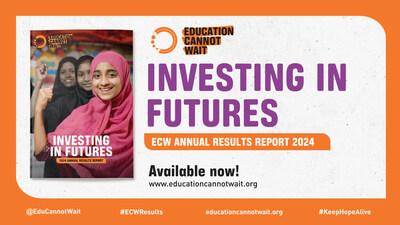

Investing in the Future: Education Cannot Wait Supports 14 Million Crisis-Affected Children Worldwide
Investing in the Future: Education Cannot Wait's Impact
Education Cannot Wait (ECW), the global fund dedicated to education in emergencies and prolonged crises, recently released its annual report titled "Investing in the Future". This report reveals that ECW has already supported 14 million children in crisis situations since its inception, with 8.3 million of those receiving assistance in 33 countries during the first half of its Strategic Plan 2023-2026. These efforts highlight the importance of inclusive and quality education for children and adolescents impacted by conflict and disaster.
The report emphasizes the pressing need for urgent funding to build upon the progress made in these critical areas. Despite favorable advancements, education remains one of the most underfunded sectors in humanitarian responses. In 2024, a mere 30% of the total education funding requirements were met due to insufficient resources, though education accounted for only 5.4% of all humanitarian appeal requirements.
A key highlight from the report is ECW's focus on equity and inclusion, with 51% of beneficiaries being girls and 43% being children who are refugees or internally displaced. These figures represent a significant effort to ensure that the most vulnerable populations receive the education support they desperately need. There have also been tangible improvements in enrollment rates, student retention, and the development of essential academic and socio-emotional skills among those affected by crisis. Notably, positive shifts in gender norms have further improved access to education and participation for girls.
Sigrid Kaag, Chair of the High Level Steering Committee for Education Cannot Wait, remarked, "These gains reflect the unique strength of our strategic model and the unwavering commitment of our global coalition of partners. It is not just coordination; it is a shared commitment that translates into collective action."
The report details the collaborative efforts of over 100 partners involved in providing education in some of the world's most complex crises. These partners include host governments, UN agencies, local and international civil society organizations, philanthropic foundations, and private sector leaders who united in 2024 to facilitate educational opportunities to children impacted by unforeseen events.
At the systemic level, ECW's rapid response model and multi-year programming continue to enhance coordination and partnerships across the humanitarian-development-peace nexus, providing increased support and ownership to local partners. In 2024, 39% of ECW’s disbursements amounting to $202 million were allocated to countries classified as "forgotten crises" including Bangladesh, Burkina Faso, Cameroon, the Democratic Republic of the Congo, Haiti, Lebanon, Mali, Myanmar, Nigeria, and South Sudan. This emphasizes the fund's commitment to assist children in the most neglected and underfunded emergency situations.
Moreover, the report highlights ECW's focus on the intersection of climate crisis and education. In 2023-2024, 41% of the children supported, totaling 3.4 million boys and girls, benefited from programs promoting climate change adaptation.
In stark contrast to these achievements, the report signals a growing funding shortfall. As of the end of 2024, ECW had mobilized $934 million towards its Strategic Plan 2023-2026—approximately two-thirds of its target. However, $113 million in promised contributions remain unpaid. Meanwhile, escalating conflicts, forced displacement, and climate disasters escalate unprecedented humanitarian needs. Education systems in crisis-affected contexts are nearing a breaking point, with 234 million children and adolescents requiring urgent educational support—an 18% increase from three years ago.
Despite being one of the most underfunded sectors in humanitarian interventions, Education Cannot Wait advocates that education is the best, if not the only hope for children enduring grave crises. Kaag urged, "To continue our work and protect the vital outcomes achieved, we call upon our partners from the public and private sectors to renew their financial contributions. We also look forward to expanding our commitments through innovative new partnerships."
To achieve its resource mobilization goal of $1.5 billion by the end of 2026, Education Cannot Wait needs additional contributions amounting to $567 million. With this support, ECW and its partners can offer quality education to 20 million of the children who need it most. Without decisive action, millions risk being left behind—not due to a lack of solutions but because of chronic under-investment.
Key Outcomes
- - 14 million children have been supported since ECW's inception, with 8.3 million in 33 countries within the first two years of the Strategic Plan 2023-2024.
- - 51% of beneficiaries are girls and over 40% are forcibly displaced, marking the highest proportion since ECW's beginning.
- - 96% of programs reported increased participation in education, with 74% demonstrating equitable gender improvements in 2023-2024.
- - Among multi-year programs offering evidence, 88% reported improved literacy or numeracy outcomes, and 78% indicated gains in socio-emotional learning in 2023-2024.
- - More than 155,000 children with disabilities benefited from the program in 2023-2024.
- - 6% of beneficiaries were of preschool age, while 20% were of secondary school age in 2023-2024, with notable advancements in girls' secondary education.
- - In the programs approved in 2024, nearly a third (29%) of funding is allocated or planned to be transferred to local and national actors.
- - 41% of children supported in 2023-2024—3.4 million boys and girls—benefited from programs focusing on climate change adaptation.
Access the full report and the summary to learn more about these pivotal outcomes.
Download the report and access high-resolution photos and noteworthy testimonials here.
Topics Policy & Public Interest)
【About Using Articles】
You can freely use the title and article content by linking to the page where the article is posted.
※ Images cannot be used.
【About Links】
Links are free to use.