



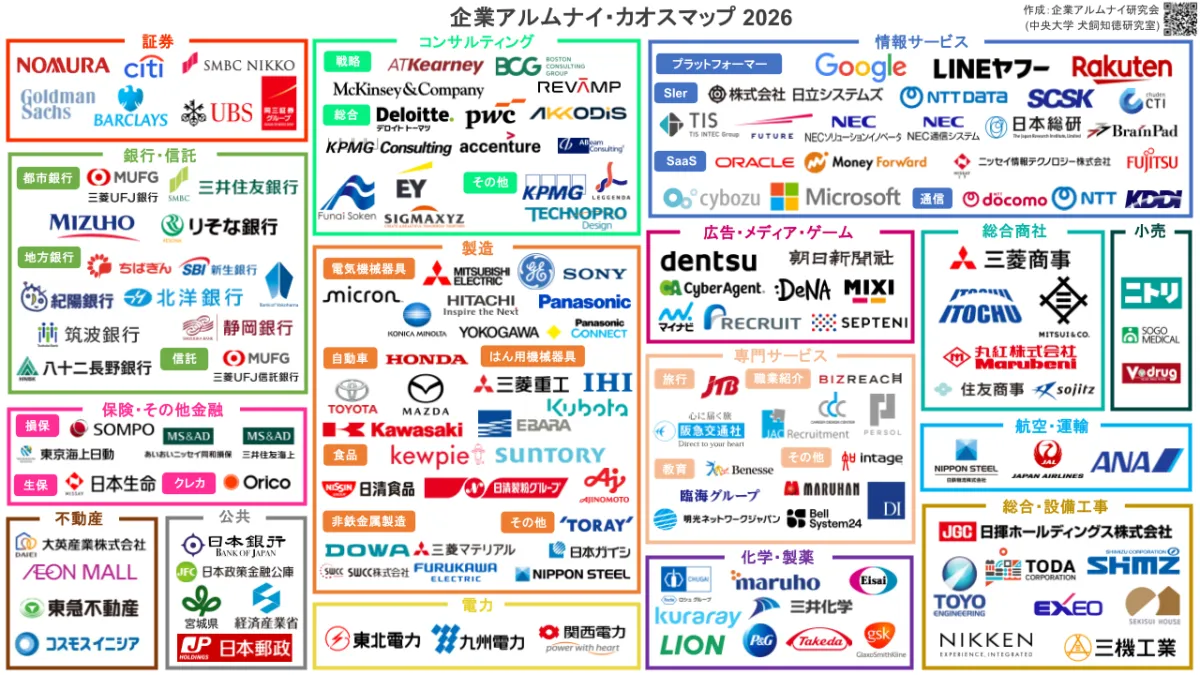
Japan's First Comprehensive Corporate Alumni Chaos Map Unveiled
In a move set to reshape the landscape of alumni networks across the nation, the Corporate Alumni Research Group, led by Professor Tomonori Inukai from Chuo University’s business school, has introduced the first-ever comprehensive 'Corporate Alumni Chaos Map' in Japan. This map surveys the alumni of 156 major companies, uncovering a scalable approach to maintaining connections between former employees and their previous organizations.
In recent years, the phenomenon of 'corporate alumni'—where businesses cultivate relationships with former staff—has surged in reaction to workforce shortages and a more fluid labor market. This initiative aims to facilitate rehiring and foster business collaborations. Notably, the 'alumni economy,' defined by transactions between former employees and their companies, has been valued at a staggering ¥1.15 trillion annually as of 2020 (Persol Research Institute).
The new map originates from the group’s desire to visualize the current scope of corporate alumni in Japan, which until now has been informally observed through media articles focusing on individual cases and vendors’ trading records. In response, the map serves as a foundational tool for future research into this rapidly expanding domain.
As the Corporate Alumni Research Group delved into their analysis, they released key statistics from their findings. The market size for alumni recruitment support services is predicted to grow from ¥5.07 billion in fiscal 2024 to approximately ¥30 billion by fiscal 2028 (Yano Economic Research Institute).
One significant trend revealed in the chaos map is the penetration of alumni networks into traditionally conservative industries. While many organizations have historically viewed retirement as a definitive separation from employment, a growing number of sectors—including major players like Toyota and NTT Group—are establishing alumni networks. Moreover, regional banks and public entities, such as Shiga Bank and Oita Bank, have also initiated their alumni associations, indicating that the corporate alumni market in Japan has reached a critical point of widespread acceptance.
As organizations begin to implement these networks, the next challenge will be determining how effectively they can sustain and generate value for the involved parties. It marks a transition into a second phase of this initiative, focused not just on establishment but also on measurable outcomes.
Professor Inukai commented on the study’s implications for human capital management. He noted that as employee mobility increases, the relationship between a company and its former employees can facilitate the circulation of knowledge and opportunities. The chaos map emerges as a systematic framework that encapsulates the growth of corporate alumni in Japan, and it is anticipated to serve as a cornerstone for further academic and practical exploration.
The chaos map was built using rigorous academic methods, including:
1. Definition and Scope: The term 'corporate alumni' refers to current professionals, excluding groups primarily composed of retirees.
2. Clear Participation Criteria: Alumni groups must have defined membership criteria and communication pathways, avoiding vague networks.
3. Community Engagement: The focus is on communities that enable interaction among members, rather than isolated rehiring practices.
Additional inclusions encompassed public organizational alumni and foreign firms with active networks in Japan. Notably, small entities or those without recent activity were excluded from this dataset.
To ensure comprehensive coverage, the research team established a list of major listed and unlisted companies, utilized generative AI to investigate alumni activities, and confirmed findings through meticulous manual verification.
The Corporate Alumni Research Group plans to continuously update this map and welcomes the submission of any missing alumni information through a dedicated feedback form. They also encourage the sharing of the map for academic and educational purposes, providing credits to the group for any redistribution.
This initiative combines academic research and practical application, driven by Professor Tomonori Inukai’s group at Chuo University’s business school. By promoting the concept of corporate alumni as a means to generate human value, the group aims to bridge theoretical findings with real-world HR practices. Noteworthy achievements include receiving the Excellence Award in the 'Career Ownership Management AWARD 2025' and organizing a corporate alumni conference that attracted approximately 300 participants in 2026.
For continuous updates and insights on corporate alumni networks, join the Corporate Alumni Research Group’s newsletter here.
In recent years, the phenomenon of 'corporate alumni'—where businesses cultivate relationships with former staff—has surged in reaction to workforce shortages and a more fluid labor market. This initiative aims to facilitate rehiring and foster business collaborations. Notably, the 'alumni economy,' defined by transactions between former employees and their companies, has been valued at a staggering ¥1.15 trillion annually as of 2020 (Persol Research Institute).
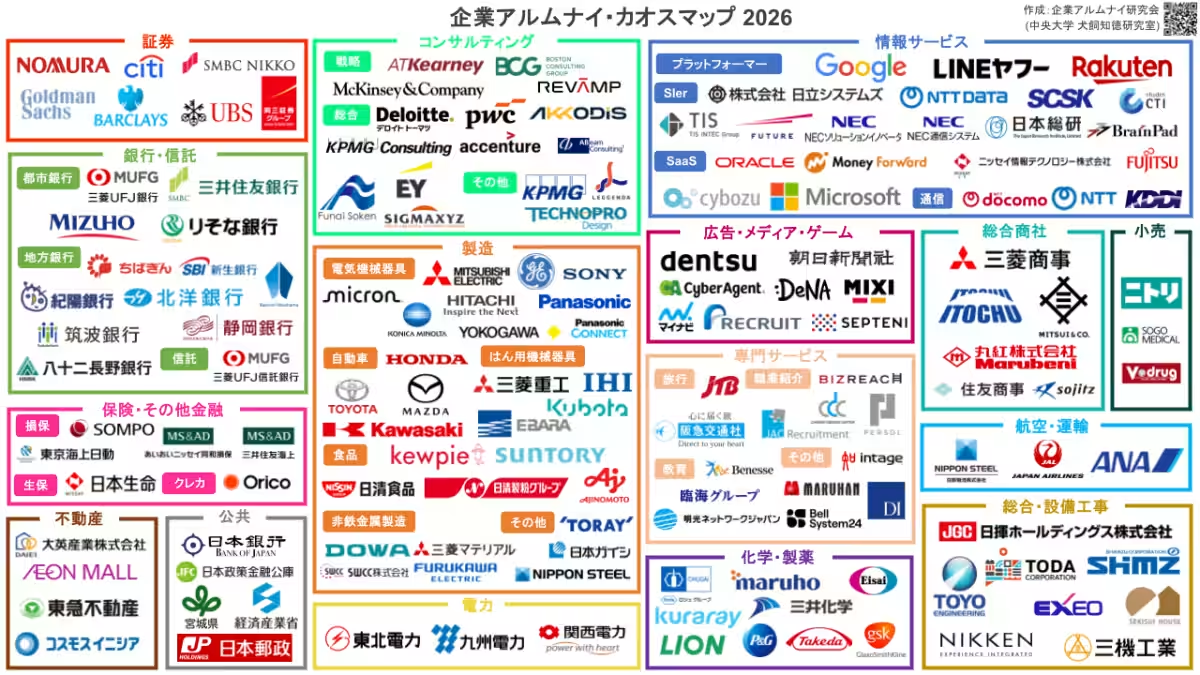
The new map originates from the group’s desire to visualize the current scope of corporate alumni in Japan, which until now has been informally observed through media articles focusing on individual cases and vendors’ trading records. In response, the map serves as a foundational tool for future research into this rapidly expanding domain.
As the Corporate Alumni Research Group delved into their analysis, they released key statistics from their findings. The market size for alumni recruitment support services is predicted to grow from ¥5.07 billion in fiscal 2024 to approximately ¥30 billion by fiscal 2028 (Yano Economic Research Institute).
One significant trend revealed in the chaos map is the penetration of alumni networks into traditionally conservative industries. While many organizations have historically viewed retirement as a definitive separation from employment, a growing number of sectors—including major players like Toyota and NTT Group—are establishing alumni networks. Moreover, regional banks and public entities, such as Shiga Bank and Oita Bank, have also initiated their alumni associations, indicating that the corporate alumni market in Japan has reached a critical point of widespread acceptance.
As organizations begin to implement these networks, the next challenge will be determining how effectively they can sustain and generate value for the involved parties. It marks a transition into a second phase of this initiative, focused not just on establishment but also on measurable outcomes.
Professor Inukai commented on the study’s implications for human capital management. He noted that as employee mobility increases, the relationship between a company and its former employees can facilitate the circulation of knowledge and opportunities. The chaos map emerges as a systematic framework that encapsulates the growth of corporate alumni in Japan, and it is anticipated to serve as a cornerstone for further academic and practical exploration.
Research Methodology
The chaos map was built using rigorous academic methods, including:
1. Definition and Scope: The term 'corporate alumni' refers to current professionals, excluding groups primarily composed of retirees.
2. Clear Participation Criteria: Alumni groups must have defined membership criteria and communication pathways, avoiding vague networks.
3. Community Engagement: The focus is on communities that enable interaction among members, rather than isolated rehiring practices.
Additional inclusions encompassed public organizational alumni and foreign firms with active networks in Japan. Notably, small entities or those without recent activity were excluded from this dataset.
To ensure comprehensive coverage, the research team established a list of major listed and unlisted companies, utilized generative AI to investigate alumni activities, and confirmed findings through meticulous manual verification.
Future Updates
The Corporate Alumni Research Group plans to continuously update this map and welcomes the submission of any missing alumni information through a dedicated feedback form. They also encourage the sharing of the map for academic and educational purposes, providing credits to the group for any redistribution.
About the Corporate Alumni Research Group
This initiative combines academic research and practical application, driven by Professor Tomonori Inukai’s group at Chuo University’s business school. By promoting the concept of corporate alumni as a means to generate human value, the group aims to bridge theoretical findings with real-world HR practices. Noteworthy achievements include receiving the Excellence Award in the 'Career Ownership Management AWARD 2025' and organizing a corporate alumni conference that attracted approximately 300 participants in 2026.
For continuous updates and insights on corporate alumni networks, join the Corporate Alumni Research Group’s newsletter here.
Topics Business Technology)
【About Using Articles】
You can freely use the title and article content by linking to the page where the article is posted.
※ Images cannot be used.
【About Links】
Links are free to use.