



Japan's Employment Landscape: Analysis of May 2026 Labor Market Reports
Overview of Japan's Labor Market Data Report
The Tsunagu Working Style Research Institute, part of Tsunagu Group Holdings based in Tokyo, has released its latest Labor Market Data Report, shedding light on the employment landscape in Japan for May 2026. This monthly report distills official labor market data from government agencies in a user-friendly fashion.
Key Highlights
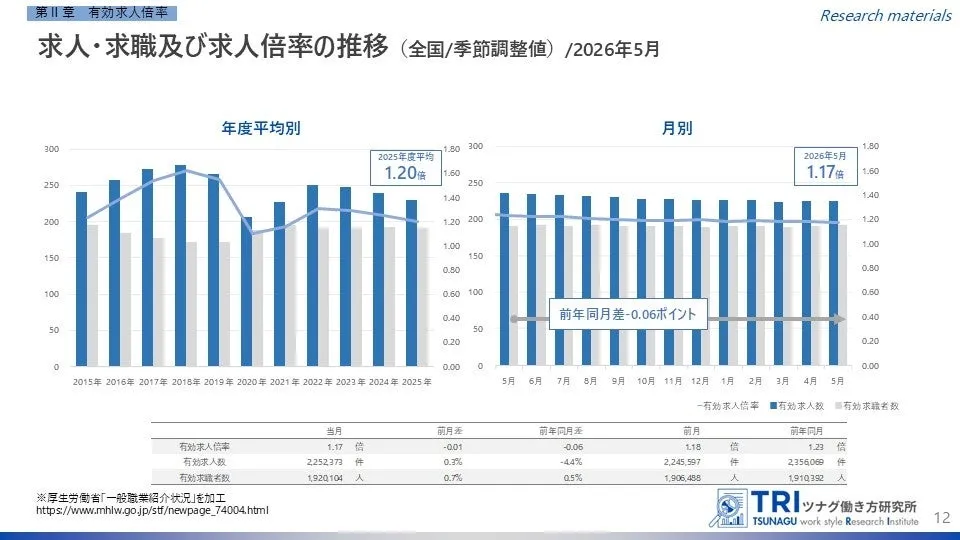
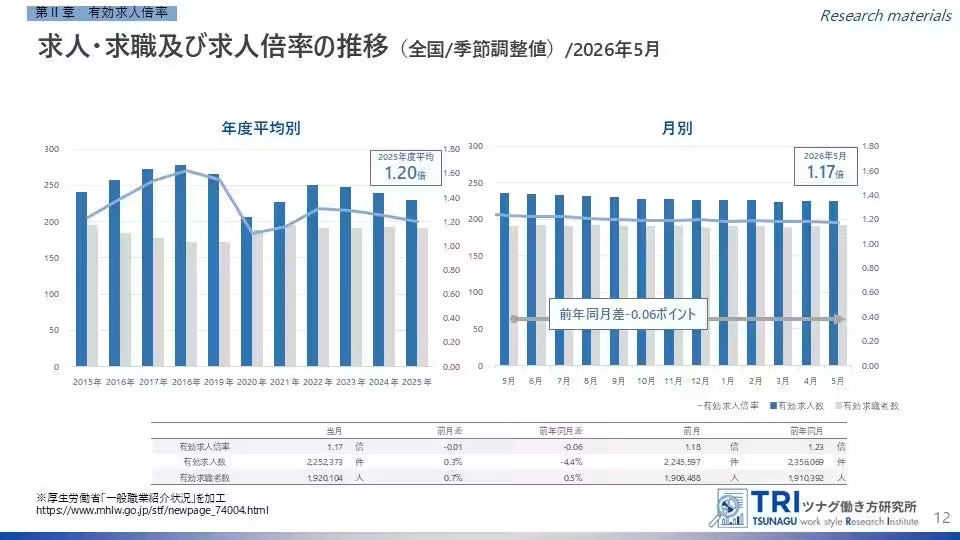
1. Job vacancy ratio stands at 1.17, indicating a slight decrease.
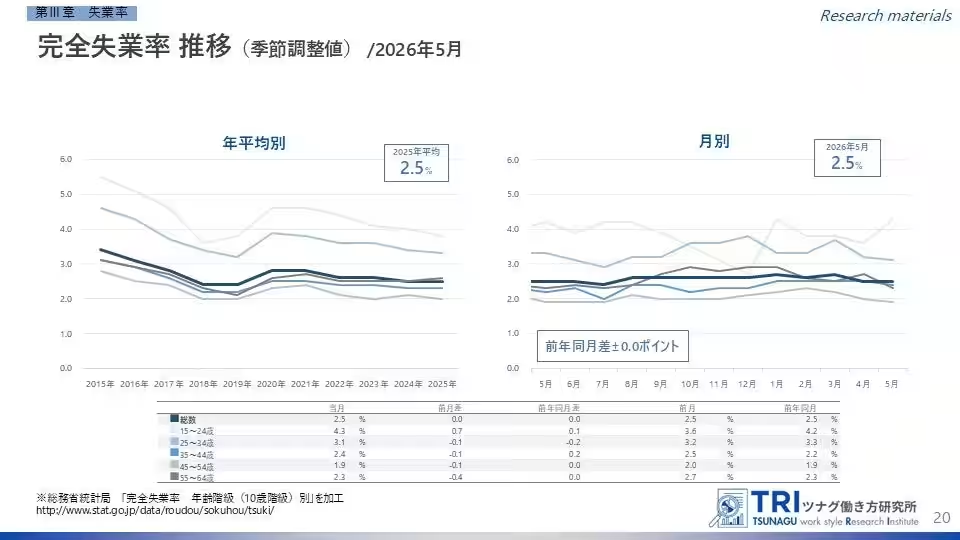
2. The total unemployment rate remains steady at 2.5%.
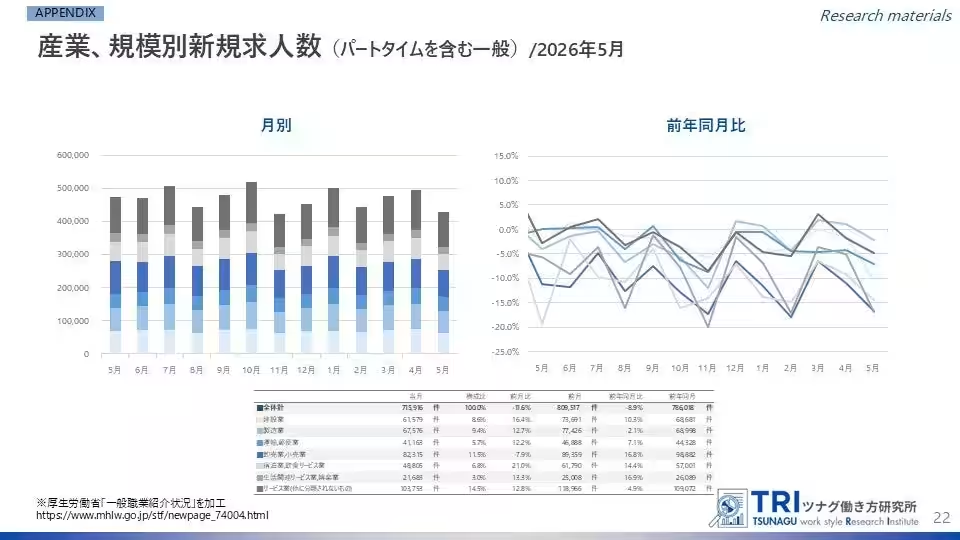
3. New job offerings are down 8.9% compared to last year, marking 13 consecutive months of decline.
Detailed Analysis
1. Job Vacancy Ratio Decline
The effective job vacancy rate for May 2026 has been recorded at 1.17, reflecting a month-over-month decrease of 0.01 points, breaking a two-month rising trend. In terms of year-on-year comparison, there has been a decrease of 0.06 points. The ratio for part-time job vacancies stands at 1.10, a drop from the previous year by 0.06 points. Furthermore, for full-time positions, the effective ratio is 0.99, continuing a streak of eight months below the benchmark of one. This data illustrates a stagnation in the job market landscape, as the decrease is minimal.
2. Unemployment Rate Steady
The unemployment rate for May is stable at 2.5%, consistent with both the previous month and the same month last year. Notably, the only age group showing improvement is those aged 25-34, with a reduction of 0.2 points compared to the same period last year. The total number of unemployed individuals counts to 1.85 million, which is an increase of 20,000 from last year, indicating an overall steady employment situation amid underlying fluctuations.
3. Plummeting New Job Offers
The new job offers have experienced a substantial drop of 8.9% compared to the previous year, marking a continuous decline for 13 months. Specific industries faced significant downturns, particularly in the life service and entertainment sectors (-16.9%), wholesale and retail sectors (-16.8%), and accommodation and food services (-14.4%). The construction industry also recorded a decrease of 10.3%, while the academic, research, and technical services saw a decline of 8.1%. This ongoing reduction in new job openings, particularly in consumer-related services, further stresses the current employment challenges in Japan.
Conclusion
The overall labor market report from May 2026 signifies a cautiously maintained employment rate, with diminishing opportunities translating to a potential stagnation in economic growth. While the consistency in unemployment levels may appear reassuring, the decline in job vacancies calls for critical attention from policymakers and stakeholders to address the employment gap effectively.
About Tsunagu Working Style Research Institute
Founded in 2015 under Tsunagu Group Holdings, Tsunagu Working Style Research Institute aims to explore diverse employment styles in collaboration with experts in the fields of HR and labor law. It seeks to document and analyze changes in labor regulations while proposing ideal future scenarios in employment. For more information, visit their website.

Topics People & Culture)
【About Using Articles】
You can freely use the title and article content by linking to the page where the article is posted.
※ Images cannot be used.
【About Links】
Links are free to use.