




Japan Airlines Advances Sustainable Aviation Fuel with Investment in Morisora Bio Refinery
Japan Airlines (JAL), headquartered in Shinagawa, Tokyo, has made a significant investment in Morisora Bio Refinery, a joint venture that aims to realize sustainable aviation fuel (SAF) derived from domestic wood sources. This move aligns with JAL's ongoing commitment to enhance the use of alternative fuels in aviation, contributing to the environmental sustainability of the industry.
Morisora Bio Refinery was established in July 2025 by three companies: Nippon Paper Industries, Sumitomo Corporation, and Green Earth Institute (GEI). The venture focuses on the production and sale of bioethanol and biochemicals derived from wood biomass, which is a key part of its "Morisora Project ®." The project aims to utilize sustainable forestry resources available in the Tohoku region, including materials like leftover wood from lumber production.
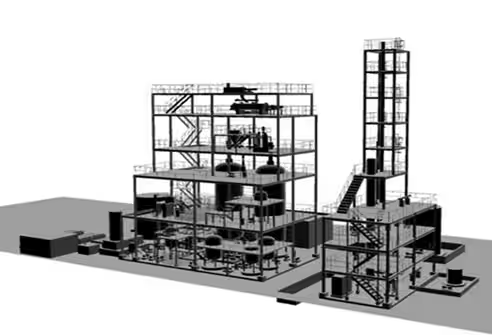
A demonstration plant is slated to be built within Nippon Paper's Iwanuma factory in Miyagi Prefecture, with plans to leverage GEI's cutting-edge technology aimed at producing low-carbon and cost-effective bioethanol. The goal is to manufacture more than 1,000 kiloliters of bioethanol annually starting in 2027, providing a local and renewable source of fuel for the aviation sector.
For over a decade, JAL has actively worked towards promoting biofuels and has been a part of the Morisora Project since March 2025. As an airline that will utilize SAF, JAL's investment is a pivotal move towards realizing a "purely domestic SAF" initiative, which underscores its dedication to Japan's green energy goals.
On October 3, 2025, a groundbreaking ceremony was held at the site of the planned demonstration plant, marking a significant step forward in the project's timeline. With the completion of the plant anticipated by the 2026 fiscal year, the aim is to establish a commercial plant capable of producing tens of thousands of kiloliters of bioethanol and biochemicals annually by 2030.
Both JAL and Morisora Bio Refinery seek to expand production and dissemination of domestically sourced SAF through the Morisora Project. Their ongoing efforts will play a crucial role in achieving a decarbonized society, revitalizing local communities, and building a sustainable future. This collaboration symbolizes the commitment of all parties to innovative solutions that address climate change and contribute to the sustainable development of Japan's aviation industry.
This investment not only signifies JAL's leadership in the transition to green fuels but also highlights the increasing importance of local resource utilization in achieving national environmental goals, setting a precedent for other companies in the sector to follow. As nations strive for a greener future, initiatives like JAL's investment in Morisora Bio Refinery showcase the potential of sustainable technologies in transforming traditional industries.


Morisora Bio Refinery was established in July 2025 by three companies: Nippon Paper Industries, Sumitomo Corporation, and Green Earth Institute (GEI). The venture focuses on the production and sale of bioethanol and biochemicals derived from wood biomass, which is a key part of its "Morisora Project ®." The project aims to utilize sustainable forestry resources available in the Tohoku region, including materials like leftover wood from lumber production.
A demonstration plant is slated to be built within Nippon Paper's Iwanuma factory in Miyagi Prefecture, with plans to leverage GEI's cutting-edge technology aimed at producing low-carbon and cost-effective bioethanol. The goal is to manufacture more than 1,000 kiloliters of bioethanol annually starting in 2027, providing a local and renewable source of fuel for the aviation sector.
For over a decade, JAL has actively worked towards promoting biofuels and has been a part of the Morisora Project since March 2025. As an airline that will utilize SAF, JAL's investment is a pivotal move towards realizing a "purely domestic SAF" initiative, which underscores its dedication to Japan's green energy goals.
On October 3, 2025, a groundbreaking ceremony was held at the site of the planned demonstration plant, marking a significant step forward in the project's timeline. With the completion of the plant anticipated by the 2026 fiscal year, the aim is to establish a commercial plant capable of producing tens of thousands of kiloliters of bioethanol and biochemicals annually by 2030.
Both JAL and Morisora Bio Refinery seek to expand production and dissemination of domestically sourced SAF through the Morisora Project. Their ongoing efforts will play a crucial role in achieving a decarbonized society, revitalizing local communities, and building a sustainable future. This collaboration symbolizes the commitment of all parties to innovative solutions that address climate change and contribute to the sustainable development of Japan's aviation industry.
This investment not only signifies JAL's leadership in the transition to green fuels but also highlights the increasing importance of local resource utilization in achieving national environmental goals, setting a precedent for other companies in the sector to follow. As nations strive for a greener future, initiatives like JAL's investment in Morisora Bio Refinery showcase the potential of sustainable technologies in transforming traditional industries.
Topics Other)
【About Using Articles】
You can freely use the title and article content by linking to the page where the article is posted.
※ Images cannot be used.
【About Links】
Links are free to use.