



Survey Reveals Insights on Keeping Ashes at Home in Japan
Survey on Keeping Ashes at Home in Japan
The National Stone Products Cooperative (Zenseki-kyo), recognized by Japan's Ministry of Economy, Trade and Industry, recently conducted a survey exploring public opinions on the practice of keeping ashes of deceased loved ones at home. This survey included 500 respondents, all aged 40 and above, from various regions across Japan, and was conducted online from September 1 to 19, 2025.
Survey Overview
- - Participants: 500 individuals aged 40 and above from across Japan
- - Period: September 1-19, 2025
- - Method: Online survey
- - Valid Sample Size: 500 respondents
Key Findings
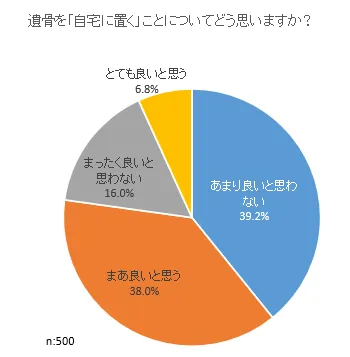
The survey revealed that views on keeping ashes at home are markedly divided. While 44.8% of participants expressed positive opinions about having ashes at home, 55.2% held negative views.
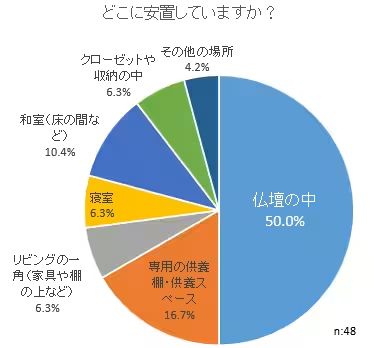
A striking point was that half of the individuals housing remains reported that the ashes were kept in a family altar (butsudan). The most cited reason for this practice was the desire to feel closer to the deceased, with 54.2% of respondents indicating this sentiment.
Detailed Survey Questions and Responses
- - Q: What are your thoughts on keeping ashes at home?
- - Free-Response Feedback:
- Participants noted the benefits of feeling a connection to the deceased and being able to conduct regular prayers or memorials at home.
- Some felt that this practice serves as a vital alternative for those who cannot visit gravesites regularly.
- Negative Feedback:
- Many respondents emphasized traditional beliefs that dictate remains should be interred in a grave.
- Others reported emotional difficulties in processing loss, citing feelings of discomfort or fear about having remains in the home.
- Concerns were also raised about the space required for keeping ashes and the potential burden this might pose for future generations.
- Neutral or Conditional Responses:
- Some individuals commented that decisions about keeping ashes should be left to the discretion of families and the deceased.
- There was mention of a conditional acceptance of this practice for specific periods, such as from a death until memorial services.
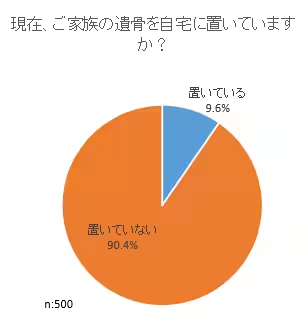
- - Q: Are you currently keeping ashes of a family member at home?
- - Q: Where in your home do you keep the ashes? (from those who keep ashes)
- - Q: Why do you choose to keep ashes at home? (response from those who keep ashes)
- - Q: What considerations do you have for products related to at-home memorialization?
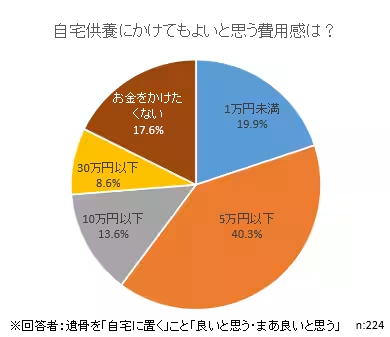
- - Q: What amount do you find acceptable to spend on home memorialization?
Conclusion
The survey results demonstrate a complex landscape surrounding the practice of keeping ashes at home in Japan. Although more respondents reported negative views, nearly 44.8% expressed positive feelings, showcasing the shifting perceptions about traditional burial practices. Religious contexts and psychological burdens contribute to resistance against the practice among some groups.
Furthermore, the data highlights a growing trend toward personalized choices regarding memorialization based on family structure and lifestyle variations. The cooperative aims to assist consumers with any queries related to burial and scattering of ashes, recognizing the need for accurate information regarding good practices.
About the National Stone Products Cooperative
The National Stone Products Cooperative (Zenseki-kyo) is an assembly of stone companies across all 47 prefectures of Japan, dedicated to providing informed responses to consumer needs and fostering a healthy growth in the stone industry. The organization strives to uphold the traditional memorial culture valued by the Japanese and facilitates access to accurate information regarding stone products.
Company Name: National Stone Products Cooperative
Established: November 22, 2012
Location: 2-9-14 Shiba Daimon, Minato-ku, Tokyo, Japan
Website: Minna no Ohaka




Topics People & Culture)
【About Using Articles】
You can freely use the title and article content by linking to the page where the article is posted.
※ Images cannot be used.
【About Links】
Links are free to use.