



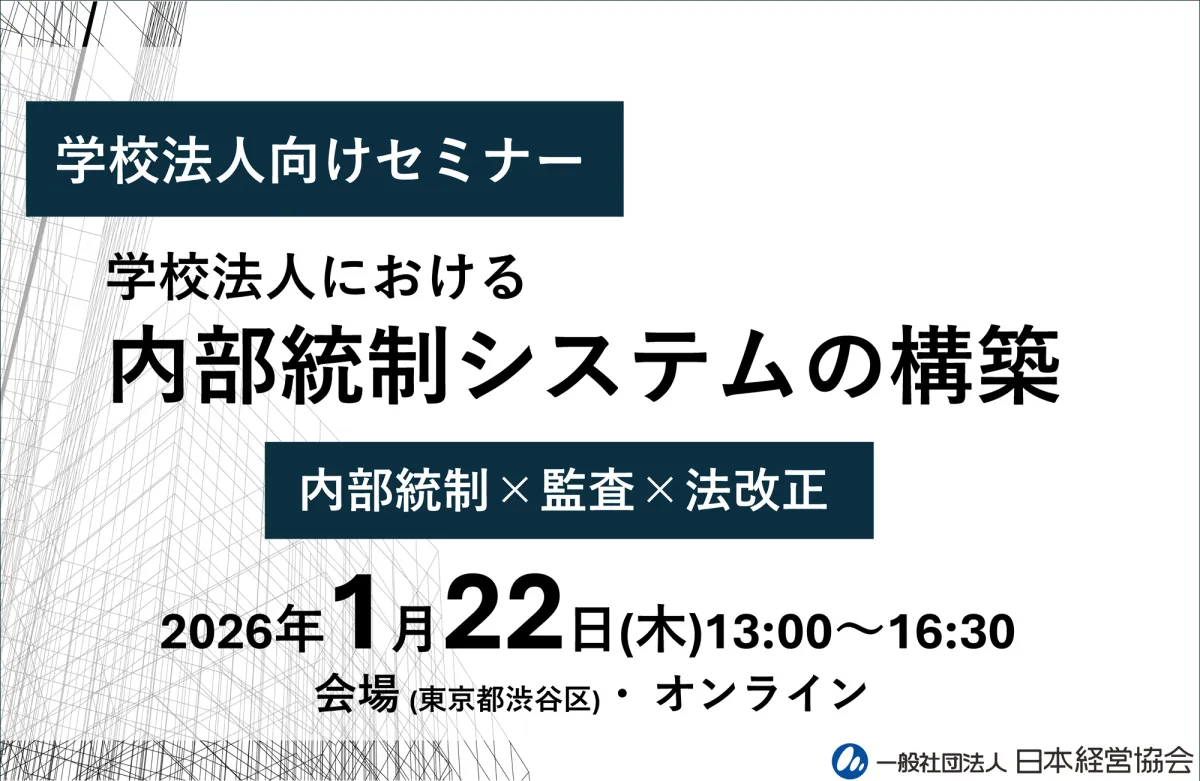
Comprehensive Training on Internal Control System for Private Schools in Japan
Introduction
The General Association of Japan Management Association is hosting an essential seminar titled "Building Internal Control Systems Required for School Corporations" on January 22, 2026. This event is crucial in the light of recent amendments to the Private School Law, which introduce strict requirements for governance and internal control frameworks.
Background of the Event
In order for school corporations to operate sustainably and transparently, a robust internal control system is vital. The modifications to the Private School Law necessitate improvements in the roles of boards of directors and auditors, the strengthening of financial information disclosure, and the establishment of comprehensive internal auditing systems. These changes highlight the increasing importance of internal controls in managing school operations.
Seminar Objectives
This seminar aims to provide participants with a holistic understanding of current challenges faced by school corporations. It will cover detailed steps in constructing an internal control system, including risk assessments and operational verifications. By the end of the seminar, attendees can expect to achieve the following objectives:
- - Gain a comprehensive understanding of the significance and roles of internal control systems.
- - Learn the standards for internal control systems as mandated by the Private School Law.
- - Acquire techniques to evaluate the effectiveness of the internal control system regarding its setup and operational status.
Featured Speaker
The seminar will be led by Mr. Mitsuhiro Nao, a licensed public accountant and head of a public accounting office. A graduate of Waseda University’s School of Commerce and former chairman of the School Legal Committee of the Japanese Institute of Certified Public Accountants, Mr. Nao possesses extensive experience in auditing school corporations and compliance with financial laws. Since founding his own practice in 2019, he has authored numerous publications on accounting and internal controls within school organizations.
Seminar Program
1. Understanding Internal Control
- Importance and objectives of internal controls as specified in internal control standards.
- Six fundamental elements of internal control.
- Overview of comprehensive internal control and operations-related controls.
- Limitations of internal controls.
- Evaluation of effectiveness in both setup and operations.
2. Specifications of Internal Control Systems Under the Private School Law
- Legal stipulations surrounding internal control systems in the Private School Law.
- Internal control system requirements under the Private School Law.
- Disclosure requirements in business reports.
- Comparison between the internal control systems of the Private School Law and general internal control standards.
- Exercise 1: Checklist evaluation of internal control system setup.
3. Evaluation of the Effectiveness of Internal Control Systems
- Internal control systems as part of risk management.
- Techniques for identifying and assessing risks.
- Identifying internal controls to mitigate identified risks.
- Evaluation of operational status of internal controls.
- Exercise 2: Creation of a Risk Control Matrix.
Event Details
- - Title: Building Internal Control Systems Required for School Corporations
- - Date and Time: January 22, 2026 (Thursday) from 13:00 to 16:30
- - Location: NOMA Training Center, Shibuya, Tokyo
- - Online Participation: Available via Zoom
- - Fees: 25,300 yen for members / 30,800 yen for non-members (tax included)
- - Target Audience: This seminar is suited for directors, corporate heads, secretarial staff, auditors, and heads of financial and general affairs departments in school corporations.
Registration
For further information and registration, please visit our official page: NOMA Seminar Details. Online attendance can be registered via this link.
About NOMA
The Japan Management Association (NOMA) was founded in 1949 and has since dedicated itself to modernizing and improving management practices in Japan. NOMA’s focus is on fostering innovation and balance between management, people, and science to contribute to the development of a sustainable society.
For more information, visit our official website at NOMA Official Site.
Topics Other)

【About Using Articles】
You can freely use the title and article content by linking to the page where the article is posted.
※ Images cannot be used.
【About Links】
Links are free to use.