



Achieving the Government's Target of 50% STEM Students Through Early Education
The Path to Achieving 50% STEM Students: The Importance of Early STEAM Education
In an effort to boost the number of students pursuing STEM (Science, Technology, Engineering, and Mathematics) fields, the Japanese government has set an ambitious target of increasing the current STEM enrollment rate from approximately 35% to 50%. This initiative is supported by a substantial budget of around 300 billion yen aimed at fostering interest and educational resources in STEM disciplines. Recent findings from a survey conducted by Human Academy Inc. highlight the impact of early STEAM education on students' career choices, particularly through their 'Robotics Professor Course' and 'Children's Programming Class'.
Key Insights from the Survey
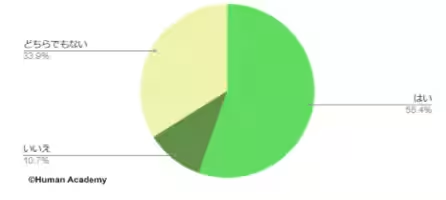
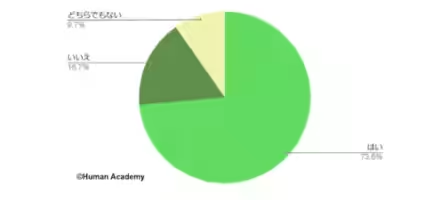
The survey, which targeted parents of current and former students in these programs, revealed that over 55.4% of middle school students and above chose STEM paths. Furthermore, this figure rises to an impressive 73.6% for high school students and above, significantly surpassing the national average of 35% for STEM enrollment.
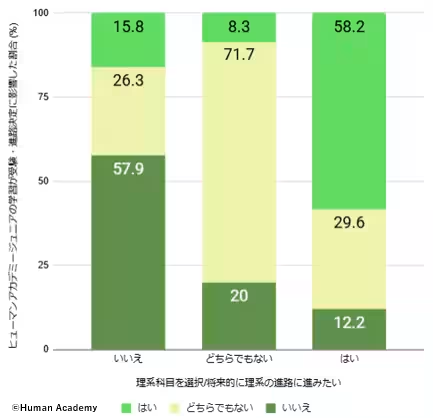
A notable 60% of respondents stated that their children's experiences in the classes influenced their choices regarding admissions and future pathways, reinforcing the positive correlation between hands-on learning experiences and the inclination towards STEM.
The survey also documented several success stories, such as students becoming candidates for the International Physics Olympiad and reaching prestigious universities like the University of Tokyo after participating in the program. These stories exemplify how such educational initiatives are nurturing the next generation of innovative professionals.
High School Students Show Strong STEM Aspirations
Among students who have reached the decision-making stage for their future careers—specifically high school and technical college students—73.6% indicated a preference for STEM paths. This reflects a strong trend towards early interest in technology and engineering, effectively countering the issue of students often feeling trapped in arts disciplines after an initial choice. This educational trend is crucial, as it facilitates adequate career anchoring at pivotal stages of academic development.
Skills Learned Aligning with Societal Needs
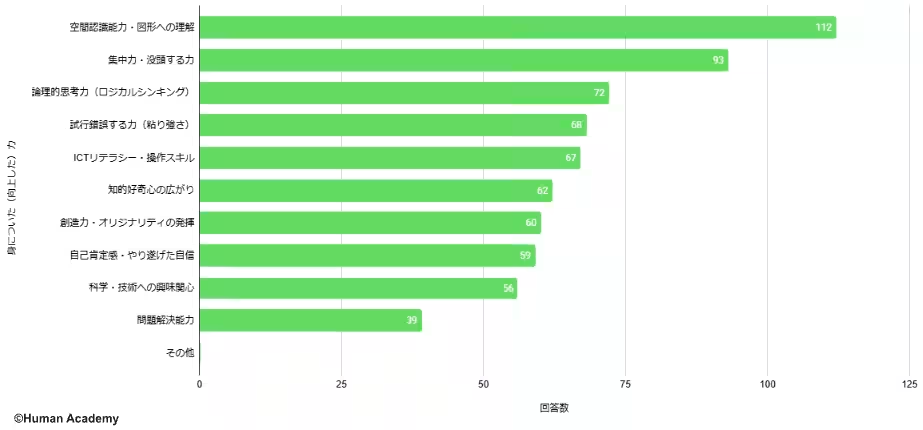
A broader analysis of skill acquisition shows that students recognize significant personal development through their classes. Key competencies cited by participants included spatial awareness, concentration, and logical thinking—all essential attributes for the advanced IT workforce that the government aims to cultivate by 2030. About 688 respondents participated in the skills assessment, indicating that the curriculum effectively prepares students for technology-driven careers.
Voices from Students and Parents
Participants in the program have shared insightful feedback about how STEAM education shaped their academic paths. One graduate expressed, “Winning the national NHK Robotics Competition allowed me to transfer to the University of Tokyo where I plan to continue researching robotics.” Another noted, “From a young age, I was able to create the robots I envisioned, and pursuing robotics engineering at university felt like a natural next step.” Additionally, a student from Keio University highlighted how the skills gained in the classes benefited their examination preparations, aiding their success.
Future Prospects
As Japan faces potential shortages of approximately 790,000 IT professionals by 2030, the need for early STEM education becomes increasingly vital. Human Academy remains committed to transforming children’s curiosity into the capabilities needed for the future workforce through innovative STEAM education. The organization is dedicated to playing a significant role in resolving Japan’s issues concerning the scarcity of STEM and digital transformation (DX) talent.
About the Human Academy Junior Robotics Class
Launched in June 2009, the Human Academy Junior Robotics Class caters to children from preschool through middle school. Under the advisory of renowned robotics creator Tomotaka Takahashi, the program has expanded to over 2,000 classes across the nation, surpassing 27,000 enrolled students as of March 2025. The curriculum includes various courses tailored to different age groups, emphasizing the development of problem-solving skills through hands-on robotics and programming.
By involving children in the exciting world of robotics, the program aims to foster foundational skills that are essential for navigating and thriving in the rapidly evolving landscape of technology.
Conclusion
The findings from Human Academy reaffirm the critical role of STEAM education in cultivating future innovators. By investing in early education that promotes creativity, technical skills, and critical thinking, Japan can take significant strides toward meeting its ambitious goals for STEM education and workforce readiness.
References
For additional details, visit: Human Academy Children's Education Research Institute


Topics Other)









【About Using Articles】
You can freely use the title and article content by linking to the page where the article is posted.
※ Images cannot be used.
【About Links】
Links are free to use.