



The Evolving Skills of Remote Work: Insights from a Recent Survey
The Evolving Skills of Remote Work: Insights from a Recent Survey
The shift to remote work has brought about a significant transformation in the way we communicate and collaborate in the workplace. This evolution not only provides flexibility and work-life balance but also comes with its own set of challenges. A recent survey conducted by TeleRimo Research Institute sheds light on the skills that have improved among employees working remotely.
Adapting to Work Environment Changes
The modern workplace faces various social challenges, ranging from declining birth rates and an aging workforce to limited job opportunities in rural areas and the burden of childcare and caregiving duties. These issues cannot be solved solely through individual efforts; however, history shows that humans have always adapted to changing environments, and the evolution of work methods is a perfect example of this.
Post-COVID-19, remote work has rapidly established itself as a viable option to overcome many of these challenges. It allows individuals to work from rural regions, thus reducing dependence on urban centers, enabling better management of work and family time.
However, as remote work gains traction, some challenges have become apparent, such as reduced communication opportunities and difficulties with reporting and communication (often referred to as "Hōren-sō" in Japan). These challenges seem to influence the ongoing trend of returning to office work. The survey by TeleRimo aimed to explore whether remote work has led to the enhancement of particular skills among individuals.
Communication: Sharper Skills Developed in Remote Work
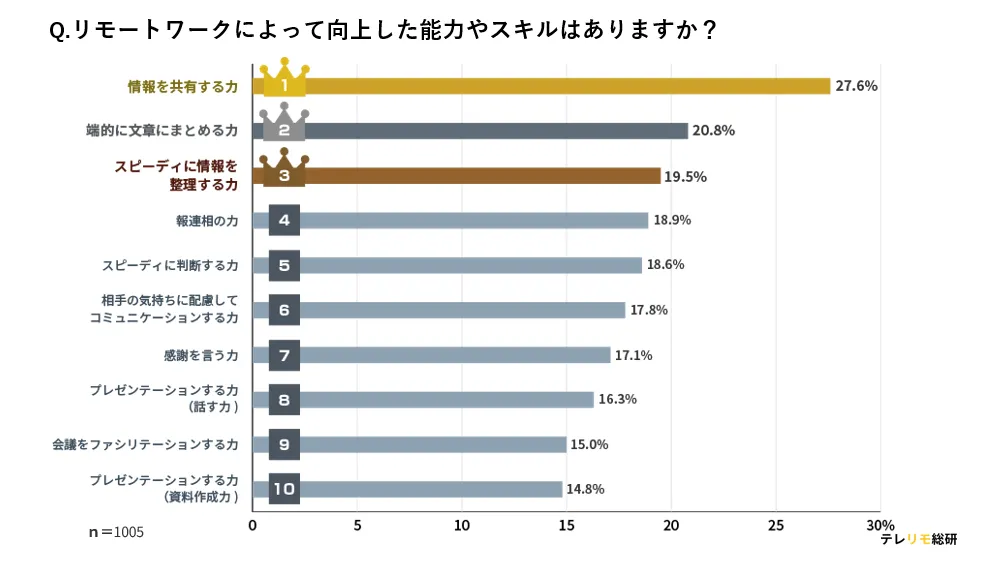
In the survey, respondents were asked, "What skills or abilities have improved due to remote work?" The most common response was the ability to share information effectively. Other notable skills included the ability to summarize information succinctly and the capacity to quickly organize data.
In a remote environment, the primary mode of communication is through emails and chat, leaving little room for casual interactions or small talk. This necessitates honing the ability to express oneself clearly, ensuring messages are without miscommunication and aptly addressing the messages' intent.
Additionally, skills such as timely decision-making and effective reporting also ranked highly. Although these skills were already expected of professionals prior to the shift to remote work, their importance seems to be magnified in a virtual setting.
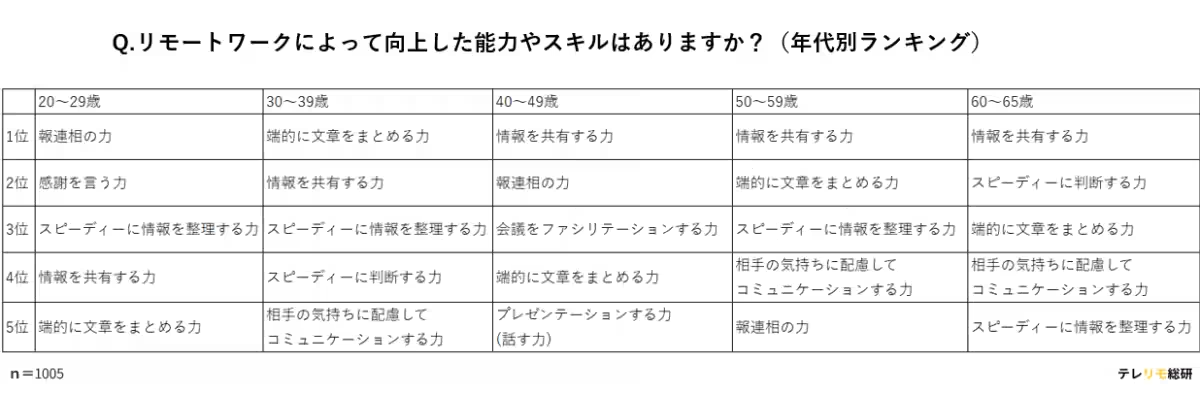
When analyzing responses by age group, it was evident that the ability to share information ranked first or second across all generations, from individuals in their 20s to those in their 60s. This indicates a universal recognition of the importance of effective communication in remote work. Other skills showed variations in their rankings among different age groups, reflecting how experience and evolving workplace roles influence what abilities are prioritized.
Generational Differences in Communication Styles
One intriguing finding was the notable difference in the responses regarding "the ability to express gratitude" and "the ability to give compliments" across generations. For instance, individuals in their 20s reported significantly higher rates of effectiveness in expressing gratitude compared to their counterparts in their 60s, with scores of 23 versus 11 respectively. The younger generation is accustomed to using various communication tools on social media, actively utilizing online expressions such as “likes” and gratitude emojis. In contrast, older generations often face challenges in adapting these communication nuances in remote settings due to a reduced frequency of direct interactions.
The cultural shift towards a more positive reinforcement model in training younger generations has likely influenced their communication style, enabling them to bring these skills into remote work environments.
The Value of Skills in the Era of Office Returns
Remote work, once a novel concept, is now an established option as the workforce continues to adapt to change. While it has faced critique regarding communication limitations, the ongoing evolution of these skills indicates resilience among employees in overcoming obstacles inherent to remote working.
Topics People & Culture)




【About Using Articles】
You can freely use the title and article content by linking to the page where the article is posted.
※ Images cannot be used.
【About Links】
Links are free to use.