



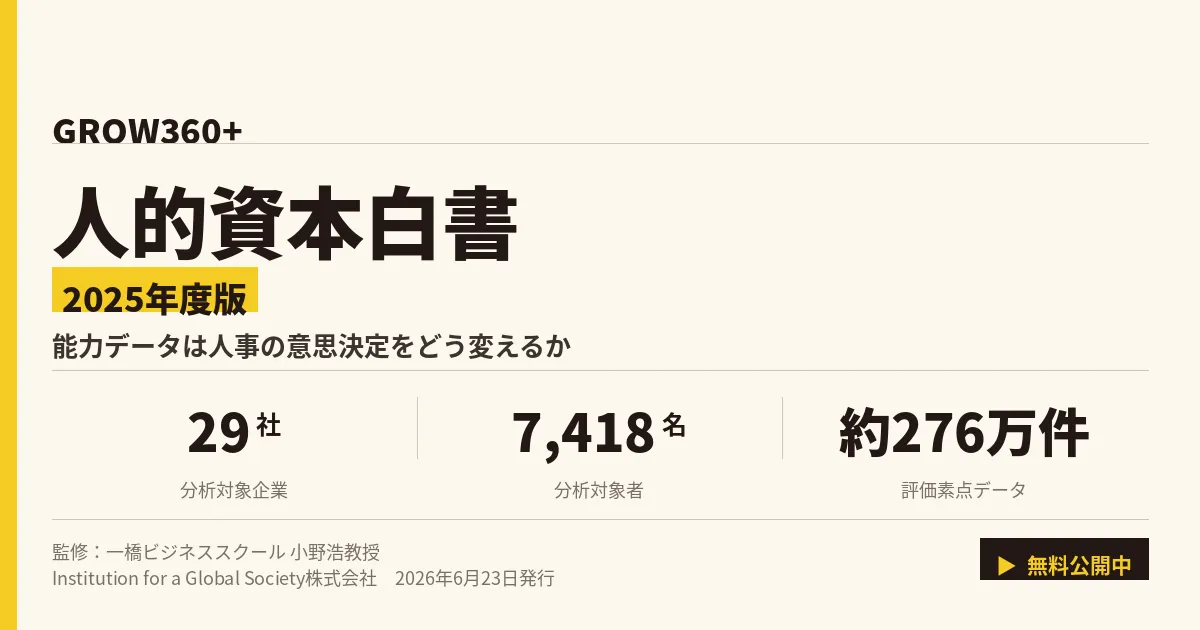
New Insights into Human Capital Management Released in GROW360+ White Paper
New Findings on Human Capital Management
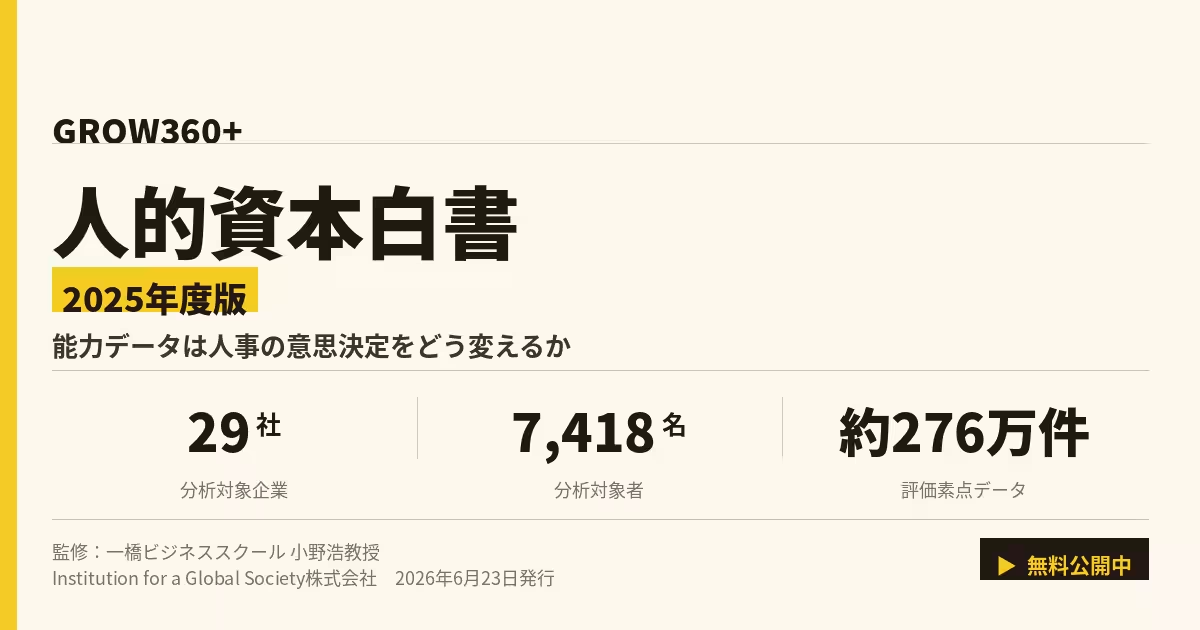
On June 23, 2026, the Institution for a Global Society (IGS) launched its latest white paper titled "GROW360+ Human Capital White Paper 2025 Edition." This document presents an analytical validation report based on 29 companies and 7,418 participants, utilizing the competency data collected from approximately 2.76 million evaluation scores. The white paper focuses on five crucial insights about human capital management related to leadership appointment, employee self-awareness, and growth patterns, all of which are available for free download.
Five Key Insights Revealed in the White Paper
1. The Most Significant Competency Gap: Influence
The analysis showed that the most prominent competency gap between managerial and non-managerial employees is the ability to exercise influence. This skill, which encompasses empathy and the ability to motivate others, has an average score differential of +17.3 points. Following this are competencies such as logical thinking, problem-setting, and sincerity. These insights suggest that while higher positions generally see enhanced overall capabilities, the competencies causing key differences are specifically concentrated.
2. Divergence in Self and Others' Evaluations
There is a notable discrepancy between how individuals assess their competencies versus how others perceive them. Participants largely fell into three categories: overestimators, underestimators, and those with accurate self-perceptions. For instance, many tend to underrate their passionate advocacy, showing an average self-assessed decline of -9.9 points. This divergence indicates that uniform training programs may not yield effective results; personalized feedback strategies are essential.
3. The Impact of Rater Bias
The analysis of 12,346 raters revealed that around 23% offer lenient evaluations, while approximately 21% tend to be stricter. This results in about 44% of the evaluations displaying some bias. Although rankings maintain a high correlation overall, individual scores can fluctuate significantly due to evaluator biases. IGS employs patented bias correction technology (Registration No. 6589257) to statistically eliminate these hidden unfairnesses.
4. Categories of Employee Growth
Employee growth and competency changes over a year are classified into four types: thriving (18%), slightly thriving (39%), stable (34%), and struggling (9%). Importantly, these types are not fixed; they can evolve with appropriate interventions. This data suggests the potential for early detection and designed interventions for those struggling.
5. Bias in Management Candidate Selection
Candidates for management positions tend to mirror the skill structures of current managers. The top 10% of non-managerial candidates often exhibit similar capabilities to existing leaders. However, this trend raises concerns about maintaining the status quo rather than fostering innovation necessary for future organizational leadership, especially in the AI-driven era.
Implications for Human Resources and Management
This white paper presents these five insights alongside critical questions for companies to consider. They prompt businesses to assess how scores change before and after bias correction, identify competencies that differ between managerial and general staff, and evaluate whether their candidate lists align with future leadership requirements.
The insights are geared toward Chief Human Resource Officers (CHROs), HR planners, talent development teams, and executive management. Furthermore, the reliability of foundational data on mandatory human capital disclosures (effective from March 2023) highlights the necessity of addressing evaluation biases.
Commentary from Audience Experts
Professor Hiroshi Ono from Hitotsubashi University and co-chair of the Empirical Research Group on Human Capital Theory emphasizes, "The core of human capital theory lies in the investment in people, which fosters improvement in abilities. However, decisions about who to develop and promote often lack objective backing. The obligation for transparency in human capital disclosures has brought this issue to light, making this white paper a crucial evidence-based effort to alleviate the gap."
Download Information
The "GROW360+ Human Capital White Paper 2025 Edition" is now available for free download using the following link:
Download here
About GROW360+
IGS's GROW360+ platform assesses individual competencies, skills, and temperament through both self and 360-degree evaluations. Since its launch in 2016, it has gathered data from approximately one million evaluations while employing patented bias correction technology to ensure accuracy in assessment. The systematic measurement across 25 competencies helps support talent development, placement, and the fundamental setup of human capital transparency.
Company Overview
Institution for a Global Society (IGS)
Founded in May 2010, IGS provides evaluation services that visualize competencies and inherent traits, focusing on non-cognitive abilities vital for societal contributions. They offer tools and services to corporations, educational institutions, and governmental bodies, supporting individual and organizational growth. The company's purpose is to provide means for achieving a sustainable society devoid of divisions while aiming to create happiness through assessment and education. IGS went public on the Tokyo Stock Exchange's Mothers market (now Growth Market) on December 29, 2021.
Topics Business Technology)

【About Using Articles】
You can freely use the title and article content by linking to the page where the article is posted.
※ Images cannot be used.
【About Links】
Links are free to use.