



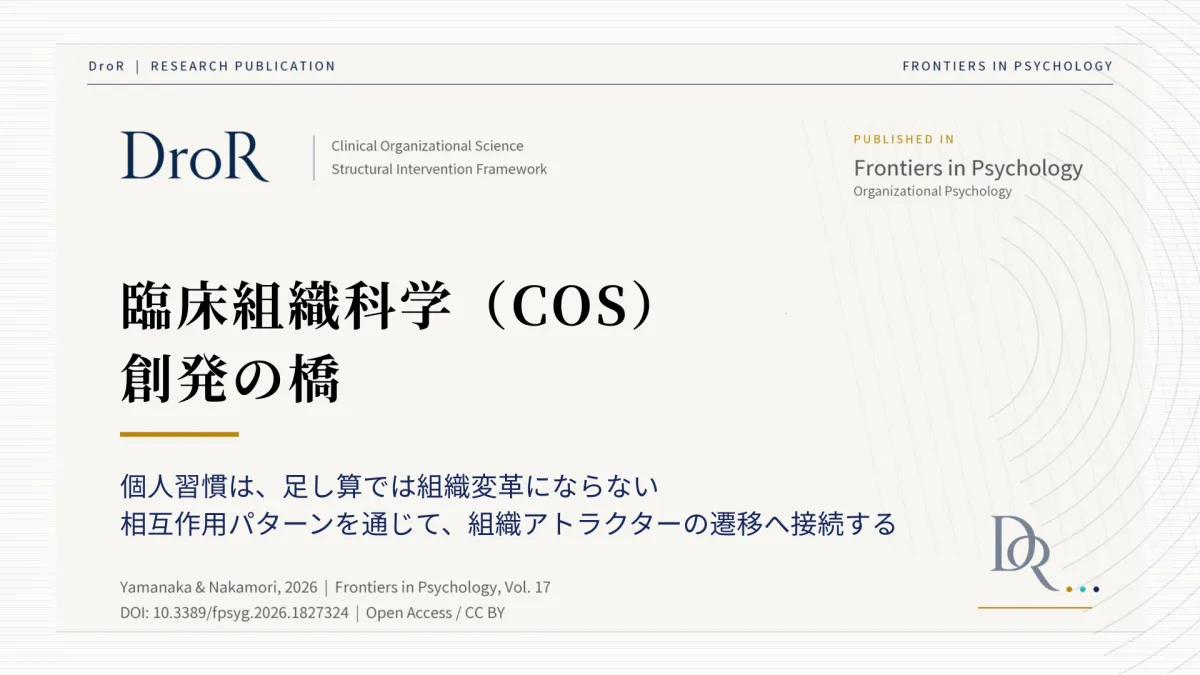
The Emergence Bridge: Connecting Personal Habits to Organizational Change
Understanding the Emergence Bridge in Organizational Change
In the realm of organizational development, the concept of Emergence Bridge illustrates how personal habits can influence structural transformations within organizations. This innovative framework, introduced by the Tokyo-based research firm DroR, emphasizes the complex interactions between individual behaviors and organizational routines, enabling a nuanced understanding of organizational dynamics. The firm's recent publication in the journal Frontiers in Psychology, showcases this concept as a key element in Clinical Organizational Science (COS), providing insights into how individual changes can lead to collective organizational shifts.
What is Clinical Organizational Science?
Clinical Organizational Science is a multidisciplinary approach that integrates complex systems science, neuroscience, organizational psychology, and behavioral science. It seeks to theorize and intervene in the structures that allow organizations to reproduce stable states actively. Rather than viewing organizational change solely as the sum of individual behavior modifications, COS proposes a more intricate view, recognizing the transition of organizational attractors as a critical element in facilitating change. The framework relies on three core techniques: Field Gradient Theory, Loop Conversion Design, and Neural Base Design, which together illuminate the pathways through which personal habits can cascade into organizational transformation.
Key Questions: How Are Individual Changes Linked to Organizational Changes?
A pivotal question in the discourse on organizational transformation is the relationship between individual changes and organizational changes. Intuitively, one might argue that if individuals shift their behaviors, the organization will naturally follow suit. However, this is not always the case. There are instances where training participants may show temporary changes in behavior without any substantial shifts in organizational patterns. Alternatively, subtle changes in behavior, such as enhanced communication and positive feedback loops, can lead to significant organizational alterations, suggesting that the relationship between individual and organizational changes is more complex and less linear than previously thought. COS offers a framework to understand this relationship as inherently emergent.
Emergence Bridge: Beyond Simple Models
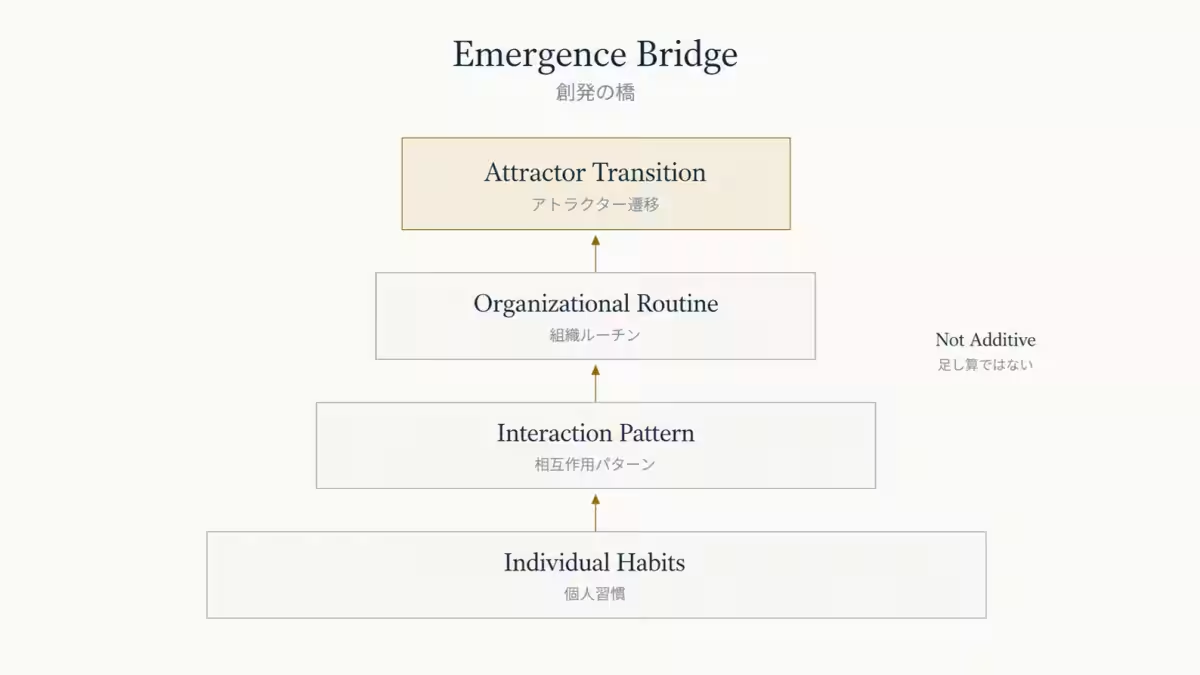
The Emergence Bridge transcends simplistic conceptualizations that equate individual change to organizational change through mere addition. COS posits that repeated, habitual behaviors at the individual level influence interaction patterns that alter organizational routines and the conditions for reproducing these organizational attractors. Consequently, organizational change within the COS framework is not merely a sum of individual transformations. Instead, it represents a complex interaction wherein individual behaviors contribute to the fabric of organizational interactions, gradually evolving into stable organizational patterns.
Three Layers of Emergence Bridge
The Emergence Bridge consists of three interconnected layers, each contributing to the organizational transformation process:
1. Individual Level
At the individual level, behaviors become habits through processes informed by neuroscience and behavioral design, as outlined by Kandel's principles of neuroplasticity and Fogg's behavior design framework. Repeated actions such as expressing gratitude, giving acknowledgment, and providing structured feedback become ingrained habits, reducing cognitive load and allowing new behaviors to emerge with minimal conscious effort.
2. Interaction Level
Habitual behaviors alone do not transform organizations. These behaviors must be integrated into various interactional contexts—meetings, chats, one-on-ones, reviews, and decision-making venues. For example, when team members begin to respond promptly to acknowledgments, it reduces waiting times and anxiety within the group. Moreover, when multiple individuals start providing constructive feedback, it alters the cycle of criticism and defensiveness, fostering a more collaborative environment. The key aspect lies in the transfer of behavior from the individual to the collective activity of the organization.
3. Organizational Level
As new interaction patterns become repeated, organizational routines will inevitably change. According to Feldman and Pentland’s theory of organizational routines, these are not fixed procedures but emergent patterns arising from repeated interactions. Once sufficient repetition occurs, the organization’s baseline stability, or attractor, will itself evolve—problems are shared more naturally, feedback loops are enhanced, and participation in discussions becomes more equitable.
Timeframe: From Temporary Changes to Autonomous Sustainability
COS acknowledges that changes in organizational attractors do not happen instantaneously. Initially, the facilitation of new behaviors requires conscious efforts from practitioners. However, after a sustained period of consistent practice, these behaviors can become habitual, altering the interaction patterns autonomously without ongoing prompting. The paper identifies this behavioral timeline as a hypothesis for future empirical testing.
Theoretical Positioning of the Paper
This publication is framed as a conceptual analysis, offering new theoretical propositions rather than claiming established efficacy for the outlined techniques. By synthesizing existing scientific knowledge, the paper redefines organizational transformation as a structural intervention problem and proposes future propositions needing validation and potential refutation.
Comments from Makoto Yamanaka, CEO
While it may seem straightforward to say that individual changes lead to organizational changes, the reality of practice often defies this simple narrative. The essence of the Emergence Bridge—highlighted in COS—is not simply about individual change but rather about how those habitual behaviors become repeated in interactions to reshape organizational patterns. This complexity underscores the importance of understanding the procedural nuances rather than relying on additive simplifications.
Upcoming Insights
On May 18, at 10 AM, we will release our next discourse focusing on the ethical principles underlying Clinical Organizational Science. This covers the four foundational principles: Autonomy, Transparency, Participation, and Revocability, further enriching our understanding of COS and its operational parameters.
About DroR
DroR, based in Shibuya, Tokyo, operates at the intersection of complex systems science and neuroscience to observe and design the ‘invisible interaction structures’ within organizations. By employing Clinical Organizational Science as a theoretical backbone, the firm offers a confluence of services including specialized BPO, organizational development, and digital transformation support. They advocate for a
Topics Other)
【About Using Articles】
You can freely use the title and article content by linking to the page where the article is posted.
※ Images cannot be used.
【About Links】
Links are free to use.