



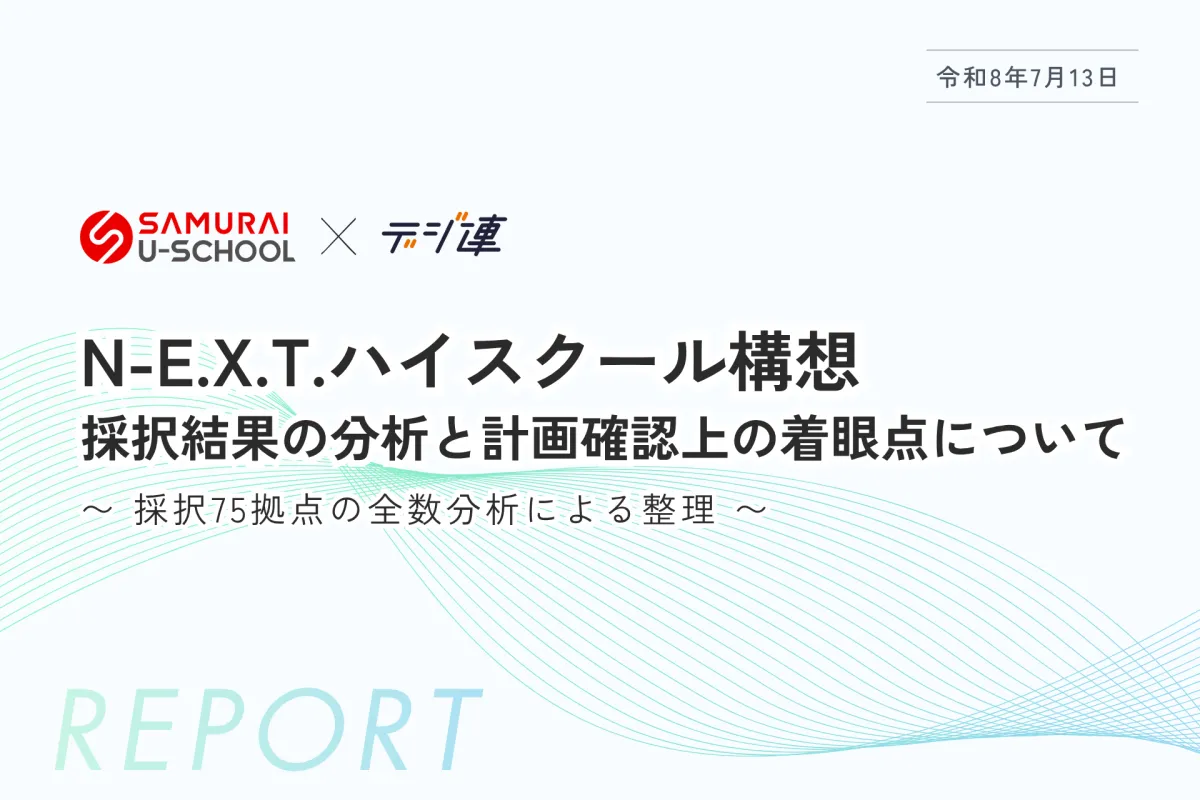
Analysis Report Released on N-E.X.T. High School Project: Key Points and Insights
The Innovative N-E.X.T. High School Project
The N-E.X.T. High School initiative, driven by Japan's Ministry of Education, aims to transform high school education to cultivate human resources that can support regional industries. The project represents a significant investment into the reform of education at the high school level and is intertwined with the future of Japan's workforce development.
Recently, SAMURAI Corporation, in collaboration with the Digital Human Resources Co-Creation Alliance (DigiRen), published a thorough analysis detailing the first three rounds of funding applications for the N-E.X.T. High School project, spotlighting 75 selected locations. This report not only lays out the characteristics shared by successful plans but also serves as a crucial resource for educational boards and municipalities preparing for future application rounds.
Background
The N-E.X.T. High School initiative was launched to address persistent complaints from various educational boards and municipalities regarding the opaque criteria for successful funding applications. As the results of the application process are typically published without individual evaluations or reasons for success, many institutions voiced confusion over what kinds of plans would be likely to receive funding.
Recognizing this gap, SAMURAI took it upon themselves to leverage their expertise in educational technology (EdTech) and their established connections in the education sector to analyze these 75 chosen locations. By examining existing documentation and public data, they identified what trends led to successful applications.
Key Findings
SAMURAI's analysis revealed several crucial factors that were consistently present in the successful applications:
1. Clear Identification of Regional Challenges: The successful plans articulated specific issues within their localities, grounded in objective data.
2. Alignment with Regional Needs: Each application successfully connected educational content with regional industrial policies and labor demands.
3. Integrated Design: Successful projects showcased a cohesive design, integrating curriculum development, performance indicators (KPIs), and management structures.
These key determinants highlight the need for a comprehensive approach to educational reform, emphasizing quantifiable engagement with local challenges, clarity in human resource development, and the establishment of a multi-stakeholder implementation framework encompassing industries, universities, and government bodies.
Additionally, the report examined unique characteristics across three different educational types - specialized high schools, general academic schools, and institutions offering diverse learning experiences, revealing varied focal points and strategies among the selected plans.
Seven Steps for Revising Proposals
Based on the findings, SAMURAI and DigiRen provided practical guidance through the delineation of seven design points for educational boards and municipalities to consider when revising their plans:
1. Review and analyze past application results and identify challenges.
2. Redesign overarching plans at the prefecture level.
3. Evaluate the participating schools and partner institutions.
4. Specify detailed educational curriculum.
5. Design measurable performance indicators (KPIs).
6. Optimize budget allocations.
7. Develop an implementation framework with a focus on sustainability post-approval.
Accessing the Full Report
For those interested in delving deeper, the full analysis report titled "Analysis of Application Status for the N-E.X.T. High School Project and Efforts Toward Reapplication" is available online. This comprehensive document serves as an essential resource for stakeholders involved in the educational landscape of Japan.
Contact Information
For inquiries regarding the report and associated training programs, please reach out to:
SAMURAI Corporation Educational Development Department
Contact: Hidume
Phone: 03-5790-9039
Email: [email protected]
About SAMURAI Corporation
Founded in 2015, SAMURAI operates Japan's first one-on-one custom programming school, “Samurai Engineer.” Recognized as a DX-certified business by the Ministry of Economy, Trade and Industry in 2023, the company is committed to advancing digital transformation in educational environments, particularly focusing on supporting high schools and their faculty in digital initiatives.
(SAMURAI official website: https://www.sejuku.net/corp)
About the Digital Human Resources Co-Creation Alliance (DigiRen)
Established in July 2022, DigiRen focuses on implementing nationwide support for digital activities among middle and high school students, working in collaboration with both the Ministry of Education and the Ministry of Economy. Their mission includes enhancing education related to digital skills and activating extracurricular programs linked to technology and industry, fostering a robust environment for learning and growth.
(DigiRen official website: https://dle.or.jp/)
Topics Other)
【About Using Articles】
You can freely use the title and article content by linking to the page where the article is posted.
※ Images cannot be used.
【About Links】
Links are free to use.