



Navigating the Chaos of AI in Education: Insights from Digital Knowledge's Conference
In recent years, the evolution of generative AI has paved the way for automated learning materials, revolutionizing the educational landscape. However, with this rapid expansion comes a new set of challenges; as the number of available resources increases, it has become increasingly difficult for educators and learners to discern the value of each material. This chaotic environment raises crucial questions about the quality control and design of educational content, which must now adapt to this new reality.
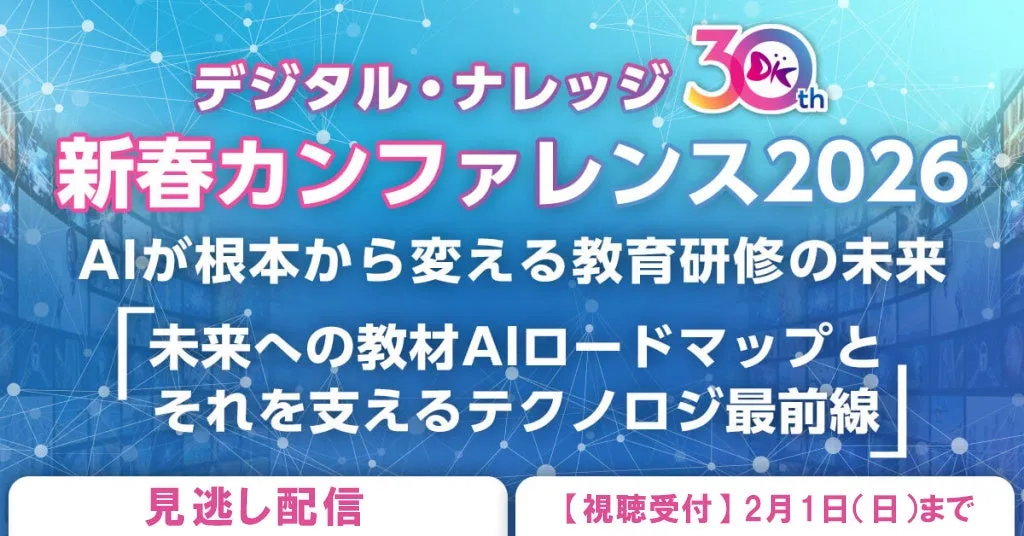
To address the pressing issues surrounding AI in education, Digital Knowledge, Japan's pioneering e-learning solution provider founded in 1995, hosted a significant conference on January 23, 2026. Titled "Digital Knowledge New Year Conference 2026," this event gathered leaders and experts to discuss these themes and offer insights on navigating the complexities of the education AI era. Due to popular demand, a limited-time re-broadcast of the conference is available, allowing broader access to its valuable content.
The keynote lecture, "The Future of Education Training Transformed by AI," was presented by Digital Knowledge's COO, Jiyu Yoshida. This talk highlighted the company's vision and the educational AI roadmap they are developing for the coming years. Through this roadmap, they aim to foster a structured approach to implementing AI technologies in educational settings.
One of the standout presentations was led by Haga Hiroaki, the CEO of Digital Knowledge, who shared the company’s three key initiatives to realize the vision laid out in the AI curriculum roadmap. These initiatives focus on leveraging AI to automate learning material creation, thereby enhancing efficiency and accessibility in educational contexts.
Additionally, Takahiro Hata from the Japan 1 EdTech Association provided a compelling talk on the latest global trends in educational DX (Digital Transformation) and the establishment of technological standards in education. His insights underscored the importance of collaboration among various stakeholders to ensure that educational technologies align with learners' needs and industry requirements.
The conference also presented multiple case studies showcasing Digital Knowledge's initiatives abroad, illustrating real-world applications of automated educational material development. These examples serve not only as proof of concept but also as inspiration for how institutions can harness generative AI technology to improve learning experiences.
The rebroadcast of the Digital Knowledge New Year Conference 2026 is available for viewing until February 15, 2026, providing a unique opportunity for educators, administrators, and tech enthusiasts to engage with cutting-edge discussions on the future of learning.
As we stand at this pivotal moment in the evolution of educational technology, it's essential that educators and institutions adopt a proactive stance. Embracing generative AI can foster more effective learning environments, but only if we also remain vigilant in ensuring quality and clarity in educational content. By addressing the chaos that accompanies such technological advancements, we can work towards creating a more efficient, equitable, and enlightening educational landscape for future generations. Together, let’s build a bridge to an informed knowledge society, where education knows no bounds.
For more information about Digital Knowledge and to access the conference re-broadcast, visit their website. Their commitment to fostering an effective learning ecosystem through innovative solutions remains clear as they celebrate their 30th anniversary in the industry.





To address the pressing issues surrounding AI in education, Digital Knowledge, Japan's pioneering e-learning solution provider founded in 1995, hosted a significant conference on January 23, 2026. Titled "Digital Knowledge New Year Conference 2026," this event gathered leaders and experts to discuss these themes and offer insights on navigating the complexities of the education AI era. Due to popular demand, a limited-time re-broadcast of the conference is available, allowing broader access to its valuable content.
The keynote lecture, "The Future of Education Training Transformed by AI," was presented by Digital Knowledge's COO, Jiyu Yoshida. This talk highlighted the company's vision and the educational AI roadmap they are developing for the coming years. Through this roadmap, they aim to foster a structured approach to implementing AI technologies in educational settings.
One of the standout presentations was led by Haga Hiroaki, the CEO of Digital Knowledge, who shared the company’s three key initiatives to realize the vision laid out in the AI curriculum roadmap. These initiatives focus on leveraging AI to automate learning material creation, thereby enhancing efficiency and accessibility in educational contexts.
Additionally, Takahiro Hata from the Japan 1 EdTech Association provided a compelling talk on the latest global trends in educational DX (Digital Transformation) and the establishment of technological standards in education. His insights underscored the importance of collaboration among various stakeholders to ensure that educational technologies align with learners' needs and industry requirements.
The conference also presented multiple case studies showcasing Digital Knowledge's initiatives abroad, illustrating real-world applications of automated educational material development. These examples serve not only as proof of concept but also as inspiration for how institutions can harness generative AI technology to improve learning experiences.
The rebroadcast of the Digital Knowledge New Year Conference 2026 is available for viewing until February 15, 2026, providing a unique opportunity for educators, administrators, and tech enthusiasts to engage with cutting-edge discussions on the future of learning.
As we stand at this pivotal moment in the evolution of educational technology, it's essential that educators and institutions adopt a proactive stance. Embracing generative AI can foster more effective learning environments, but only if we also remain vigilant in ensuring quality and clarity in educational content. By addressing the chaos that accompanies such technological advancements, we can work towards creating a more efficient, equitable, and enlightening educational landscape for future generations. Together, let’s build a bridge to an informed knowledge society, where education knows no bounds.
For more information about Digital Knowledge and to access the conference re-broadcast, visit their website. Their commitment to fostering an effective learning ecosystem through innovative solutions remains clear as they celebrate their 30th anniversary in the industry.
Topics Consumer Products & Retail)
【About Using Articles】
You can freely use the title and article content by linking to the page where the article is posted.
※ Images cannot be used.
【About Links】
Links are free to use.