



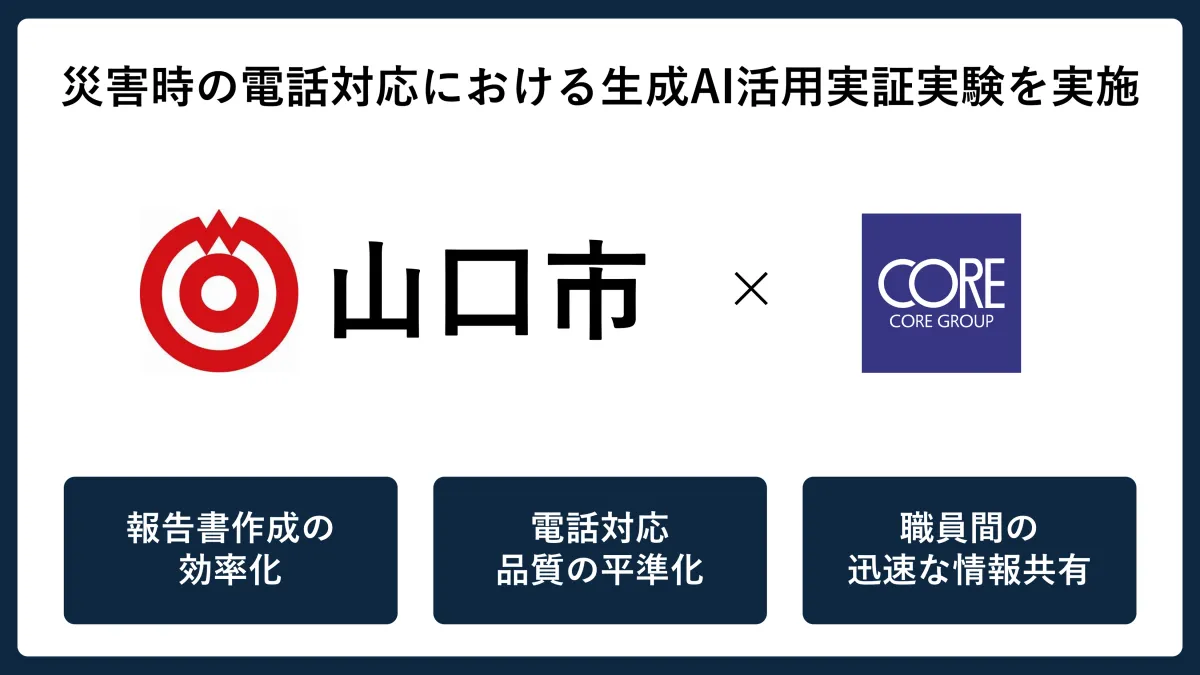
Core Innovations in Disaster Response through AI: A Case Study in Yamaguchi City
Revolutionizing Disaster Response with AI
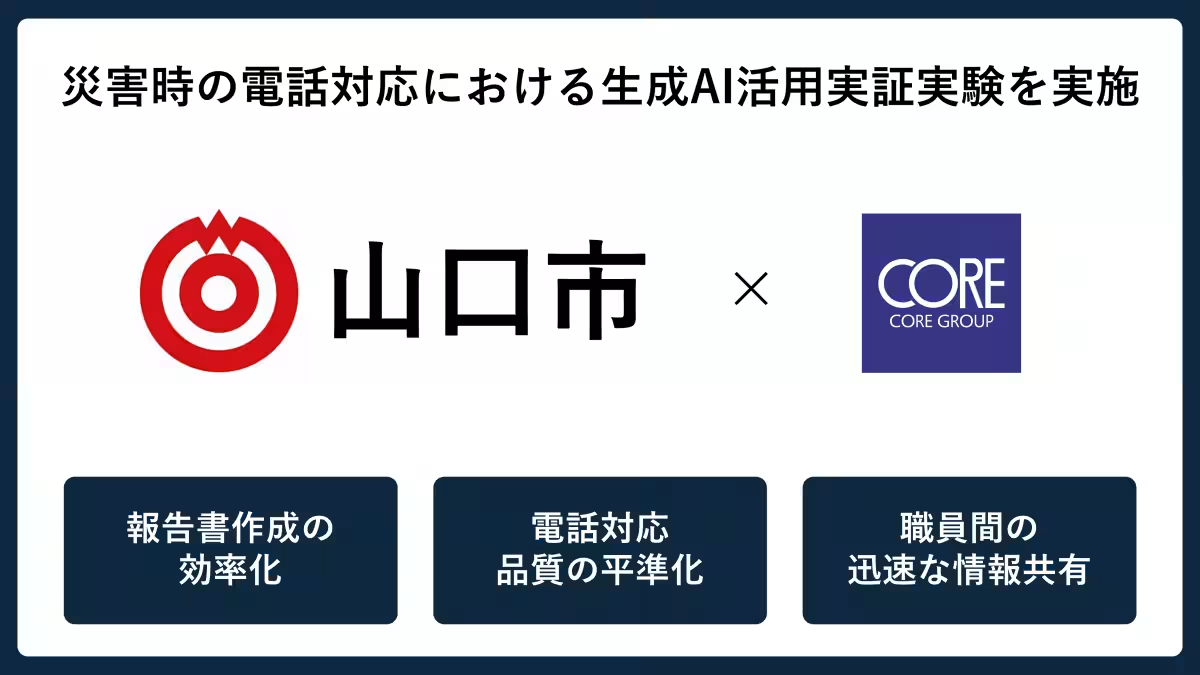
Core Inc., based in Setagaya, Tokyo, has successfully implemented a proof of concept (PoC) in collaboration with the Disaster Crisis Management Division of Yamaguchi City. The aim of this initiative is to streamline telephone response operations during disasters and to facilitate swift initial responses utilizing generative AI-based systems. This project lays the groundwork for the future introduction of a highly efficient telephone reception support system.
Background and Challenges
In the aftermath of a disaster, local governments receive an overwhelming number of phone calls from residents, which demand significant resources for effective handling. Additionally, with frequent personnel changes in municipalities, newly assigned staff or supportive personnel often manage the initial response, leading to inconsistencies in the quality of phone handling. The main challenges identified include:
- - Preventing important information from being overlooked
- - Ensuring the accuracy of recorded data
- - Facilitating rapid information sharing
- - Alleviating the psychological burden on staff members
To tackle these key issues, Core and Yamaguchi City launched a proof of concept focused on automating and standardizing telephone response quality with generative AI technology.
Overview of the Proof of Concept
This PoC was conducted over three days, from February 3rd to 4th and on the 12th, 2026, at the Disaster Crisis Management Division in Yamaguchi City. The key areas of verification were as follows:
1. Accuracy of AI voice recognition and transcription
2. Automated creation of disaster information reports
3. Detection and advice on data entry omissions
4. Transcription and report creation in foreign languages
By employing generative AI to assist staff in information gathering and report writing, it aims to enable less-experienced personnel to manage duties efficiently and effectively.
Major Achievements of the Proof of Concept
The results of this proof of concept highlighted several important outcomes:
1. Voice Recognition and Transcription Accuracy
The transcription accuracy received a score of 3.9 out of 5 in participant surveys, demonstrating that even local dialects and onomatopoeic expressions were captured without disrupting operations.
2. Automated Report Generation
The time required to complete reports was predicted to decrease by approximately 70%. Key details such as names, contact information, and addresses were automatically entered from calls, with accurate summaries generated. Continuous learning concerning geographical names indicates potential further improvements in report efficiency.
3. Advice and Detection for Data Entry Omissions
The effectiveness of the data entry support function scored 3.8 out of 5 in surveys, confirming its utility; however, suggestions for improvements in user interface design were noted.
4. Foreign Language Transcription and Report Generation
Calls conducted in Chinese, French, Korean, and Spanish were instantaneously transcribed, allowing for the production of translated summaries and automated report generation.
These support functionalities significantly lessened the burden of handwritten records for inexperienced staff and proved to be effective tools for operational support.
Overall Assessment of the Proof of Concept
The experiment engaged over half of the anticipated responders, including four team leaders who would manage assistance during disasters. In feedback surveys, 85% rated the concept with top marks on a five-point scale, showing overwhelming support for deployment in real scenarios. Participants also expressed a desire for implementation, emphasizing the proof of concept’s beneficial results concerning on-site challenges.
Comment from Yamaguchi City’s Disaster Crisis Management Division
Mr. Ota from Yamaguchi City noted that this proof of concept unveiled new possibilities in disaster response operations. Especially, the capability to transcribe call content in real time and the automatic integration into reports significantly improved the quality and speed of initial responses, effectively bridging the gap caused by varying levels of employee experience. Additionally, the practicality of multilingual support in situations involving inquiries from foreign citizens and tourists is deemed highly effective, easing the psychological strain on staff while facilitating precise information organization. The implementation period was constructive, allowing for comprehensive feedback, improvement suggestions, and insights regarding future scalability, making this a meaningful endeavor beyond mere technical validation.
Future Prospects for Product Evolution
Based on feedback from this proof of concept, Core aims to evolve from a simple transcription tool to a potent decision-making tool for understanding and sharing information during disasters. Efforts will focus on enhancing mapping integration, refining user interface, and improving recognition accuracy for place names and unique identifiers, pushing towards full operational readiness.
About Core Inc.
Core Inc. positions itself as a ‘solution platformer’, addressing societal and industrial challenges via ICT. Its strength lies in providing comprehensive solutions from planning and design to development, operation, and maintenance, thereby facilitating the evolution of client business models and contributing to sustainable value creation.
https://www.core.co.jp/
For Investors
Please note that this press release serves to inform about the qualitative progress of our business and is not intended as an investment solicitation. For the latest updates concerning our performance and management indicators, please refer to our financial statements and disclosures.
Contact Information
Core Inc. Future Solutions Company
TEL: 03-3795-5153
E-Mail: [email protected]
Topics Other)




【About Using Articles】
You can freely use the title and article content by linking to the page where the article is posted.
※ Images cannot be used.
【About Links】
Links are free to use.