



EAGLYS Releases 2025 Report on Secret Computing for Researchers
In a recent development, EAGLYS, a Tokyo-based company, has unveiled its eagerly awaited "Secret Computing Report 2025." This publication meticulously compiles and interprets significant research papers on secret computing, specifically targeting the advancements and insights expected in the year 2025. For researchers and enthusiasts in the field, this report represents a significant resource, providing a nuanced understanding of essential topics such as speed optimization, security measures, applications, and notable trends in secret computing.
The report is the result of careful research conducted by EAGLYS' own researcher, Wakatsuki. He presents in-depth analyses of key papers segmented according to the four crucial angles mentioned above. These analyses are accessible in Japanese, ensuring that a broader audience can engage with complex concepts without needing extensive technical background knowledge.
Comprising 30 pages, the report’s structure is designed to provide clarity and insight. The first half of the report offers an overview of the year’s most compelling topics, allowing readers to grasp key takeaways without delving into overly technical specifics. Furthermore, it includes chapter impressions, which serve as guides to the critical discussions within.
In the section that focuses on the speed of secret computing, the report emphasizes work by A. Alexandru, A. Kim, and Y. Polyakov, whose paper titled "General Functional Bootstrapping using CKKS" was presented at Eurocrypt 2025. The authors aim to enhance the efficiency of secret computing processes through innovative methodologies characterized by their applicability in practical scenarios.
When discussing security, the same authors’ work continues to shine a light on effective mechanisms to safeguard data in secret computing environments. Their findings underscore various approaches that can be implemented to create more robust systems capable of withstanding potential breaches.
Moreover, the report delves into the various applications of secret computing by highlighting the paper by M. Cho, W. Chung, and collaborators, titled "FRAST: TFHE-friendly Cipher Based on Random S-Boxes." This research, shared at FSE 2025 and ToSC 2024, illuminates the rich possibilities that secret computing holds in developing secure algorithms that can transform the way data encryption is conducted.
Lastly, the report addresses intriguing themes within secret computing, featuring research led by H. Corrigan-Gibbs, A. Henzinger, Y. T. Kalai, and V. Vaikuntanathan. Their work, titled "Somewhat Homomorphic Encryption from Linear Homomorphism and Sparse LPN," presented at Eurocrypt 2025, discusses groundbreaking findings which could pave the way for the next generation of encryption methodologies.
Researchers and practitioners interested in this cutting-edge field can download the “Secret Computing Report 2025” for free. It promises to be a thorough resource that not only highlights current achievements but also sets the stage for future exploration in the domain of secret computing. By providing a detailed yet accessible analysis of significant papers, EAGLYS is empowering the research community with vital information that is crucial for advancing knowledge and fostering further innovation in secret computing. To access and download the report, follow the link provided below.
Download Secret Computing Report 2025
The report is the result of careful research conducted by EAGLYS' own researcher, Wakatsuki. He presents in-depth analyses of key papers segmented according to the four crucial angles mentioned above. These analyses are accessible in Japanese, ensuring that a broader audience can engage with complex concepts without needing extensive technical background knowledge.
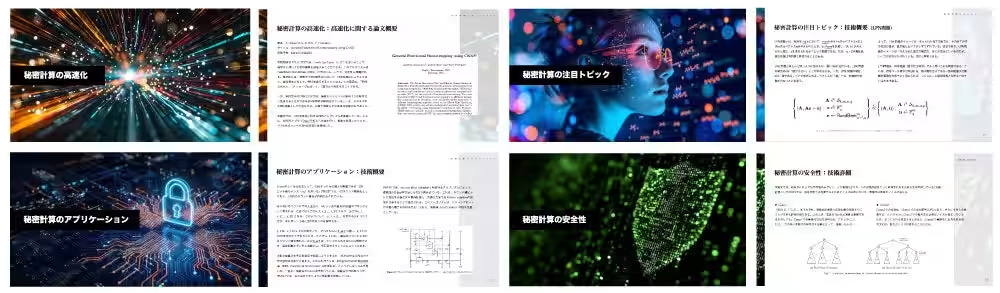
Comprising 30 pages, the report’s structure is designed to provide clarity and insight. The first half of the report offers an overview of the year’s most compelling topics, allowing readers to grasp key takeaways without delving into overly technical specifics. Furthermore, it includes chapter impressions, which serve as guides to the critical discussions within.
In the section that focuses on the speed of secret computing, the report emphasizes work by A. Alexandru, A. Kim, and Y. Polyakov, whose paper titled "General Functional Bootstrapping using CKKS" was presented at Eurocrypt 2025. The authors aim to enhance the efficiency of secret computing processes through innovative methodologies characterized by their applicability in practical scenarios.
When discussing security, the same authors’ work continues to shine a light on effective mechanisms to safeguard data in secret computing environments. Their findings underscore various approaches that can be implemented to create more robust systems capable of withstanding potential breaches.
Moreover, the report delves into the various applications of secret computing by highlighting the paper by M. Cho, W. Chung, and collaborators, titled "FRAST: TFHE-friendly Cipher Based on Random S-Boxes." This research, shared at FSE 2025 and ToSC 2024, illuminates the rich possibilities that secret computing holds in developing secure algorithms that can transform the way data encryption is conducted.
Lastly, the report addresses intriguing themes within secret computing, featuring research led by H. Corrigan-Gibbs, A. Henzinger, Y. T. Kalai, and V. Vaikuntanathan. Their work, titled "Somewhat Homomorphic Encryption from Linear Homomorphism and Sparse LPN," presented at Eurocrypt 2025, discusses groundbreaking findings which could pave the way for the next generation of encryption methodologies.
Researchers and practitioners interested in this cutting-edge field can download the “Secret Computing Report 2025” for free. It promises to be a thorough resource that not only highlights current achievements but also sets the stage for future exploration in the domain of secret computing. By providing a detailed yet accessible analysis of significant papers, EAGLYS is empowering the research community with vital information that is crucial for advancing knowledge and fostering further innovation in secret computing. To access and download the report, follow the link provided below.
Download Secret Computing Report 2025
Topics Consumer Technology)
【About Using Articles】
You can freely use the title and article content by linking to the page where the article is posted.
※ Images cannot be used.
【About Links】
Links are free to use.