



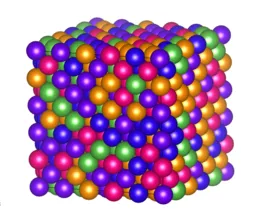
Quantum Algorithms Once Struggling with Limited Data Accelerate Complex Material Development
Accelerating Complex Materials Development with Quantum Algorithms
Introduction to Quantum Circuit Learning
In recent years, the application of information science to material development has gained momentum, primarily through Materials Informatics (MI). This approach leverages machine learning to improve efficiency in creating new materials. However, the scarcity of experimental data and the inherent complexities at the atomic level pose challenges, particularly when attempting predictions with minimal data.
Prof. Tomoyuki Yamamoto from Waseda University and a research group from Fujitsu have conducted experiments utilizing Quantum Circuit Learning (QCL), showcasing its effectiveness in estimating the hardness of complex high-entropy alloys, a key material type. This innovative method has demonstrated superior predictive capabilities over traditional machine learning techniques, especially in scenarios with limited datasets.
Significance of the Research
The primary findings of this research include:
- - The utility of quantum algorithms (specifically QCL) compared to conventional machine learning models in providing accurate predictions in the domain of material science.
- - The capability of QCL to offer precise predictions from a small amount of experimental data, paving the way for accelerated development of materials with complex structures.
The results are set to be published in Scientific Reports on April 20, 2026.
Current State of Materials Informatics
Recent studies show a shift toward incorporating MI in materials science. Traditionally, researchers relied on experiential knowledge for material creation, which proved time-consuming and costly. Modern practices utilizing machine learning techniques—such as linear models, decision trees, and neural networks—have expedited this process. However, key challenges remain:
- - Data Scarcity: Existing datasets for machine learning in material sciences are often limited to hundreds of entries at best, hindering the predictive capabilities of deeper models that require extensive data.
- - Prediction Capabilities: Standard machine learning models struggle with extrapolating data from known to unknown territories, often leading to inaccuracies and overfitting.
Advancements Brought by QCL
To address these limitations, the team applied quantum circuit learning. This advanced methodology offers high versatility and predictive precision for materials development, particularly when facing limited experimental data. The study specifically focused on high-entropy alloys, utilizing five or more metals mixed in nearly equal proportions to demonstrate QCL's effectiveness in predicting material properties.
Key Features of Quantum Circuit Learning
1. Hybrid Quantum-Classical Algorithm: Designed for noisy intermediate-scale quantum (NISQ) devices, QCL operates by blending quantum computations with classical optimization techniques for enhanced learning.
2. Enhanced Expression and Reduced Overfitting: The quantum characteristics allow QCL to maintain high expression capabilities, which minimize the overfitting associated with data scarcity.
3. Feature Selection: For broader applicability, QCL utilizes properties derived from chemical compositions rather than crystallographic structures, processing 24 variables into a 10-dimensional input.
These unique features enabled QCL to outperform traditional models. For instance, during the comparison of hardness predictions, QCL showed remarkable strengths in extrapolation beyond known ranges, maintaining accuracy even with sparse data sets.
Societal Impacts and Future Perspectives
The implications of this research extend to various sectors:
1. Material Development Speed: By facilitating high-precision predictions from minimal data, the methodology used in QCL could allow for substantial reductions in time and costs associated with new material design, thus accelerating their introduction to the market.
2. Creation of High-Performance Materials: The applications of high-entropy alloys may lead to innovations in industries necessitating robust materials, such as aerospace engineering and next-generation nuclear reactors.
3. Practical Application of Quantum Computing: Demonstrating QCL's application potential using current quantum technologies illustrates the practical benefits of quantum computing, encouraging further advancements in the field.
Challenges Ahead
Though promising, several hurdles require addressing for real-world implementation:
- - Computational Time: Today's simulations demand extended computation periods, indicating a vital need for the refinement of quantum algorithms and hardware.
- - Validation on Quantum Devices: Continued validation on actual quantum hardware is necessary to prove QCL's superiority over existing methodologies thoroughly.
- - Broader Applicability: The adaptability of QCL to other complex materials remains to be tested, optimizing the technique for diverse applications.
In solving these challenges, the potential exists for developing a more effective material discovery method, facilitating higher efficiency in unknown material explorations.
Conclusion
In conclusion, as machine learning continues to evolve, achieving substantial breakthroughs in material science may become a reality, paving the way for revolutionary advancements in technology through the integration of quantum computing. The study by Prof. Yamamoto and Fujitsu's team not only highlights QCL's potential but also marks a significant step toward practical applications in materials development.
Publication Information:
Journal: Scientific Reports
Title: Efficient Quantum Algorithm for the Design of Complex Materials: Quantum Circuit Learning
Authors: Sota Osaki, Kazuki Hoshitani, Makoto Nakamura, Koichi Kimura, Tomoyuki Yamamoto (Waseda University)
Publication Date: April 20, 2026
Publication URL: Link to Paper
DOI: 10.1038/s41598-026-43584-8
Topics Consumer Technology)
【About Using Articles】
You can freely use the title and article content by linking to the page where the article is posted.
※ Images cannot be used.
【About Links】
Links are free to use.