



How Lumission's Business Model Reduces Employee Turnover Rates Effectively
Introduction to Employee Retention Strategies
In recent discussions about workforce stability, LUMISSION Co., Ltd., located in Minato Ward, Tokyo, has unveiled its innovative management concept themed around the idea of reducing employee turnover rates through a comprehensive approach called Five-Way Good Management.
This initiative emphasizes creating a structure within organizations that minimizes the likelihood of employees leaving by reassessing the criteria that managers use to make decisions rather than solely focusing on improving systems or enhancing employee benefits.
The Underlying Problem of Turnover
Many companies have implemented various strategies to improve retention, including:
- - Revising evaluation systems
- - Introducing one-on-one meetings
- - Enhancing employee benefits
- - Strengthening training programs
Despite these efforts, companies often hear from their employees, “Why are people still not staying?” Lumission believes the root cause lies in the lack of shared understanding regarding the criteria for managerial decisions. When business leaders change their decisions based on the context without providing clear reasons, employees are left in a constant state of uncertainty and anxiety about their roles in the company.
Understanding the Concept of 'Employee Good'
The term Employee Good within the Five-Way Good Management framework does not merely refer to creating a comfortable work environment. It involves a deeper understanding of:
- - Why certain decisions are prioritized
- - Why specific objectives are set
- - How individual roles align with the company's future
When these concepts are clearly articulated and shared within the organization, employees are less likely to leave because they understand the rationale behind decisions, rather than exiting simply due to feeling overwhelmed.
The Common Structures of Companies with Low Turnover Rates
1. Consistent Decision-Making Criteria
In organizations where differing opinions come from supervisors or departments, employees often feel uneasy. However, in companies with clear decision-making criteria, everyone moves in the same direction, enhancing psychological safety among staff.
2. Clear Path for Growth
Employees are more likely to leave when they don't see a future for themselves in the organization. When roles, expectations, and evaluation systems are well-defined, employees can envision their futures within the company.
3. Unified Communication Between Management and Employees
Organizations that fail to translate principles into actionable behaviors often reduce work to mere tasks. On the other hand, companies that connect decision-making with action experience higher motivation and retention rates.
Positioning Employee Good within Five-Way Good Management
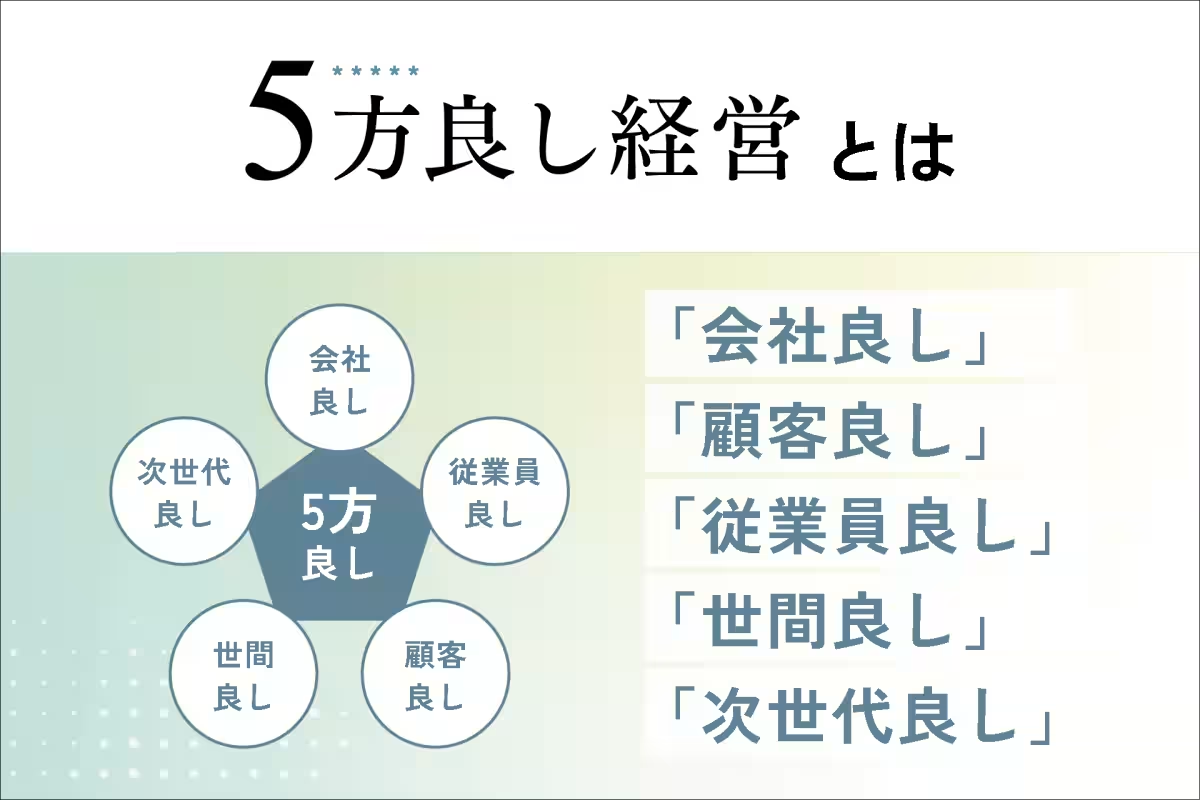
The Five-Way Good Management philosophy aims for a harmonious existence among five key areas that must thrive concurrently: the company, its employees, customers, society, and future generations. Employee Good can only be achieved when the other four areas are well-aligned.
- - Company Good: Profitability and sustainability
- - Customer Good: Value provision and trust
- - Societal Good: Social significance
- - Future Generational Good: Sustainable structures for the future
When this cycle is in balance, employees are not just likely to stay; they desire to continue working for the company.
The CEO as a Representation of Organization's Vision
Lumission promotes the **
Topics Other)
【About Using Articles】
You can freely use the title and article content by linking to the page where the article is posted.
※ Images cannot be used.
【About Links】
Links are free to use.