



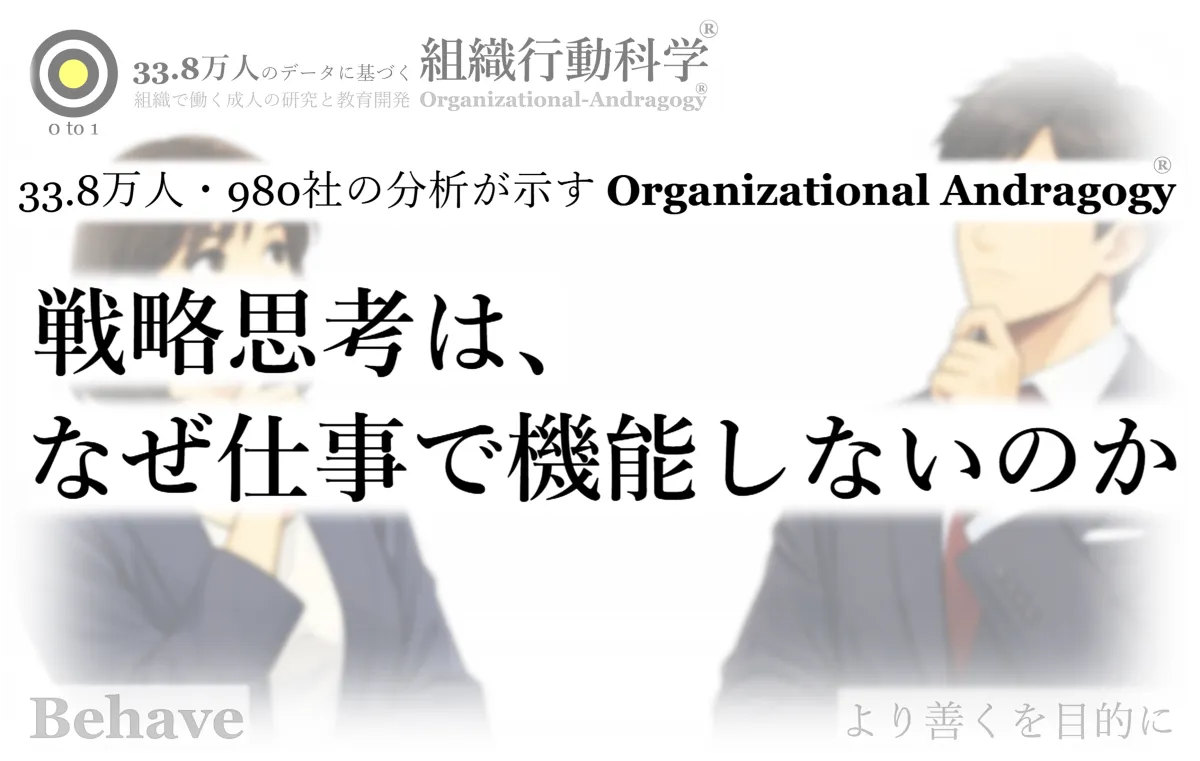
Why Strategic Thinking Fails in the Workplace: Insights from a Study of 338,000 People
Why Strategic Thinking Fails in the Workplace
In a recent report published by Request Inc. (Request株式会社), which specializes in organizational behavior science, the findings derived from analyzing data from 338,000 individuals across 980 companies reveal critical insights into why strategic thinking often does not function as intended within workplaces. Rather than focusing solely on the competencies and methods of strategic thought, the report emphasizes understanding the design of work itself.
The Real Issue: Organizational Structure Over Strategy
The report clarifies that the functioning of strategic thinking is not hampered by an inability to think strategically; rather, it is obstructed by organizational structures that allow work to proceed without necessarily requiring strategic judgment. Despite familiarity and use of strategic frameworks such as 3C and SWOT in many companies, there remains an independence between the frameworks and actual decision-making outcomes.
Companies often find themselves in a cycle where:
- - Frameworks are applied, yet decisions remain unchanged.
- - Analysis is conducted, yet conclusions do not diverge or lead to actionable results.
- - Documentation increases, but business momentum fails to materialize.
This poses a clear conclusion: it is not that strategic thinking is ineffective; it’s that the surrounding work environment often circumvents the need for strategic judgment, hindering its prominence in operations.
Redefining the Role of Strategic Frameworks
The report advocates for a broader understanding of strategic frameworks. Instead of viewing them merely as procedural tools or templates that yield answers when filled out, it suggests redefining them as structures that organize past decisions and their outcomes, facilitating their reuse in future decision-making contexts. This insight necessitates breaking knowledge down into two types for better clarity:
- -
- -
When strategic thinking is consistent with the latter, it becomes evident that true understanding only arises from direct experience with the outcome of decisions. Knowledge that is separated from practical application has limited utility.
Why Does Strategic Thinking Converge to Generalities?
It is not merely a lack of ability or analytical skill that leads analyses to converging on generalizations. If work does not involve assuming judgment, intrinsic detail often goes missing, leading to analyses that conclude prematurely. Within environments primarily relying on precedent and conformity, essential learning is undermined. Critical reflections on the discarded options, bets taken, and resulting outcomes are lost, culminating in decision-making processes that yield sameness across different analytical attempts.
Assessing the Functionality of Strategic Thinking
In this context, the report proposes three pivotal questions to evaluate whether strategic thinking effectively manifests in practice:
1. Can you specifically identify what has been discarded in this job?
2. Are the results of those judgments provided back as facts afterward?
3. Are those results periodically updated as decision-making standards?
Should the answers to any of these questions falter, it suggests that the challenge lies not in the effectiveness of strategic thinking itself, but in the structural design of the work that fails to elicit strategic judgment.
Overview of the Report
The focus of this report extends beyond strategic thinking alone; it showcases how 'experience-based knowledge,' formed through the cycles of judgment, hypothesis, failure, and validation, operates under various organizational structures. Unique in its approach, it does not revert to capability theories or training discussions but instead reframes the issue as a matter of 'work design' concerning precedents, accountability, evaluation, and decision-making placements.
For anyone interested in the detailed analysis or related resources, further information can be accessed through the links provided in the report, including a downloadable version and additional insights into the Human Capital Development Planning Center’s work, which aims to better understand human growth and development within organizational contexts.
Contact Information
For inquiries or further details, reach out via email: [email protected].
Request Inc. - Company Overview: Corporate Profile
Download the Company Profile: Download Here
CEO Profile - Tomoyasu Kohata: Profile Here

Topics Business Technology)

【About Using Articles】
You can freely use the title and article content by linking to the page where the article is posted.
※ Images cannot be used.
【About Links】
Links are free to use.