



EY Supports Japan's Ministry of Land, Infrastructure, Transport and Tourism in Green Infrastructure Financing Guidelines
EY Supports Development of Green Infrastructure Financing Guidelines
EY Strategy and Consulting (EYSC), led by CEO Satoshi Kondo and based in Chiyoda, Tokyo, has provided support to Japan's Ministry of Land, Infrastructure, Transport and Tourism (MLIT) in compiling the "Finance Guidelines for Green Infrastructure (Interim Summary)." This first comprehensive guideline aims to expand investment in green infrastructure by structuring various funding methods. The guidelines are designed to facilitate the implementation of green infrastructure projects by both public and private sectors while leveraging EYSC's expertise in social finance aimed at utilizing natural capital and creating social value.
In recent years, as the intensity of natural disasters due to climate change and biodiversity loss has become more serious, green infrastructure (GI) has gained attention both domestically and internationally as a solution to societal issues by utilizing the diverse functions of nature. GI refers to social capital that generates combined value from both nature and society, aiding in risk reduction from water disasters, cooling urban heat, ecosystem conservation, and enhancing the attractiveness of communities.
The importance of GI is clearly positioned in the mid- and long-term policy "GI Promotion Strategy 2030," formulated by MLIT, which aims to promote the sustainable development of lands, cities, and regions using the various functions of nature. Projects related to strengthening resilience and sustainable urban development are being actively considered across the country involving various stakeholders.
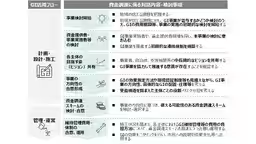
These new guidelines systematically outline key elements necessary for real-world practice, highlighting the clear process to visualize the value of GI projects and connect them to appropriate funding sources. Here are some of the key features:
- - Basic concepts and workflow of GI
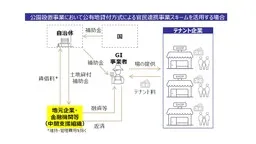
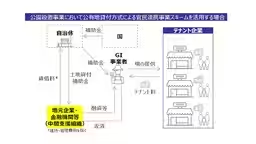
- - Types of projects and funding methods (such as green bonds, public-private partnerships (PPP/PFI), pay-for-success (PFS/SIB), credits, donations, and grants)
- - Clarifying methods to organize project value and benefits using logic models
- - Framework for cooperation between public and private sectors to promote funding and project execution.
The guidelines are expected to serve as a practical reference for local developers, financial institutions, investors, and municipalities as they assess investment opportunities and design schemes for GI.
Comment from EySC Director Keiichi Hasegawa
Keiichi Hasegawa, head of the Public and Social Infrastructure Sector at EYSC, stated: "This guideline is the first practical guide systematically organized from the perspective of funding regarding the multifaceted value of GI, which is gaining significance amid increasing climate change risks and ecosystem degradation. Although the benefits of GI span various aspects such as disaster prevention, environmental improvement, and enhancement of regional value, they are often difficult to capture in the market as external economic effects, making investment decisions complicated. By visualizing value through logic models and clarifying the relationship between project types and funding schemes (including green bonds, PPP/PFI, and credits), this guideline aims to provide a foundation for municipalities, businesses, financial institutions, and investors to discuss in a common language. We hope this contributes to the expansion of GI investments through public-private cooperation and the formation of sustainable regional infrastructure."
Finally, the guidelines can be accessed via the MLIT website.
About EY
EY aims to create new value for clients, members, society, and the planet while establishing trust in capital markets towards building a better society. Utilizing data, AI, and advanced technology, EY’s teams support clients in shaping their futures with confidence while delivering solutions to urgent current and future challenges. EY’s areas of expertise span assurance, consulting, tax, strategy, and transactions, supported by industry knowledge and a diverse network of global partners across over 150 countries.
All in to shape the future with confidence.
EY refers to the global network of Ernst & Young Global Limited and may refer to one or more member firms, each of which is a legally distinct entity. Ernst & Young Global Limited is a UK limited liability company and does not provide customer services. Please visit ey.com/privacy for information on how EY collects and uses personal data as well as the rights individuals have regarding data protection laws. EY member firms cannot provide legal services where prohibited by local law. For more information about EY, kindly visit ey.com.
EY Consulting Services
EY’s consulting services aim to transform businesses through the power of people, technology, and innovation, contributing to a better society. We strive to be the world's leading consultants in transformation. Encompassing over 70,000 EY consultants with diverse skills, we focus on people-centric approaches, rapid technology implementation, and large-scale innovation to support client transformations, creating long-term value for people, clients, and society.
For further details, please visit ey.com/ja_jp/consulting.
Topics Business Technology)
【About Using Articles】
You can freely use the title and article content by linking to the page where the article is posted.
※ Images cannot be used.
【About Links】
Links are free to use.