



New Discoveries in Ionosphere Abnormalities Linked to the Showa Tounankai Earthquake
New Discoveries in Ionosphere Abnormalities Linked to the Showa Tounankai Earthquake
Recent research led by Professor Ken Umeno from Kyoto University's Graduate School of Informatics has uncovered compelling evidence of significant anomalies in the ionosphere just prior to the Showa Tounankai earthquake. Using historical handwritten ionograms from the National Institute of Information and Communications Technology (NICT), Professor Umeno identified a rapid increase in electron density beginning approximately one and a half hours before the earthquake struck on December 7, 1944, at 1:36 PM.
This presentation was delivered at the upcoming Japan Earthquake Prediction Society Conference scheduled for December 20, 2025, where Professor Umeno will discuss the correlation between ionospheric anomalies and the detectability of pre-slip—a phenomenon connected to earthquakes.
During the time of the Showa Tounankai earthquake, strict information control was in place due to wartime conditions. However, with predictions of future Nankai Trough earthquakes potentially leading to casualties in the range of 300,000 people, it has become crucial to detect these premonitory signs in a reliable manner to mitigate loss of life dramatically.
Historically, Dr. Akihisa Imamura identified pre-slip through level measurements in the area between Omazaki and Kakegawa, making him one of the few known figures to have reported such phenomena before the earthquake. Previously, the absence of measuring devices for detecting ionospheric anomalies led researchers to believe that such disturbances were non-existent at that time.
Professor Umeno's analysis of NICT's archival data revealed an alarming increase in electron density that aligns remarkably well with known historical data. The publicly available handwritten ionograms can be accessed through NICT's official site at NICT Handwritten Ionograms.
Figures Analyzing Data
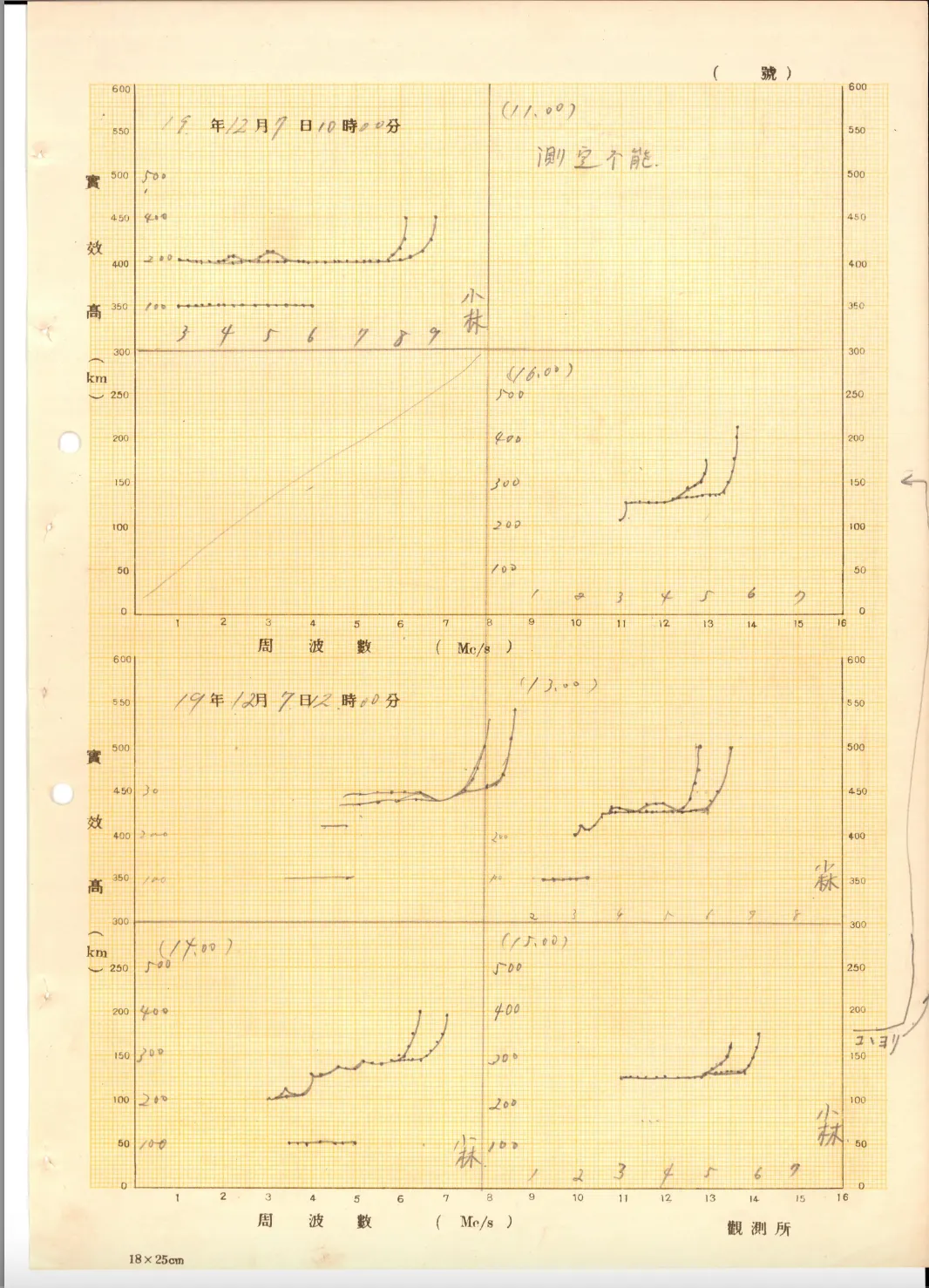
- - Figure 1: This ionogram illustrates the data recorded on December 7, 1944, in Kokubunji. A critical frequency jump to 8.6 MHz indicates a significant spike in electron density, captured precisely at noon on the earthquake day. The frequency is measured according to Army standards, ranging from low to high from left to right.
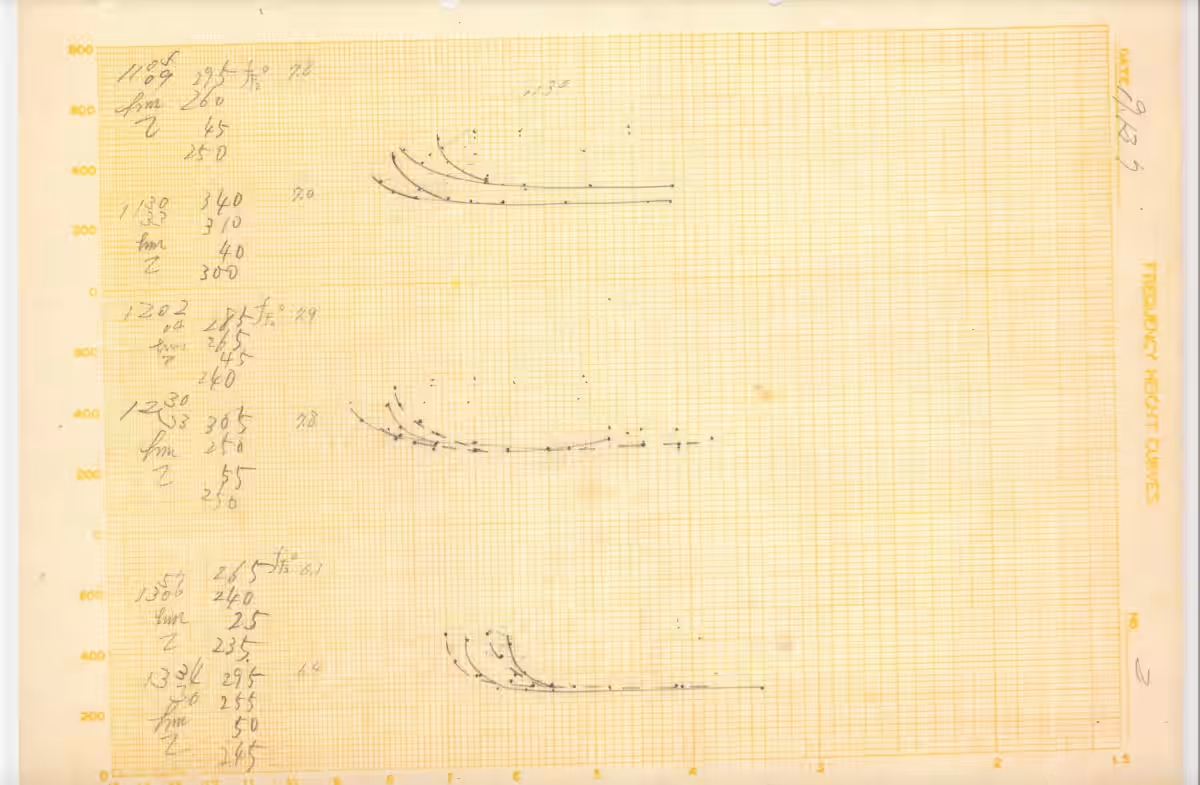
- - Figure 2: Another published ionogram from the same day, recorded at Hiratsuka in Kanagawa Prefecture, shows a critical frequency jump to 7.8 MHz at 12:30 PM. This ionogram adhered to Navy standards, with frequency measured from right to left.
Despite the sophistication of Japan's historical ionospheric observation network, the divergence in standards between Army and Navy methods led to inconsistencies in data representation. However, documents that managed to survive from that era provide critical insights that prove the existence of ionospheric anomalies concurrent with pre-slip phenomena.
Social Impact of This Discovery
Previously, the records related to premonitory signs of Nankai Trough mega earthquakes were scarce, limited to Dr. Imamura's findings. Thanks to the comprehensive ionospheric observation network from before the war, scientists have fortuitously retained substantial observations that affirm the concurrent occurrence of ionospheric anomalies and pre-slip signs before these geological catastrophes. This scientific evidence opens new avenues for monitoring both the crustal movements and ionospheric disturbances expected to precede future earthquakes at the Nankai Trough.
To minimize potential damage from such disasters, it is imperative for government entities to actively adopt measures to establish observational systems that detect these anomalies. The necessity of studying and understanding the physical correlations between crustal movements and their effects on the ionosphere is now more critical than ever.
Future Research Directions
The exploration of earthquake precursors must encompass both the detection of pre-slip and the ionospheric anomalies that typically occur within a similar timeframe. Setting up a modernized framework involving contemporary instruments (ionosondes and GNSS) will facilitate real-time monitoring and observation network enhancements. Furthermore, investigating the physical causation for ionospheric abnormalities as a consequence of pre-slip phenomena is vital for systemic comprehension.
At Kyoto University's Graduate School of Informatics, the physics statistical science group is endeavoring to elucidate how smectite, a clay-like material found in sub-surface faults, transforms water into 'supercritical water' under high temperature and pressure, thereby gaining insulating properties. This phenomenon is theorized to contribute to the development of coupling models between the ionosphere, crust, and subsurface that resemble an electrical circuit. However, this proposed causal relationship requires experimental verifiability, which remains to be established.
In conclusion, as we advance into an era increasingly fraught with seismic risks, establishing robust methodologies to predict and observe these geological events will play a critical role in safeguarding lives and minimizing disaster impact.
Topics People & Culture)


【About Using Articles】
You can freely use the title and article content by linking to the page where the article is posted.
※ Images cannot be used.
【About Links】
Links are free to use.