




Transforming Cross-Boundary Learning into Results: Research Insights from Organizational Andragogy®
Transforming Cross-Boundary Learning into Results
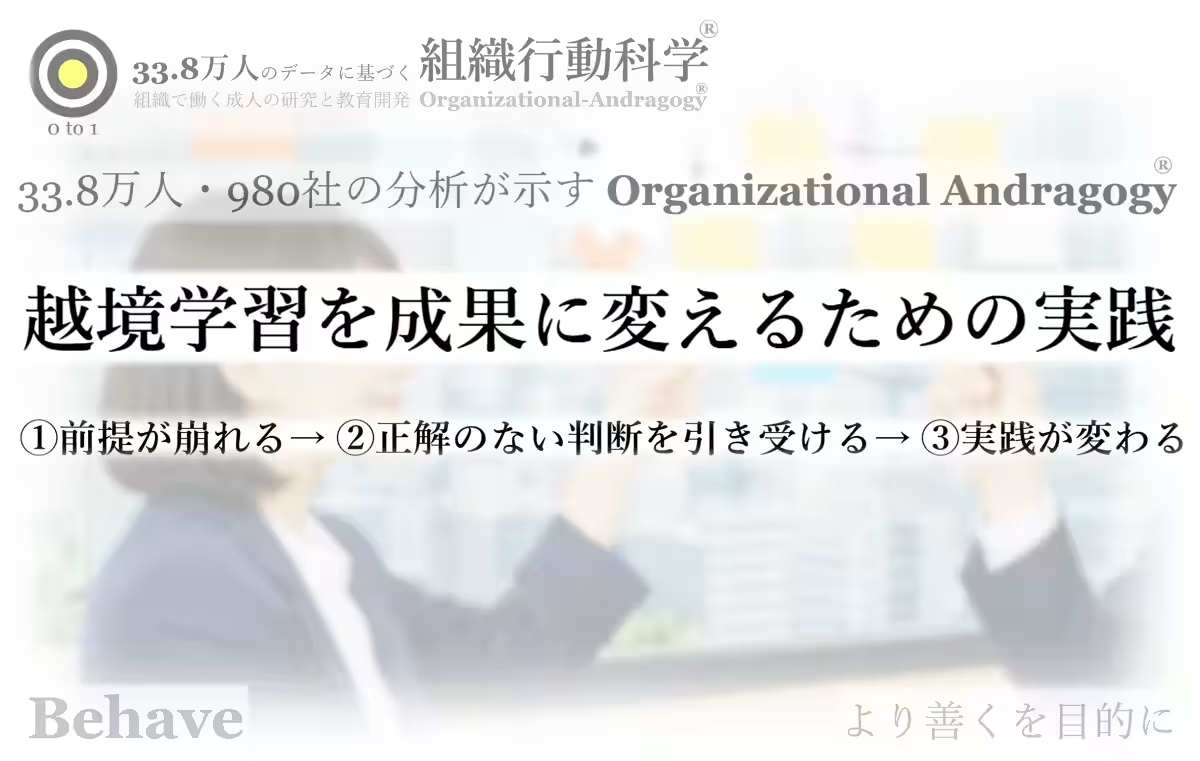
The Request Company, headquartered in Shinjuku, Tokyo, is making significant strides with its report titled "Transforming Cross-Boundary Learning into Results". This report is based on an extensive analysis of behavior data from 338,000 individuals across 980 organizations. It delves into the practical frameworks needed to convert cross-boundary learning into concrete outcomes for organizations.
Understanding the Gap in Cross-Boundary Learning
In recent years, cross-boundary learning has become a prevalent strategy in human resource development and organizational growth. The idea is that by exposing employees to different departments, companies, and industries, they gain broader perspectives that encourage growth. While this expectation is not without merit, there are recurring observations on the ground that raise questions:
1. Employees feel stimulated and learn during the cross-boundary experiences.
2. Sharing sessions or presentations often take place.
3. However, upon returning to their original workplace, there is little to no change in work methods or decision-making quality.
This report aims to dissect this disconnection, identifying it as a structural issue within the workplace rather than a lack of individual motivation or the quality of cross-boundary experiences. The crux of the problem lies in the fact that insights gained during cross-boundary interactions often fail to be integrated as valid forms of judgment in the employees' original workplaces.
Key Findings on Learning Effectiveness
An analysis conducted by the Human Capital Development Planning Center revealed a clear and consistent distinction between organizations where learning translates effectively into results and those where it does not.
In organizations that achieve results, there seems to be:
- - Clearly defined prerequisites for decisions.
- - Documentation of alternatives and the reasoning behind selections.
- - A structured method for updating future conditions based on past decision outcomes.
Conversely, organizations that fail to achieve results tend to exhibit:
- - A tendency to share opinions and anecdotes without formal structure.
- - Outputs that consist solely of conclusions or action items, without a legacy of decision-making trails.
This discrepancy can be attributed not to the occurrence of cross-boundary learning, but to the underlying structure by which original workplaces handle decision-making.
Defining Successful Cross-Boundary Learning
The report defines successful cross-boundary learning as a process wherein:
- - Existing assumptions are challenged.
- - Employees make decisions amidst uncertainty.
- - These decisions lead to tangible changes in practices back at the original workplace.
A notable aspect of this report is its focus on work changes following cross-boundary experiences, as opposed to just evaluating experiences during the learning phase.
Reframing Cross-Boundary Learning
Instead of viewing cross-boundary learning as solely a developmental initiative, the report positions it as a diagnostic tool. It assesses whether the organizational structure facilitates decision-making when core assumptions are disrupted and whether practices can adapt accordingly.
Should cross-boundary learning fail to function, this does not signify a failure of the initiative; rather, it highlights that the organization’s learning structure is not yet adequately developed.
Implementation of Work Design for Minimal Costs
Furthermore, the report illustrates that it is feasible to confirm the existence of effective learning without sophisticated evaluation systems or complex KPIs. By focusing on three core elements, organizations can assess learning efficacy:
- - Prerequisites: Explicitly stating the assumptions behind a task.
- - Decisions: Documenting rejected options and the reasons for these decisions.
- - Updates: Ensuring that expectations and standards are refreshed for future tasks.
Additionally, practical templates for modifying work specifications to be used across meetings, reports, and reviews are suggested, providing a concrete methodology for the reliable establishment of the evaluated elements.
Conclusion and Target Audience
This report, "Transforming Cross-Boundary Learning into Results", presents a comprehensive analysis of the structural obstacles to effective learning, defines crucial work design principles, and offers actionable steps for practitioners, including executives, HR professionals, and managers, to implement practices that can truly change organizational landscapes.
For more details and to download the report, please visit Request Company Downloads.
About Human Capital Development Planning Center
The Human Capital Development Planning Center is dedicated to analyzing behavior data from 338,000 individuals, focusing on rethinking the design of work, roles, and judgment structures, rather than reducing growth and development to individual issues.

Topics Business Technology)

【About Using Articles】
You can freely use the title and article content by linking to the page where the article is posted.
※ Images cannot be used.
【About Links】
Links are free to use.