



Revolutionary Technique Developed for Cost-Effective Purification of Immunoglobulin A
Advancements in Immunoglobulin A Purification Technology
Researchers from the AIST and universities like Hokkaido and Tsukuba have made a significant breakthrough in the purification of Immunoglobulin A (IgA). The new method utilizes zirconia particles, which are cost-effective inorganic materials, to simplify and lower the expenses associated with IgA purification. This advancement could potentially accelerate the development of IgA-based pharmaceuticals aimed at preventing infectious diseases and addressing pandemic challenges.
Overview of Immunoglobulin A
IgA is an essential immune protein found predominantly on mucosal surfaces throughout the body. It plays a crucial role in defending against pathogens such as viruses and bacteria. Despite its promising potential for use as a preventive treatment for infections, actual applications of IgA drugs have been limited. This has largely been due to the high costs associated with its purification processes, which traditionally rely on expensive organic materials designed for specific adsorption of IgA.
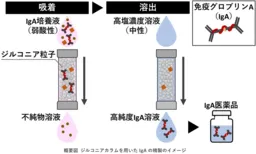
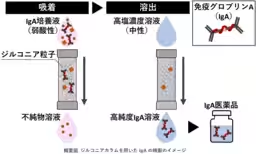
The newly developed technique uses a column filled with zirconia particles, allowing for selective recovery of IgA by simply adjusting the pH and salt concentration of the solution. Such adjustments can be made without adversely affecting the structure or functionality of IgA. Given that zirconia is abundant and low-cost, this purification method could lead to reduced production costs while ensuring the high purity required for pharmaceutical applications.
Significance of the Research
This breakthrough has important implications for public health since IgA can provide immediate immunity against infections, unlike vaccines, which may take days to become effective. Current vaccinations focus on limiting the severity of diseases rather than preventing the actual entry of pathogens. In contrast, IgA has the potential to block pathogen entry, making it a highly valuable therapeutic option.
Traditionally, IgA is produced utilizing human cells, which can introduce various impurities that may trigger adverse effects upon administration. To address this, high-purity purification techniques are necessary. The innovative use of zirconia particles signifies a major step toward making IgA purification more feasible and cost-effective.
Research Techniques and Outcomes
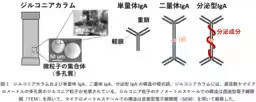
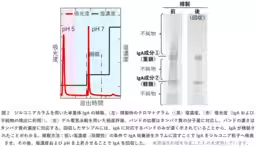
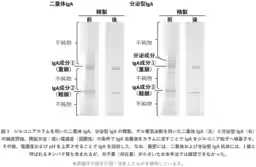
In this research, porous zirconia particles were synthesized using a spray-drying method, resulting in micron-sized spherical particles. The study indicates that the use of these particles in a chromatography setup can effectively purify different forms of IgA, including monomeric, dimeric, and secretory IgA, with considerable reductions in impurities detected through gel electrophoresis.
The optimization of purification conditions, including systematic adjustments in solution parameters, enabled clear distinctions between purified IgA and contaminating substances. Despite the presence of nucleic acid and non-proteinaceous impurities, the zirconia column successfully captured the IgA while allowing other components to pass through, demonstrating its effectiveness and reusability.
Future Directions
With confirmation of its ability to purify IgA at high purity levels, the focus will now shift towards improving purification yields. Future work will involve surface modification of the zirconia particles to enhance yields further, paving the way for more practical IgA purification methodologies in the upcoming health and pharmaceutical applications.
This research has received support from the Japan Agency for Medical Research and Development (AMED) and the Japan Science and Technology Agency (JST).
Published findings can be accessed in the journal "ACS Applied Materials & Interfaces" under the title Purification of Immunoglobulin A Using Mesoporous Zirconia Particles Coated with Phosphate.
Topics Health)
【About Using Articles】
You can freely use the title and article content by linking to the page where the article is posted.
※ Images cannot be used.
【About Links】
Links are free to use.