



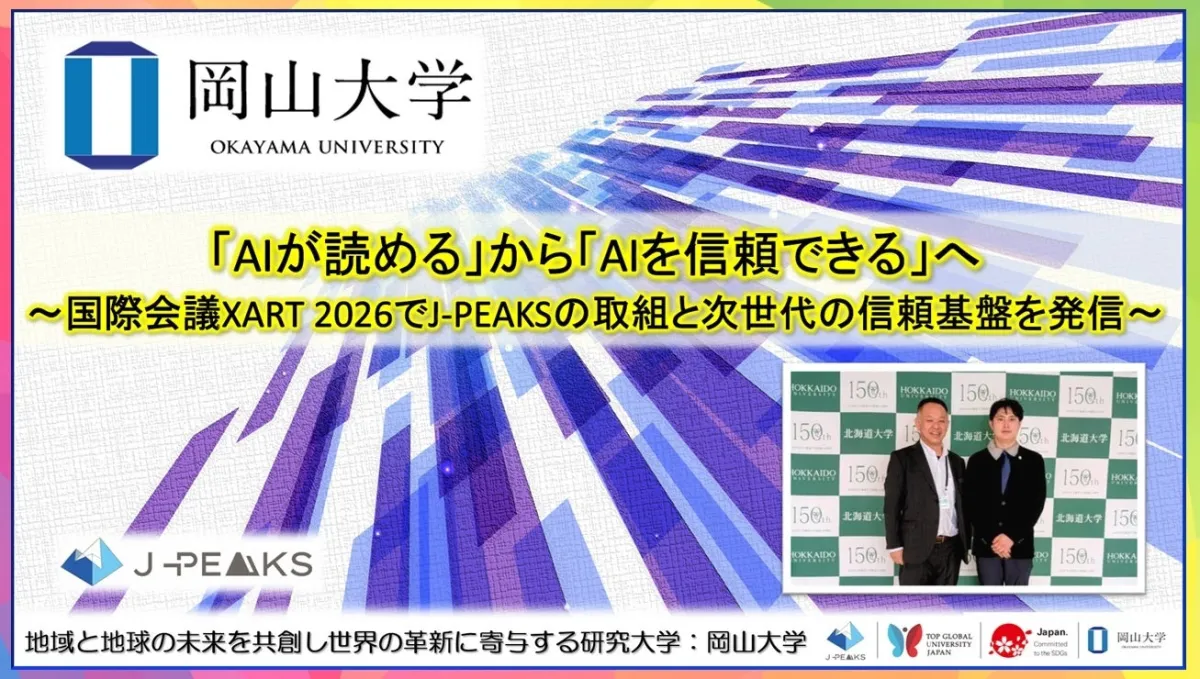
Okayama University Leading Innovations for AI-Readable Trust Infrastructure at XART 2026
Okayama University Showcases AI-Readable Trust Infrastructure at XART 2026
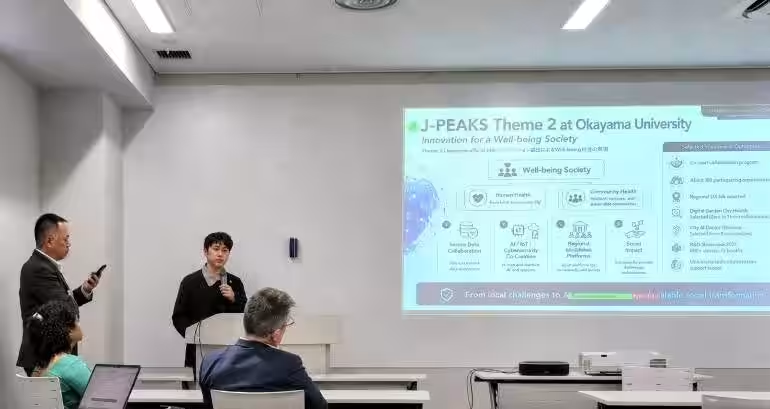
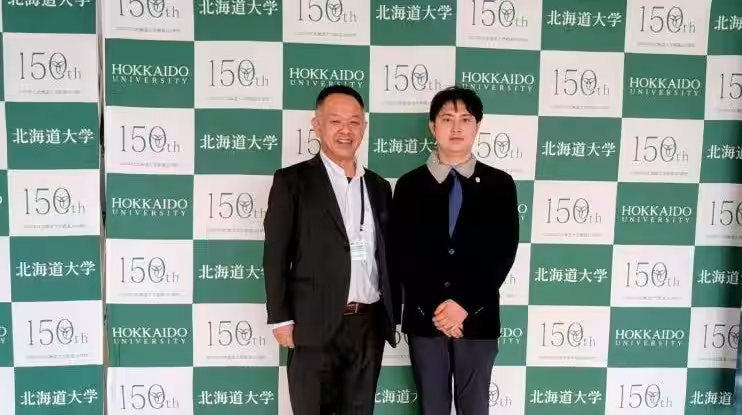
On July 10, 2026, Okayama University, under the leadership of its president, Masatomo Nasu, and distinguished professors Yasunori Nogami and Kento Sasano, participated in the XBRL Asia Round Table 2026 (XART 2026) at Hokkaido University. The theme of their presentation, "AI-Readable Trust Infrastructure," highlighted the university's commitment to promoting research excellence through its J-PEAKS initiative (a project aimed at enhancing regional core and distinctive research universities).
XBRL, which stands for eXtensible Business Reporting Language, serves as a global digital reporting standard that simplifies the representation of corporate financial and sustainability information for computer reading and analysis. The XART conference gathered policymakers, regulatory bodies, and industry experts to discuss advancements in digital financial reporting, Ai utilization, and sustainability disclosures.
During the presentation, Professors Nogami and Sasano emphasized the importance of creating a trust framework to secure the reliability of corporate reporting in the AI age, focusing on three core components: Data Trust, AI Security, and Social Impact. They argued that while generative AI capabilities are advancing, ensuring that AI-read information is trustworthy remains critical.
Key Elements of the Trust Framework
1. Data Trust: This component emphasizes the necessity for authenticity, provenance, and verifiability of data shared within corporate reporting frameworks. It ensures that the data utilized by AI is both credible and comprehensive.
2. AI Security: This aspect addresses the importance of accuracy in information retrieval, establishing clear foundations for AI-generated responses, and validating output content. It encompasses overall safety in the processes handled by AI technologies.
3. Social Impact: This component encourages examining how AI applications impact society, focusing on equitable markets, sustainable finance, and community well-being. It's essential to regard the broader societal repercussions of AI deployment.
During the conference, interactive tools such as Slido were used to foster dialogue among participants regarding the nature of trust in AI-assisted corporate reporting as well as highlighting potential risks when summarizing financial and sustainability data.
With an eye towards the upcoming XART 2027, which Okayama University is set to host, the professors outlined four key action principles: Observe, Secure, Validate, and Create Impact. They proposed a rigorous approach involving principles for creating trustworthy AI-readable reports, risk maps, practical prototypes, and collaborations across the Asia Pacific region.
Professor Nogami noted the importance of considering the entire system's security, from data acquisition and access rights to output verification involving external tools. He stated, "We need to examine the entire system's safety, which includes not just AI models but also the integrity of the data utilized."
Professor Sasano expressed his vision for international collaboration moving forward, stating, "We hope to progress towards XART 2027 from Okayama by integrating data, AI, security, and social impact into a unified framework."
Look forward to the ongoing initiatives from Okayama University as they foster international cooperation in preparation for XART 2027, continuing to engage with researchers, corporations, financial institutions, and standard-setting bodies to ensure the safe and reliable application of AI in corporate reporting. With their unwavering commitment as a unique regional research university, Okayama University aims to construct a solid foundation for the future of innovation and trust in AI technologies.

Topics Other)
【About Using Articles】
You can freely use the title and article content by linking to the page where the article is posted.
※ Images cannot be used.
【About Links】
Links are free to use.